Wholesale wooden nursing care bed for seniors supplier: What Buyers Should Check Before Ordering
The core trade‑off is solid hardwood versus engineered panel: hardwood gives higher load margins and a premium feel but adds weight and tooling cost; engineered panel reduces mass and shortens lead time but demands stricter moisture control and a more robust finish system.
Deflection under load governs the service life of a wooden nursing care bed.
Procurement officers tracking warranty claims find that most returns stem from frame flex exceeding 5 mm under a 120 kg static load, from finish cracking at the head‑board joint, or from caster‑stem loosening after repeated height‑adjust cycles. A supplier that can demonstrate consistent joint torque values and a finish that survives 200 clean‑room wipe cycles will cut claim rates by a measurable margin.
Scope of Supply and Physical Form
The interface between parts determines how the bed ships and assembles.
A complete unit ships as a knock‑down kit: head/foot boards, two side rails, a slatted mattress platform, four lockable casters, and the height‑adjustment mechanism. All wooden components are pre‑drilled for dowel‑and‑bracket assembly; metal brackets are zinc‑plated to resist corrosion from disinfectant sprays. Packaging uses double‑wall corrugated with corner protectors to keep dimensional tolerance within ±2 mm during sea freight.
| Variant | Overall Length (mm) | Width (mm) | Height Range (mm) | Frame Weight (kg) | Static Load Rating (kg) |
|---|---|---|---|---|---|
| Standard | 2000‑2100 | 900‑950 | 400‑600 | 38‑44 | 130‑150 |
| Large | 2100‑2200 | 1000‑1050 | 420‑620 | 44‑50 | 150‑180 |
| Bariatric | 2200‑2300 | 1100‑1150 | 440‑640 | 55‑62 | 200‑250 |
What the Design Has to Balance
Consistency depends on the joinery method and finish selection.
Mortise‑and‑tenon joints in solid beech deliver a rigid frame that resists racking under dynamic loads, but each joint adds 15 minutes of CNC cycle time and requires a skilled operator for hand‑fit verification. Dowel‑and‑bracket construction on birch plywood cuts cycle time by roughly 40 % and reduces unit weight by 6‑8 kg, yet the adhesive bond line must survive 90 % relative humidity at 35 °C for 500 hours to avoid delamination. The finish system — water‑based acrylic lacquer with a UV‑cured topcoat — provides a 120 µm dry film that passes 200 cycles of ISO‑type abrasion testing, but any thickness variation beyond ±15 µm creates visible gloss differences that trigger retail rejection.
Design Perspective
Deflection under load governs the selection of frame material for the target load class.
For a standard‑care environment the 130‑150 kg rating is met comfortably with a 35 mm thick beech frame; moving to a bariatric class pushes the required section modulus up, so the supplier typically switches to a 45 mm laminated veneer lumber (LVL) core with solid‑wood edge banding. The height‑adjustment screw must maintain a torque tolerance of ±0.3 Nm across 10 000 cycles; this is achieved by specifying a hardened steel lead screw and a bronze nut, both sourced from a single qualified vendor to avoid batch‑to‑batch drift.
How to Choose Before Requesting a Quote
The interface between parts determines that a single finish spec does not cover all exposure zones.
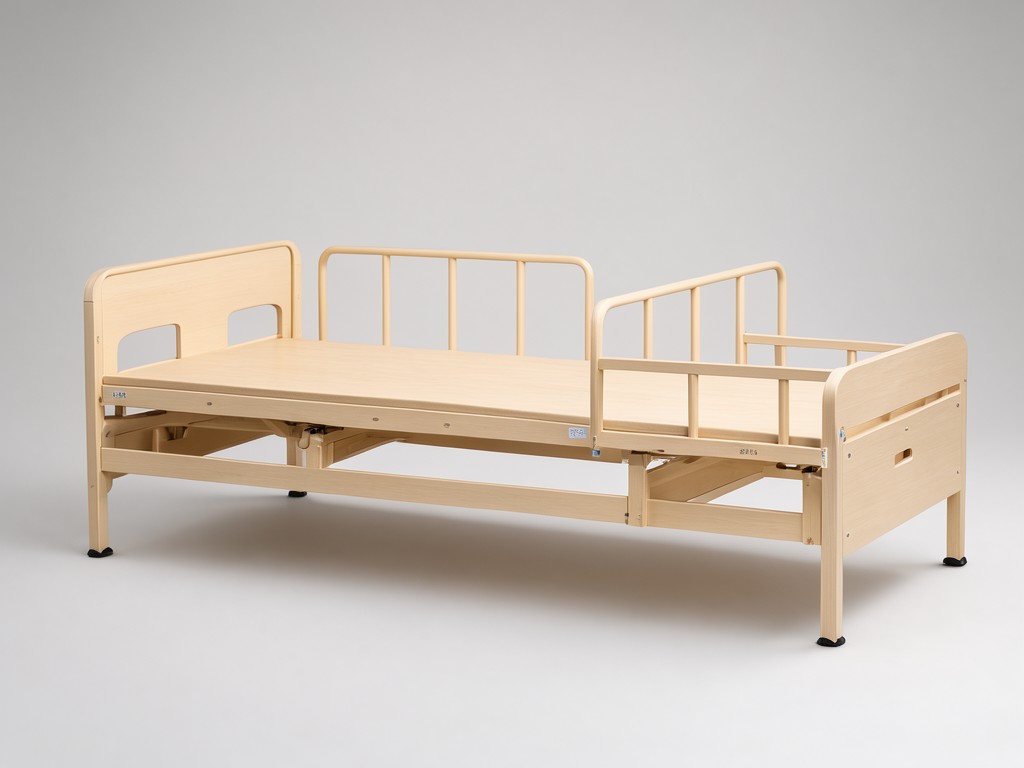
Buyers should first lock the load class, cleaning protocol, and expected annual volume. A facility using chlorine‑based disinfectants daily needs a finish with ≥150 µm total film and a corrosion‑rated caster stem; a low‑volume specialty dealer can accept a 100 µm film and standard zinc casters. Tooling amortisation means that orders below 200 units incur a 12‑week lead time and a 1.3× unit‑cost multiplier, while 500‑unit runs drop lead time to 6 weeks and bring the multiplier to 1.0.
| Material | Joinery | Typical Weight (kg) | Moisture Resistance | Unit Cost Index (1‑5) | Lead Time (weeks) |
|---|---|---|---|---|---|
| Solid Beech | Mortise‑Tenon | 42‑48 | High (kiln‑dried 8‑10 % MC) | 4‑5 | 10‑12 |
| Engineered Plywood (Birch core) | Dowel + Bracket | 34‑38 | Medium (requires edge seal) | 2‑3 | 6‑8 |
| Mixed (Solid Rails + Plywood Platform) | Hybrid (Mortise‑Tenon rails, Dowel platform) | 38‑44 | High on rails, Medium on platform | 3‑4 | 8‑10 |
Assumptions Buyers Should Stop Making
The interface between parts determines that a single finish spec does not cover all exposure zones.
Common misconceptions that inflate return rates:
- All wood species behave identically under humidity cycling.
- Casters are interchangeable across load classes without re‑rating.
- Side rails can be omitted for “open‑access” models without affecting structural certification.
- A single coat thickness guarantees uniform chemical resistance on vertical and horizontal surfaces.
What Can Be Customised and What Cannot
Consistency depends on the tooling set‑up for each configurable dimension.
Customisable: overall length and width within ±10 % of the standard envelope, side‑rail profile (full‑height, half‑height, split), caster diameter (75 mm or 100 mm lockable), finish colour from the approved RAL palette, and logo/branding applied by pad‑print or laser etch on the head board. Non‑customisable: static load rating (set by frame cross‑section), mattress platform slat spacing (fixed at 65 mm for pressure‑redistribution compliance), joinery pattern (mortise‑tenon vs dowel) because each requires a dedicated CNC fixture, and the height‑adjustment travel range (fixed at 200 mm).
Submit your artwork and branding brief for a formal review and quotation. Request a branding review