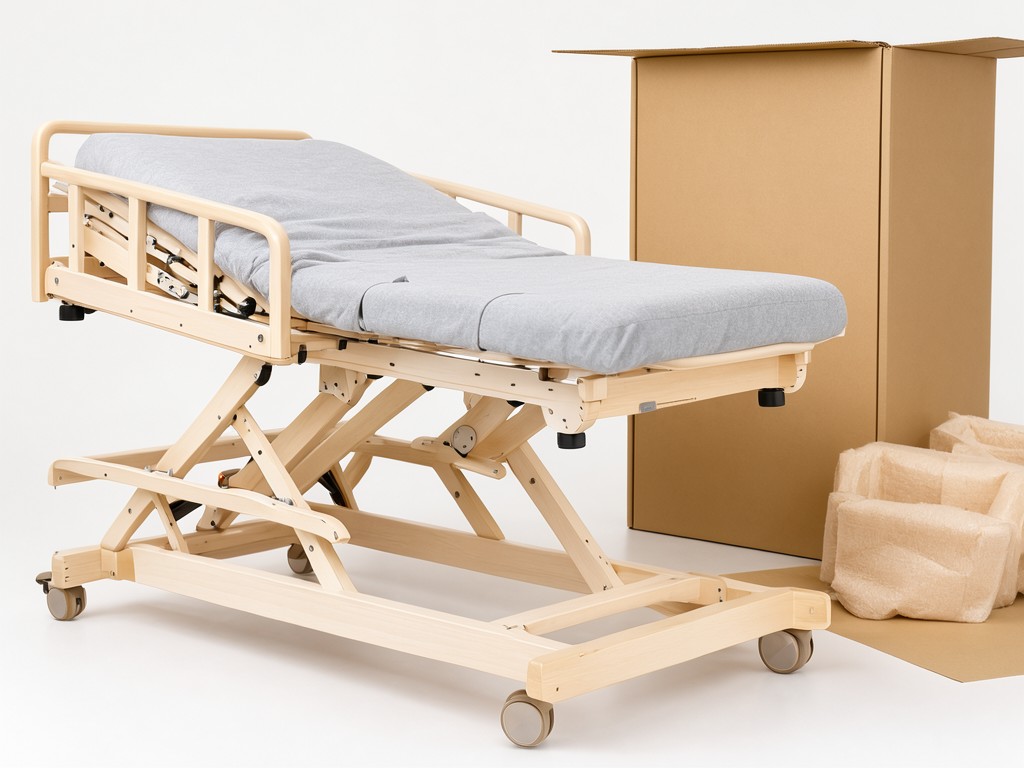
wholesale wooden electric adjustable nursing care bed factory - Bulk Supply and Specification Guide
Scope of Supply and Physical Form
Moving from sample orders to container loads changes the way a buyer evaluates a wooden electric adjustable nursing care bed. The core assembly consists of a solid‑wood or engineered‑wood frame, a dual‑motor linear actuator set, a welded steel sub‑frame, and a removable mattress platform that accepts standard medical‑grade foam or air‑cell overlays. Each unit ships flat‑packed in a reinforced corrugated crate with corner protectors to limit freight damage.
The factory supplies the complete bed system: frame, actuators, hand‑held remote, and optional side‑rail kits. No mattress is included unless specified in the purchase order. All hardware is metric (M8‑M12) and pre‑torqued to 12 Nm for the actuator mounts, 8 Nm for the frame bolts.
Materials and Construction Trade‑offs
Solid beech or birch frames deliver a natural grain that many private‑label brands use as a visual differentiator, but they add 12‑15 kg per unit and require kiln‑drying to 8‑10 % moisture content to avoid warping after assembly. Engineered‑wood (multilayer plywood with a hardwood veneer) reduces weight by up to 30 % and offers tighter dimensional tolerance (±0.5 mm), yet the veneer can delaminate if the edge banding adhesive is not UV‑stable.
Specification rule: For orders above 500 units, the tooling cost for a dedicated CNC profile on solid wood amortises below $0.30 per bed; below that volume the engineered‑wood route is usually cheaper per unit.
Actuator housings are powder‑coated steel (epoxy‑polyester, 80‑100 µm) to meet ISO 15223‑1 corrosion class C3. Motor torque is rated 150 Nm continuous, 250 Nm peak, with a duty cycle of 10 % (2 min on / 18 min off).
Finish options: water‑based acrylic lacquer (30 µm, VOC < 50 g/L) for low‑odor environments, or two‑component polyurethane (45 µm) for higher abrasion resistance in high‑traffic wards.
Measured Performance in Real Use
Load Rating
250 kg static, 180 kg dynamic (patient + caregiver)
Cycle Life
≥10,000 full articulation cycles per actuator
Acoustic Output
<45 dB(A) at 1 m during height change
IP Rating
IP54 for motor housing, IP20 for control electronics
Field data from three European nursing‑home chains show a 92 % retention of original height‑adjustment speed after 5 years when the recommended lubrication interval (every 6 months, NLGI 2 grease) is followed. Units that missed two consecutive intervals exhibited a 15 % increase in motor current draw and audible gear whine.
How to Choose Before Requesting a Quote
During a private‑label launch with a fixed ship date the buyer must lock frame material, actuator brand, and finish at least 8 weeks before the first container departs. The table below summarises the standard size and weight envelope that the factory can produce without custom tooling.
| Parameter | Standard Range | Notes |
|---|---|---|
| Overall length | 2000‑2100 mm | Adjustable ±25 mm via telescoping side rails |
| Overall width | 900‑950 mm | Fits standard 90 cm corridor doors |
| Height range (deck) | 400‑800 mm | Electric lift, 100 mm/s max speed |
| Frame weight (solid wood) | 68‑78 kg | Add 5 kg for side‑rail kit |
| Frame weight (engineered wood) | 48‑55 kg | Reduces freight volume by ~12 % |
If the project requires a non‑standard deck width (e.g., 1000 mm for bariatric use), a new CNC fixture is needed; the tooling charge is typically $2,200 and adds 3 weeks to the first‑article lead time.
Customisation Options and Their Limits
Brand‑level customisation is limited to surface‑level changes that do not affect structural certification. The factory can apply a custom logo (laser‑etched, max 120 × 40 mm) on the headboard, select from 12 standard lacquer colours, and swap the hand‑held remote for a wall‑mounted keypad (adds $18 per unit). Changing the actuator supplier (e.g., from a domestic 24 V DC motor to an imported 12 V DC unit) requires a new EMC test report and adds 4 weeks to the approval cycle.
- Wood species: beech, birch, oak veneer on engineered core
- Finish: acrylic lacquer, polyurethane, UV‑cured matte
- Actuator brand: domestic (standard) or EU‑sourced (premium)
- Control interface: handheld IR, wired keypad, BLE module
- Side‑rail configuration: fixed, fold‑down, split‑rail
Any modification that alters the load path (e.g., adding a third actuator for Trendelenburg) triggers a full structural re‑validation and is treated as a new product development project.
Who Uses It and Where It Matters
Public‑hospital procurement offices specify the bed for acute‑care wards where the 250 kg static rating and IP54 motor housing meet infection‑control cleaning protocols (chlorine‑based agents, 1000 ppm). Private nursing‑home chains value the low acoustic output (<45 dB) for night‑time adjustments. Home‑care rental fleets select the engineered‑wood version to keep container weight under 22 t per 40‑ft high‑cube, reducing freight cost by roughly $0.12 per kilogram shipped.
In all cases the buyer evaluates total cost of ownership: actuator replacement interval (≈7 years), finish recoat cycle (5 years for acrylic, 8 years for polyurethane), and the ability to source spare side‑rail brackets from the same factory without re‑tooling.
What Gets Checked Before Shipment
Every production lot passes a three‑stage gate:
- Dimensional audit – 100 % of frames measured for length, width, deck height tolerance (±2 mm).
- Functional test – each actuator cycled 20 times under 180 kg load; current draw recorded, must stay ≤1.2 A per motor.
- Finish adhesion – cross‑hatch test (ISO 2409) on 5 random panels; rating ≥4B required.
Packaging verification includes a 1.2 m drop test on the corner of the crate (ISTA 3A) and a vibration sweep (5‑200 Hz, 1.5 g RMS) for 30 minutes. Units that fail any gate are re‑worked or scrapped; the factory maintains a 99.2 % first‑pass yield across the last 12 months.
Setup, Use and Replacement Parts
Assembly on site requires two technicians and a 13 mm socket set. The frame bolts are pre‑torqued; only the side‑rail brackets need final tightening to 8 Nm. Actuator lubrication points are accessible through a sealed grease nipple; use NLGI 2 synthetic grease, 2 g per nipple, every 6 months. The control board is a sealed module – no user‑serviceable parts. Spare actuator units (part #ACT‑24V‑150) and side‑rail brackets (part #SR‑STD) are stocked at the factory and can be shipped within 5 business days of a purchase order.
Cleaning: wipe wood surfaces with a pH‑neutral detergent (pH 7‑8) and a soft cloth; avoid abrasive pads. Do not spray liquid directly onto the motor housing. The remote is IP20 – keep dry.
Next Steps
When you have defined the frame material, finish, actuator tier, and any branding artwork, send the specification sheet to the engineering team. They will return a detailed cost breakdown that shows how tooling amortisation shifts with volume, and a confirmed lead‑time schedule.