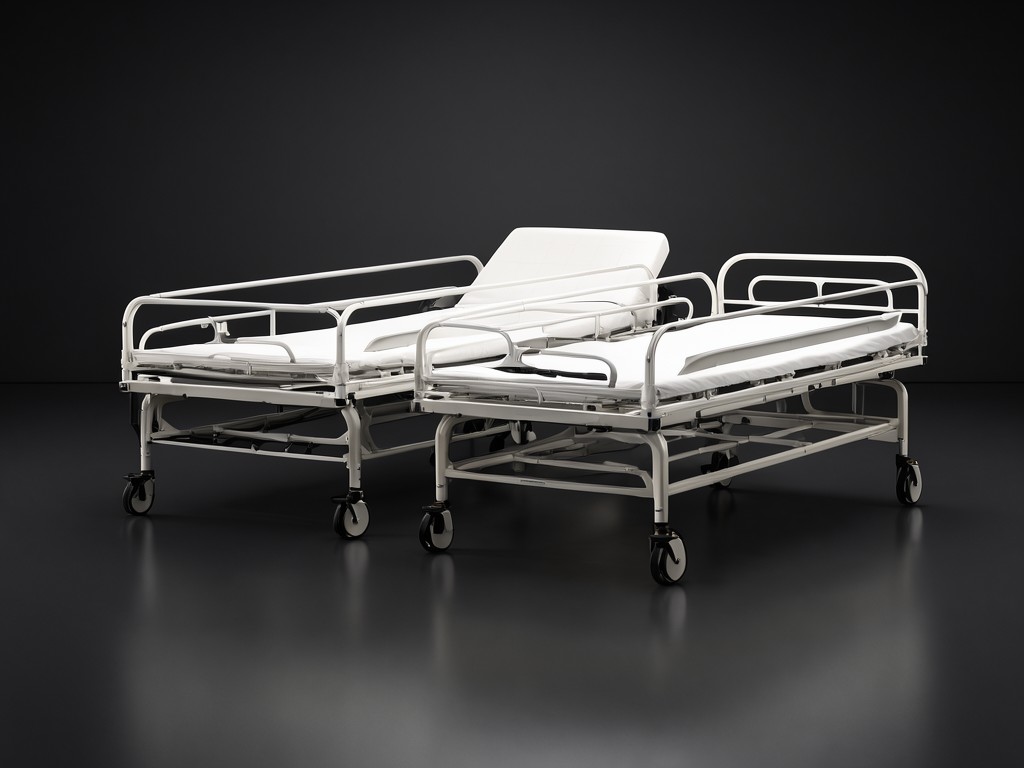
wholesale patient home care nursing beds for elderly supplier - Bulk Supply and Specification Guide
What This Product Is and Where It Fits
These beds sit between acute-care ICU platforms and basic residential adjustable bases. The buyer is typically a private-label brand or regional distributor supplying home medical equipment (HME) dealers, hospice agencies, or direct-to-consumer e-commerce. Volume drives the conversation: a 40-foot high-cube container holds 180–220 knockdown units depending on side-rail configuration, so per-unit freight cost drops sharply once you standardize on a single frame platform across three mattress widths (36", 39", 42").
The frame is a welded rectangular tube chassis (50 × 30 × 2 mm Q235B) with four planetary gear motors driving Hi-Lo, backrest, knee-break, and Trendelenburg/Reverse Trendelenburg. Mattress deck uses either a four-section spring-link grid or a perforated steel platform — spring-link adds 3.2 kg but reduces pressure-injury risk for patients > 120 kg. Side rails are split aluminum extrusions with dual-lock gas springs; they ship nested inside the frame to keep crate height under 320 mm.
Control architecture matters. Handset options: 6-button wired (IPX4), 10-button wireless (2.4 GHz, paired at factory), or Bluetooth module for app integration. All variants share the same control box (DC 29 V, 4.5 A max) so inventory stays lean. Battery backup is a 2.2 Ah sealed lead-acid block mounted in the foot-end tray — good for 12 full Hi-Lo cycles during outage.
The Problem Buyers Keep Paying For
Consistency depends on the tolerance stack between the motor mounting brackets and the actuator mounting points. A 0.8 mm lateral shift in the backrest pivot bracket translates to 4 mm misalignment at the headboard — enough to bind the gas spring, cause premature seal wear, and generate a warranty claim within 14 months. We've seen competitors skip the fixture check on every 50th frame; the resulting drift costs the brand 3–5 % return rate on the first container.
Another silent cost: caster spec mismatch. The central-locking 125 mm twin-wheel caster (polyurethane tread, precision ball bearing) must carry 150 kg dynamic load per corner. Some suppliers substitute a 100 mm single-wheel caster rated 110 kg to save $1.80/unit. On carpeted home floors, the smaller caster digs in, the frame racks, and the Hi-Lo motor draws 22 A peak — tripping the control-box thermal fuse. That fuse is not user-replaceable; the whole box ships back.
- Motor bracket positional tolerance: ±0.3 mm vs. typical ±0.8 mm
- Caster dynamic load rating verified at 3 km/h on 80° Shore A polyurethane
- Gas-spring force decay < 5 % after 10,000 cycles at 25 °C
How It Performs in Use
Deflection under load governs both patient perception and structural fatigue. The spring-link deck deflects 18 mm at 135 kg centered load (ISO 20340 static test), while the perforated steel deck deflects 9 mm. For a 90 kg patient spending 18 hours/day in bed, the spring-link maintains > 80 % of initial support stiffness after 24 months; the steel deck holds 95 % but transmits higher peak interface pressure — 42 mmHg vs. 28 mmHg on a 150 mm foam mattress.
Articulation angles are factory-set: backrest 0–75°, knee-break 0–40°, Trendelenburg ±12°. The control box enforces soft limits via hall-effect feedback on each motor; no mechanical stops to bend. Hi-Lo range 400–800 mm (deck height without mattress) clears standard 390 mm bedside commodes and fits under 850 mm over-bed tables. Lift speed 28 mm/s unloaded, 19 mm/s at 200 kg — slow enough to prevent shear forces on fragile skin.
Spring-Link Deck
Better pressure redistribution, quieter articulation, +3.2 kg weight, 15 % higher BOM.
Perforated Steel Deck
Rigid, lower cost, easier to clean, higher interface pressure, audible "thunk" at end-of-stroke.
Buying Mistakes That Lead to Returns
The interface between parts determines whether a bed stays in service or comes back as "damaged in transit." Most common error: ordering the 39" frame with 36" side rails because the SKU sheet lists "universal rails." The 75 mm gap at each end creates an entrapment hazard (FDA guidance < 60 mm) and fails IEC 60601-2-52 clause 201.12.4. We print the mattress width on the frame's foot-end label and laser-etch the same code on each rail — mismatch is visible in 10 seconds at receiving.
Second mistake: specifying "powder coat" without defining pretreatment. Zinc-phosphate + 80 µm epoxy-polyester passes 500 h neutral salt spray (ASTM B117). Iron-phosphate + 60 µm polyester shows red rust at 180 h in coastal warehouses. The $0.40/ft² pretreatment difference saves $12/unit on re-coating claims over a three-year tender.
Third: ignoring handset cable routing. The wired handset coil cord (1.5 m extended) must clear the knee-break articulation envelope. If the clip-on cable guide is omitted during assembly, the cord shears against the deck hinge at 40° knee-break — 100 % failure within 6 months. We ship the guide pre-installed; some buyers remove it to "simplify unpacking."
Quality Control and Batch Consistency
| Test Point | Method | Acceptance | Frequency |
|---|---|---|---|
| Frame dimensional audit | CMM 12-point check: diagonal, rail pocket depth, motor mount XY | ±0.5 mm all points | Every 10th unit |
| Motor no-load current | Bench test at 29 VDC, 25 °C | ≤ 1.8 A per motor | 100 % |
| Hi-Lo cycle endurance | 200 kg load, 400–800 mm, 10 cycles/hr | 10,000 cycles no structural crack, motor temp < 95 °C | First article + lot sample (n=3) |
| Electrical safety | IEC 60601-1: earth leakage, dielectric strength, PE resistance | Leakage < 100 µA, 1.5 kV AC 1 min, PE < 0.1 Ω | 100 % |
| Coating adhesion | Cross-hatch (ISO 2409) + pull-off (ISO 4624) | 5B cross-hatch, ≥ 5 MPa pull-off | Per shift |
| Caster swivel torque | Torque wrench at 50 kg vertical load | 0.8–1.5 Nm initial, < 2.0 Nm after 5 km drum test | Incoming lot (n=20) |
Batch traceability links each bed's serial number to the motor date codes, caster lot, coating shift, and final inspector ID. A QR code on the foot-end label resolves to a PDF pack: dimensional report, Hi-Lo current curve, and dielectric test certificate. This is what the HME dealer's procurement officer asks for when a tender specifies "full manufacturing traceability."
Export Packaging and Handling Protection
Knockdown configuration: frame base (deck folded), head/foot boards, side rails (nested), control box, handset, casters (bolted), mattress retainers. All components for one bed fit in a single 5-ply double-wall corrugated carton (K/B flute, 450 g/m² outer liner). Carton dims: 2080 × 1020 × 310 mm. Gross weight 68–74 kg depending on deck choice. Two cartons per pallet (1100 × 1100 mm), stretch-wrapped with corner boards, 44 pallets per 40'HQ.
| Packaging Element | Specification | Purpose |
|---|---|---|
| Outer carton | 5-ply DW, K/B flute, 450 g/m² kraft liner, burst strength 275 psi | Stack load 350 kg (5-high in container) |
| Internal foam | PE foam 30 kg/m³, 25 mm thick, custom die-cut for motor mounts | Prevents bracket bend at 1.5 g vertical shock |
| VCI film | Volatile corrosion inhibitor, 100 µm, wraps frame only | 6-month ocean transit rust protection |
| Desiccant | Clay desiccant 500 g per carton (4 units × 125 g) | Keeps RH < 40 % inside carton |
| Shock indicator | ShockWatch 25G label on two adjacent carton faces | Evidence for freight claim if triggered |
| Label set | GS1-128 barcode, mattress width, voltage, serial range, handling icons | Warehouse scan-in, customs, end-user ID |
Pallet load plan: bottom carton motors-down, top carton motors-up. This balances the center of gravity and keeps the control box (heaviest single component at 4.2 kg) from concentrating load on the deck hinges. Strapping tension 1,200 N per strap — verified with a tension meter at loading. Over-tension crushes the foam inserts and transfers shock to the motor shafts.
Care, Storage and Service Life
Storage before installation: keep cartons on pallets, indoors, 5–35 °C, RH < 60 %. Do not stack > 3 high without pallets — the bottom carton's foam inserts compress permanently, losing motor-mount protection. If outdoor staging is unavoidable, add a breathable tarp (not plastic sheeting) to prevent condensation cycling.
In-service maintenance schedule for the HME dealer's biomedical tech: monthly — wipe frame with quaternary ammonium disinfectant (no phenolics, they craze the powder coat), check caster brake engagement force (should be 15–25 N), verify handset button actuation. Quarterly — apply PTFE dry lubricant to side-rail gas-spring rods and Hi-Lo lead screws. Annually — load-test Hi-Lo at 200 kg for 5 cycles, measure motor current; replace motor if no-load current > 2.2 A or stall current deviates > 15 % from baseline.
Expected service life: frame 15 years, motors 8–10 years (20,000 Hi-Lo cycles), control box 7 years, casters 5 years, gas springs 6 years, battery 3 years. The limiting factor is usually the control box electrolytic capacitors — they dry out in warm bedrooms (28 °C average). We specify 105 °C rated caps (vs. standard 85 °C) which adds $0.90/unit but doubles capacitor life. That $0.90 prevents a $180 control-box swap at year 4.
Request a Pre-Production Sample
We ship a fully assembled, QC-cleared sample bed (your choice of deck, handset, and voltage) within 10 working days of drawing approval. The sample carries the same serial-traceability pack as production units. Use it for dealer showroom evaluation, pressure-mapping trials, or your own drop-test protocol.
Request Sample & Spec Sheet