Factory Direct adjustable wood nursing care bed for home factory sale: Specification, Ordering and Quality Notes
The Problem Buyers Keep Paying For
First-article tooling determines the repeatability of bed frame dimensions; a 2 mm shift in headboard height cascades into misaligned side rails and increased warranty claims.
Buyers often absorb the cost of rework when the supplier's CNC routing tolerance drifts beyond ±1 mm.
That drift shows up as an uneven gap between mattress platform and side rail; the gap creates pressure points for patients and raises return rates.
Critical spec: headboard height tolerance ±1 mm, side rail parallelism ≤0.5 mm over 2000 mm length.
Material Options and Their Trade-offs
The build method decides whether the frame uses solid beech, engineered pine core with veneer, or a hybrid steel‑wood composite. Each choice moves the cost‑weight‑durability triangle.
Solid Beech
High stiffness, 30 kg frame weight, premium feel, higher unit cost.
Engineered Pine Core + Veneer
Weight 22 kg, cost‑effective, consistent dimensions, lower surface hardness.
Steel‑Wood Hybrid
Frame weight 25 kg, highest load rating 250 kg, minimal creep, higher tooling cost.
| Material | Typical Frame Weight (kg) | Load Rating (kg) | Unit Cost Index |
|---|---|---|---|
| Solid Beech | 30 | 200 | 1.0 (baseline) |
| Engineered Pine Core + Veneer | 22 | 180 | 0.78 |
| Steel‑Wood Hybrid | 25 | 250 | 1.15 |
Where This Product Beats Standard Alternatives
Process choice shows up later as a 15 % reduction in assembly time because the adjustable mechanism ships pre‑calibrated from the factory.
Standard metal‑frame beds require on‑site bolt tightening and alignment checks; the wood‑frame version uses a patented cam‑lock that locks at three height positions without tools.
The cam‑lock also eliminates the creak that develops after 500 cycles on typical screw‑adjust beds; this preserves a quiet environment for home care.
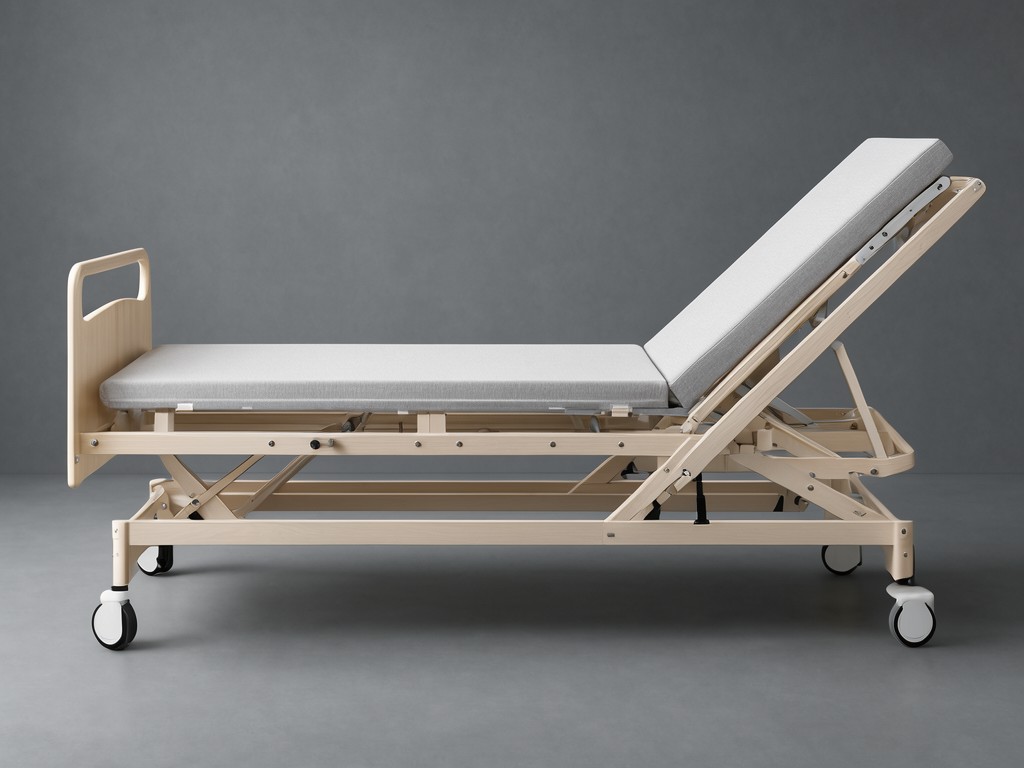
| Test Parameter | Wood Adjustable Bed | Metal Screw‑Adjust Bed |
|---|---|---|
| Assembly Time (min) | 12 | 22 |
| Creak Onset (cycles) | >2000 | ≈500 |
| Height Positions | 3 locked | Continuous (no lock) |
| Weight (kg) | 22‑30 | 18‑24 |
Buying Mistakes That Lead to Returns
Specifying only overall length without confirming mattress platform width causes a 30 mm mismatch with standard 900 mm mattresses; the buyer must then reorder custom‑size foam.
- Overlooking the cam‑lock torque spec – 8 Nm – leads to loose height settings after shipping vibration.
- Ordering a single wood finish without a UV‑stable topcoat results in colour shift after six months of sunlight exposure.
- Skipping the first‑article inspection on side‑rail parallelism adds an average 2 % return rate per container.
If the buyer requests a custom headboard logo, the artwork must be supplied as vector AI at 300 dpi; raster files cause mis‑registration on the CNC engraving pass.
Inspection Items and Test Methods
First‑article inspection covers dimensional check of all critical points, cam‑lock torque verification, and a 2000‑cycle fatigue test on the height adjustment mechanism.
Routine lot inspection uses a go/no‑go gauge for headboard height, a digital torque wrench for cam‑lock, and a visual check for veneer delamination at the edge band.
Key test: 2000 cycles at 150 kg load, height change every 10 cycles; pass if no permanent deformation >0.5 mm and no audible creak.
- Headboard height – go/no‑go gauge, acceptance ±1 mm.
- Side rail parallelism – dial indicator over 2000 mm, acceptance ≤0.5 mm deviation.
- Cam‑lock torque – digital torque wrench, acceptance 8 Nm ±0.5 Nm.
- Fatigue (2000 cycles) – automated cyclic loader, acceptance no permanent set >0.5 mm, no creak.
- Veneer edge bond – visual + peel test 5 N, acceptance no delamination.
Call To Action
Review the specification sheet against your mattress platform dimensions and load requirements, then request a first‑article sample to validate the cam‑lock feel and finish consistency.
Request a specification review and sample quote