Custom wooden frame home nursing care bed supplier: What Buyers Should Check Before Ordering
During a private-label launch with a fixed ship date, a European distributor ordered 400 units of a three-function wooden-frame care bed. The first container arrived with headboard joints that had opened 2 mm after transit humidity cycles. The retailer rejected the lot. The factory had quoted beech plywood frames with dowel-and-glue joints but switched to rubberwood solid lumber to meet the price — without telling the buyer. That substitution cut 18 % off the frame cost but added a warranty exposure the brand still carries two years later.
This page sets out the specification checkpoints that separate a repeatable production run from a claim-generating one. Every point below is framed in the units your quality team actually measures: joint gap in millimetres, finish adhesion in cross-hatch rating, actuator cycle life, and container load factor.
Scope of Supply and Physical Form
Frame Construction
Species: European beech (Fagus sylvatica) or maple (Acer spp.), kiln-dried to 8–10 % MC
Joinery: Mortise-and-tenon with PVAc D4 glue, reinforced with 8 mm beech dowels on 45 mm centres
Finish: Two-component water-based polyurethane, 80 µm dry film, cross-hatch 5B
Function Set
Backrest: 0–75 °, 6000 N actuator, IP66 handset
Knee-break: 0–35 °, synchronised with backrest
Height: 400–800 mm, dual-motor, 8000 N combined thrust
Deck & Safety
Deck: 4-section beech slats, 68 mm spacing, 150 kg static load per section
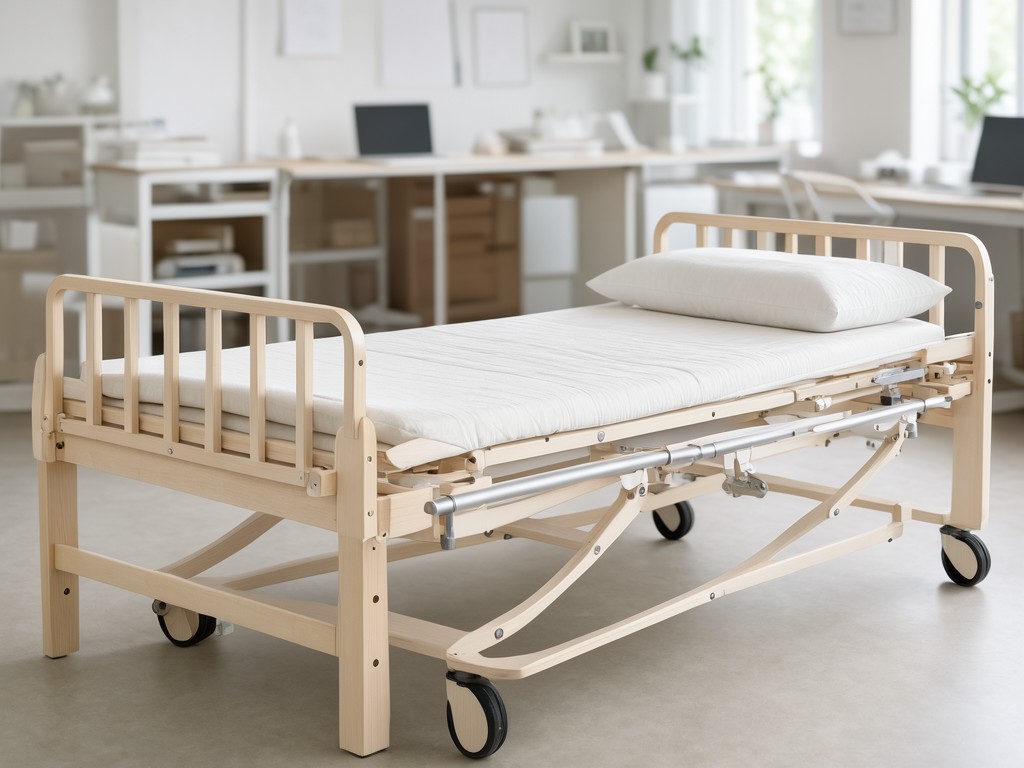
Side rails: Split wooden rails, 380 mm above deck, tool-free drop
Castors: 100 mm twin-wheel, central brake, 150 kg dynamic rating each
The spec cards above represent the baseline we quote for private-label programmes. Any deviation — species change, glue class downgrade, actuator derating — must be documented in the technical agreement before tooling is cut.
The Problem Buyers Keep Paying For
Joint opening after humidity cycling tops the claim list. A 2 mm gap at the headboard mortise translates to a 0.8 mm seasonal swing in a 40 %–60 % RH household. If the tenon shoulder wasn't cut to a 0.1 mm tolerance on a CNC mortiser, the glue line carries shear it wasn't designed for. We see this when a supplier substitutes a 3-axis router for a 5-axis mortiser to save 45 minutes per frame.
Finish adhesion failure follows. Single-component acrylic lacquer passes a 24-hour salt spray but fails the 100-cycle cross-hatch after six months of bedside disinfectant wipes (quaternary ammonium, 0.5 % active). Two-component polyurethane holds 5B after 200 cycles. The cost delta is €3.20 per bed. Brands that spec the cheaper system typically reorder with the upgrade after the first field failure.
Actuator drift rounds out the top three. A 6000 N actuator running at 4500 N continuous load on a 95th-percentile patient will exceed its duty cycle (10 % on, 90 % off) within 18 months if the control box doesn't enforce a hard thermal cutout. We specify control boxes with 70 °C thermal shutdown and log the cycle count in non-volatile memory — data your service team can read via the handset port.
Assumptions Buyers Should Stop Making
Assumption vs. Reality
"Solid wood means solid performance." Species, grain orientation, and moisture content at assembly matter more than the word "solid" on a spec sheet. Rubberwood (Hevea brasiliensis) machines faster but has 22 % lower modulus of rupture than beech. That difference shows up as headboard deflection under a 120 kg patient leaning back.
"All actuators with the same force rating are interchangeable." Stroke length, retraction speed, and IP rating vary across suppliers. A 6000 N actuator with 200 mm stroke and 8 mm/s speed will not synchronise with a 6000 N unit running 12 mm/s on the opposite side — the bed twists, and the frame joints take the moment.
"Container loading is the freight forwarder's problem." A 40 ft HC takes 48 assembled beds if the head/foot boards are nested and the side rails are flat-packed. If the supplier ships fully assembled, the count drops to 26. That €1,200 per container difference funds the knock-down packaging jig in the first production run.
Working as a Production Partner, Not a Catalogue Supplier
When a brand extends an existing range, the first engineering review should happen before the purchase order. We run a joint DFM session covering:
- Tooling ownership: who pays for the mortise-and-tenon fixture, the slat-profile knives, the side-rail hinge die
- First-article inspection protocol: 5 units pulled at 0 %, 25 %, 50 %, 75 %, 100 % of the run, measured against a 37-point dimensional checklist
- Change-control gate: any material or component substitution requires a signed ECN with updated FMEA before the next production batch
The output is a controlled bill of materials locked to revision level. Your procurement team gets a single PDF that traces every critical component — actuator batch, glue lot, finish batch — to the bed serial number. That traceability cuts root-cause investigation from weeks to hours when a claim does arrive.
Volume Planning and Lead Time
| Order Quantity | Tooling Amortisation | Lead Time (FOB) | Unit Cost Index |
|---|---|---|---|
| 100–249 | Buyer owns tooling; €4,800 upfront | 55–60 calendar days | 1.00 (baseline) |
| 250–499 | Shared; €2,400 each | 45–50 calendar days | 0.93 |
| 500–999 | Supplier absorbs; no upfront | 35–40 calendar days | 0.87 |
| ≥1,000 | Supplier absorbs; dedicated fixture set | 28–32 calendar days | 0.81 |
Lead times assume beech lumber is in stock at our kiln. If the order calls for maple or a custom stain, add 10–14 days for lumber procurement and colour matching. The cost index reflects labour, glue, finish, and actuator volume breaks — not freight or duties.
Keeping Repeat Orders Supplied
On a club programme that reorders twice a season, the brand holds a 60-unit buffer at our warehouse. We pull from that buffer for drop-ship orders under 20 units, invoicing at the agreed replenishment price. The buffer is replenished on a rolling 30-day cycle triggered by the brand's POS data feed. This eliminates the 35-day lead time for small top-ups and keeps the retailer's shelf continuously stocked.
The same model works for importers with multiple SKUs. A shared safety stock of 120 frames (mixed sizes) covers three bed models. When a SKU hits its reorder point, we batch it into the next production run rather than running a dedicated short batch. The trade-off: the importer accepts a 5 % overage/underage tolerance on each replenishment PO.
Export Packaging and Handling Protection
Knock-down packaging is not optional for wooden-frame beds. The headboard and footboard ship nested face-to-face with 3 mm EPE foam between surfaces. Side rails lay flat in a dedicated compartment. The deck slats bundle in groups of four, banded with PET strapping. Actuators and control boxes travel in anti-static bags inside a corrugated insert.
Each carton carries a ShockWatch 25G indicator and a Tip-N-Tell. If either triggers, the receiver photographs the indicator before opening — that photo is the first evidence in any transit-damage claim. We load 48 knock-down units per 40 ft HC with 180 mm air bags in the door void. The configuration survives a 0.5 g longitudinal deceleration test (ISTA 3E simulation) without joint gap increase beyond 0.3 mm.
Ready to Review Your Specification?
Send us your current technical file — BOM, drawings, finish spec, actuator data sheets. We return a marked-up gap analysis within three business days, highlighting the substitutions that drive claims and the volume thresholds that change your landed cost.
Start a specification review