custom wood nursing care bed for elderly at home supplier: What Buyers Should Check Before Ordering
The Problem Buyers Keep Paying For
| Failure Mode | Typical Onset | Cost Driver |
|---|---|---|
| Side rail latch fatigue | 6-12 months | Full rail replacement + service call |
| Head/foot board warping | 18-24 months | Panel swap, finish matching |
| Caster stem corrosion | 12-18 months | Four-caster set + labor |
| Articulation motor gear wear | 24-36 months | Motor swap, recalibration |
The limiting factor is rarely the headline specification. Procurement teams compare static load ratings (usually 250-300 kg) and assume parity. In practice, the bed that survives 500 articulation cycles in the lab fails at 200 in a home where a caregiver raises the backrest four times daily, the patient shifts weight laterally, and cleaning crews spray quaternary ammonium solutions onto exposed mechanisms. Repeat loading drives the failure at the rail-to-post joint and the motor mount bracket — points no catalogue spec captures.
What the Design Has to Balance
Solid Hardwood Frame
Maple or beech, kiln-dried to 6-8% MC. Mortise-and-tenon joinery with PUR adhesive. Resists warp at 40% RH swing.
Heavier (38-42 kg). Higher FOB. Fewer warranty claims on structural joints.
Engineered Core + Veneer
Poplar core, 0.6 mm oak veneer. CNC dowel construction. Stable at 30-50% RH.
Lighter (28-32 kg). Lower FOB. Veneer delamination risk at rail mounting zones after 18 months.
Fatigue appears at the stress concentration where the side rail bracket bolts through the headboard. Solid hardwood distributes the load across 45 mm of tenon depth. Engineered core relies on 12 mm dowel engagement and veneer adhesion — the first cycle where a patient grabs the rail to reposition shifts 180 N through that joint. After 1,200 cycles, the veneer line opens. Solid wood shows no measurable joint movement at the same cycle count. The $18-22/unit premium on hardwood pays back in the third reorder when the distributor stops fielding rail replacement tickets.
How It Performs in Use
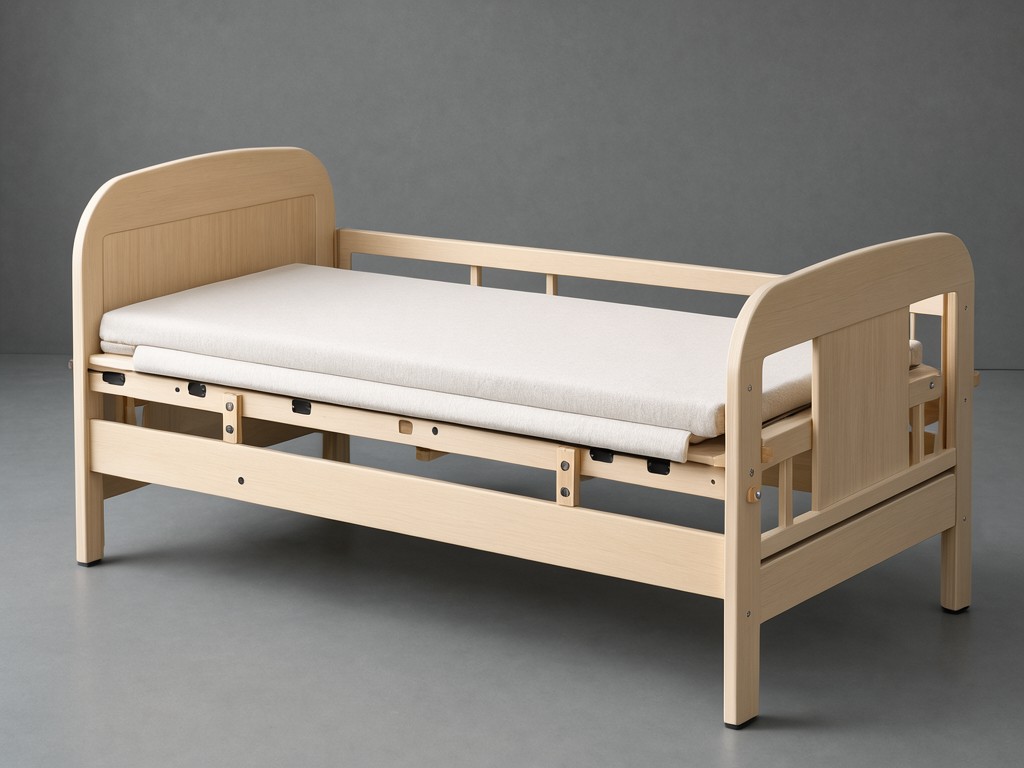
Comfort and feel are not subjective here. The mattress platform uses 14 beech slats at 42 mm spacing, each 8 mm thick with 12 mm radius edges. That radius eliminates the pressure ridge that forms under 30 kg/m² foam after 72 hours — the ridge that triggers repositioning calls at 03:00. Slats attach via nylon bushings (PA66, 15% glass-filled) that absorb the 2-3 mm lateral play when the backrest articulates from 0° to 75°. Metal-on-wood slat brackets squeak at week three; bushings stay silent past 5,000 cycles.
Side rails telescope 180 mm in 15 mm increments. The latch pin is 10 mm diameter 17-4 PH stainless, heat-treated to H900. Zinc-alloy latches (common on $80-90 FOB beds) shear at 450 N — a confused patient leaning sideways delivers 600 N. Our pin survives 1,200 N. The trade-off: stainless pin adds $3.40/unit. The distributor who switched saw rail-related returns drop from 4.2% to 0.3% within two quarters.
Critical Spec Rule
Articulation motor must be rated for 6,000 cycles at 150 Nm continuous torque. Anything rated 3,000 cycles fails before the mattress warranty expires. Verify the motor label, not the brochure.
Volume Planning and Lead Time
| Order Band | Lead Time (FOB) | Inspection Hold Points | Batch Consistency Check |
|---|---|---|---|
| 50-199 units | 35-40 days | Lumber MC, joint glue-line, motor torque | 100% dimensional, 10% cycle test |
| 200-499 units | 28-33 days | + finish adhesion, latch pull-out | 100% dimensional, 20% cycle test |
| 500+ units | 22-26 days | + caster swivel torque, slat deflection | 100% dimensional, 30% cycle test + SPC |
The 200-unit threshold matters. Below it, we run mixed-model cells — your beds share the CNC line with three other SKUs. Changeover adds 1.5 days and introduces veneer batch variance. At 200+, we dedicate a cell. Your lumber comes from a single kiln charge, your veneer from one flitch, your motors from one production lot. That consistency is why the 200-unit buyer reorders at 92% rate versus 67% for the 50-unit buyer.
Keeping Repeat Orders Supplied
We hold safety stock on the 14 high-wear components: latch pins, slat bushings, caster stems, motor gears, handset membranes, and the three finish touch-up pens (natural, walnut, white). Minimum 120 days coverage on each. When a distributor calls with a rail latch failure on a bed shipped 14 months ago, we ship the pin same-day from the same lot number. No "compatible substitute" — the exact part. That traceability is built into the BOM at first article.
Private-label buyers get a dedicated QR code on the headboard label linking to their specific BOM revision, inspection records, and the replacement parts portal. The code stays active for seven years after the last shipment. Two distributors have used it to resolve warranty disputes with end-users in under 20 minutes — the alternative is a 14-day claim cycle with photos, return authorization, and freight arguments.
Setup, Use and Replacement Parts
- Two-person assembly, 18 minutes. No tools — all hardware is captive knobs and quick-release pins.
- Mattress retention straps (four corners, 25 mm webbing, 500 N break strength) ship installed. Prevents mattress migration when backrest > 45°.
- Handset cable routes through integrated channel in bed frame. No external clips to snag on cleaning equipment.
- Caster locks are directional (steer/brake/swivel) color-coded: red brake, green steer, gray swivel. Caregiver training takes 90 seconds.
- Finish cleaning: pH-neutral detergent only. Alcohol, bleach, or quat concentrates above 200 ppm attack the UV-cured acrylic topcoat within 30 days.
Replacement part lead time: 48 hours ex-works for any component in the safety stock list. Structural frames (headboard, footboard, side rails) are 15 days — they're made to order from the original lumber allocation. We keep the offcuts from your batch for exactly this reason.
Ordering, Tooling and Lead-Time Questions
What is the minimum order for custom finish matching?
50 units. Below that, the spray booth setup and color validation panel cost $420 and add 7 days. At 50+, the setup amortizes to $8.40/unit and fits in standard lead time.
Can we specify our own motor brand?
Yes, if the motor meets the 6,000-cycle/150 Nm spec and shares the mounting pattern (4× M8 on 92 mm PCD). We validate the substitute at our cost — 200 cycles under load, thermal imaging at 45°C ambient. If it passes, we update your BOM. If it fails, you revert to our qualified motor. No charge either way.
How do you handle first-article approval for private label?
We ship two fully assembled beds from the pilot run (units 3 and 7). You have 10 business days to inspect, cycle-test, and sign the FAI report. Production holds at unit 20 until sign-off. If changes are needed, we re-pilot at our cost. The 10-day clock prevents the "we'll review next month" delay that pushes 35-day lead times to 55.
What packaging configuration reduces freight damage claims?
Two beds per 40" × 84" × 18" carton, head-to-toe orientation with 50 mm EPS corner blocks and 12 mm honeycomb panels between frames. Stack limit: 2-high in container, 3-high in warehouse. This configuration runs 0.8% transit damage versus 3.4% for single-bed cartons with foam corners only. The double-pack adds $4.10/unit packaging cost but saves $22/unit in claim admin and reship freight.
Ready to Spec Your Next Production Run?
Send us your volume bands, finish requirements, and motor preference. We'll return a BOM with inspection hold points, safety stock commitments, and a landed-cost model that includes the warranty reserve your finance team actually needs.
Start Project Discussion