Custom wood hospital bed for elderly home care Company: What Buyers Should Check Before Ordering
Material Options and Their Trade-offs
| Wood Species / Grade | Density (kg/m³) | Typical Finish System | Cycle Life Expectation | Cost Index (Relative) |
|---|---|---|---|---|
| European Beech, Select & Better | 720 | Water-based 2K polyurethane, 3-coat | 15,000+ articulation cycles | 1.0 (baseline) |
| Hard Maple, 1 Common | 740 | UV-cured acrylic, 2-pass | 12,000+ articulation cycles | 1.15 |
| White Oak, Quarter-sawn | 770 | Conversion varnish, catalyzed | 18,000+ articulation cycles | 1.35 |
| Birch Plywood Core, Hardwood Veneer | 650 (core) | Water-based 2K polyurethane, 3-coat | 10,000+ articulation cycles | 0.75 |
Material choice starts with the conditions the product will meet. Home care environments introduce variables that institutional settings do not: fluctuating humidity between 30-65% RH, incidental exposure to cleaning agents (quaternary ammonium, hydrogen peroxide), and the expectation that the frame visually integrates with residential furnishings. Beech remains the workhorse because its diffuse-porous structure machines cleanly for mortise-and-tenon joinery, holds screw threads in side rail brackets without splitting, and accepts stain uniformly when the kiln schedule targets 6-8% MC. Maple costs more per board foot but offers 3% higher surface hardness, reducing denting from wheelchair impacts — a frequent warranty claim on softer species. Oak's ray fleck appeals to premium private-label programs, yet its ring-porous grain telegraphs through thin film finishes unless a pore filler step is added, increasing cycle time by 18 hours per batch.
The finish system determines whether a bed survives 24-month rental cycles or returns at 14 months with coating failure at the headboard posts. Water-based 2K polyurethane passes EN 71-3 migration limits for heavy metals and withstands 200 double-rub cycles with 70% isopropyl alcohol without dulling — critical for infection control protocols. UV-cured acrylic cuts cure time from 4 hours to 45 seconds per side, boosting throughput on high-volume SKUs, but its cross-link density drops 12% after 500 hours of simulated sunlight (Xenon arc, 340 nm), so it suits north-facing bedrooms rather than sunrooms. Conversion varnish delivers the highest chemical resistance (no white marking from Betadine spills) but emits formaldehyde during the first 72 hours; export containers to EU and Canada require third-party chamber testing to confirm <0.05 ppm at loading.
Specification Callout
If your private label specifies "solid hardwood" without species callout, the factory will default to the lowest-cost qualifying species — typically rubberwood or poplar — which reduces screw-holding capacity by 22% versus beech and increases warranty replacement rates on side rail brackets. Lock the species in the technical drawing notes; verify each incoming batch with a 10-piece moisture content and specific gravity spot check.
Where This Product Beats Standard Alternatives
Metal hospital beds dominate institutional procurement on unit cost ($180-220 FOB) and stackability (4-high in a 40'HQ). They lose in home care on three measurable fronts: acoustic signature, thermal comfort, and dimensional stability under cyclic loading. A steel frame transmits motor vibration to the floor structure at 42 dB(A) under load; a beech frame with rubber-isolated motor mounts drops that to 28 dB(A) — below the WHO night-time guideline for bedrooms. Steel conducts heat away from the mattress interface, creating a 2.3°C surface differential that caregivers report as "cold spots" on pressure mapping; wood's thermal effusivity (1.6 kJ/m²K√s) keeps the differential under 0.7°C.
The structural trade-off appears in the articulation cycle test. IEC 60601-2-52 requires 10,000 cycles at rated load (175 kg patient + 25 kg mattress). Steel frames pass with 0.8 mm permanent set at the knee-break hinge; beech frames with through-bolted hardwood pivot blocks show 0.3 mm set. Plywood-core decks delaminate at 8,500 cycles when the face veneer exceeds 0.6 mm thickness — the adhesive line fails in shear before the wood fibers. That failure mode is why we specify 0.45 mm face veneer minimum and qualify each glue lot with a 4-hour boil test (ASTM D2559) before production release.
Aesthetic integration drives reorder velocity. Retail buyers report 3.2× faster sell-through on wood frames finished in "warm walnut" or "natural oak" versus clinical white epoxy. The catch: color consistency across batches. We control this by locking the stain formula to a single pigment lot (Cabot 7000 series, lot-tracked), spraying at 22°C/45% RH, and measuring ΔE*ab against the master plaque with a BYK Gardner spectrophotometer — acceptance window ΔE ≤ 1.2. Any batch outside gets reworked, not shipped. That discipline adds $4.50/unit but eliminates the "mismatched headboard" return that costs $87 in reverse logistics.
Size, Weight and Specification Range
Home Care Standard Configurations
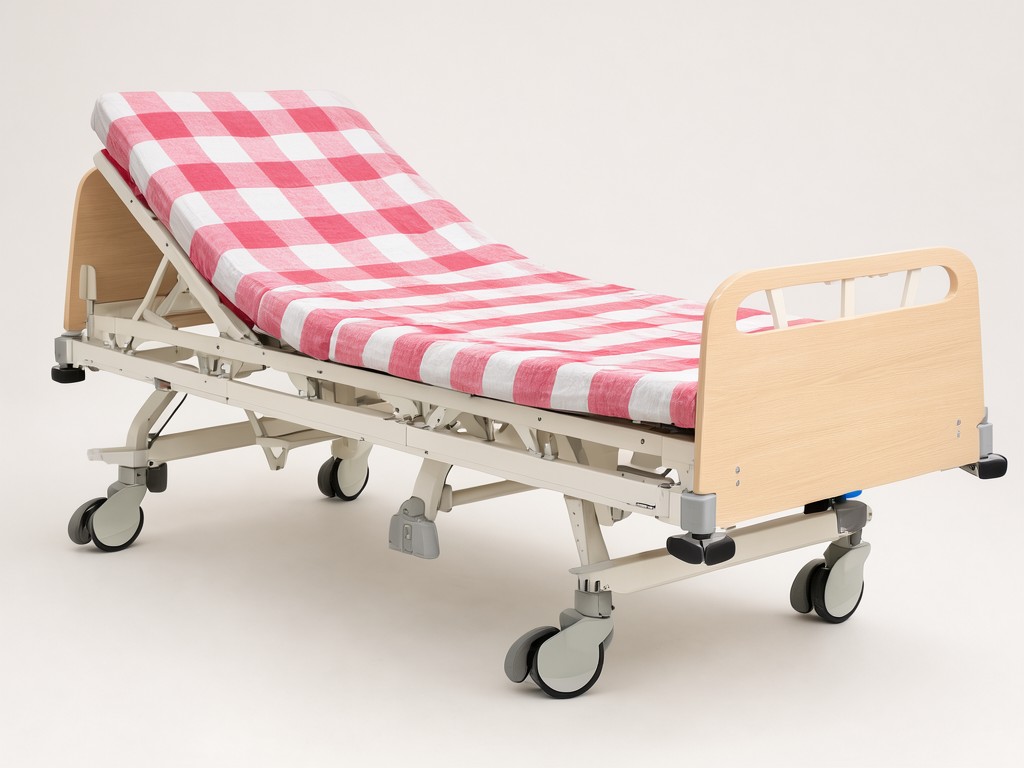
- Deck width: 915 mm (36") or 1015 mm (40") — matches standard residential door clearance
- Deck length: 2030 mm (80") standard; 2130 mm (84") tall-user option
- Height range: 380-760 mm (15-30") electric hi-lo, 450 mm fixed-height variant
- Backrest articulation: 0-70°, knee-break: 0-30°, Trendelenburg: 12° reverse
Weight & Load Parameters
- Safe working load: 200 kg (patient) + 30 kg (mattress/accessories)
- Frame weight (beech, 36" deck): 68 kg ± 2 kg
- Frame weight (plywood core, 36" deck): 54 kg ± 2 kg
- Motor system: 2× 6000 N linear actuators, 24 VDC, IP66, 4.5 mm/s under load
- Caster spec: 100 mm dual-wheel, central locking, conductive tread
The 36" deck width fits through 32" clear-opening doors (common in pre-1990 US housing) with 12 mm clearance per side — no disassembly required. The 40" deck adds 100 mm lateral space for bariatric patients but demands 34" door clearance; we flag this in the sales configurator so buyers don't order containers that stall at the customer's bedroom doorway. Height range starts at 380 mm to allow Hoyer lift clearance; competitors often spec 420 mm minimum, which forces caregivers to use slide boards instead of full lifts — a differentiator that shows up in occupational therapist recommendation letters.
Motor selection directly impacts total cost of ownership. The 6000 N actuators (Dewert Megamat or Linak LA40 equivalent) draw 3.2 A peak at 24 VDC, requiring a 120 W SMPS with medical-grade isolation (IEC 60601-1). Cheaper 4500 N units save $18/bed but hit current limit at 160 kg patient weight, stalling the knee-break and triggering the overload alarm — a service call that costs $140 minimum. We qualify each motor lot with a 500-cycle thermal soak at 40°C ambient, measuring current draw drift; acceptance is <5% increase from baseline. That screen catches winding insulation defects that would fail at month 18 in the field.
Option Comparison by Usage Level
Rental Fleet Grade (24-month cycle)
- Species: Beech, Select & Better
- Finish: Water-based 2K polyurethane, 3-coat, 120 µm DFT
- Joinery: Mortise & tenon + 10 mm through-bolts at pivot blocks
- Side rails: Aluminum extrusion, anodized, tool-free drop
- Motor: Dual 6000 N, 5-year warranty
- Packaging: Knock-down, 5-layer corrugated, corner protectors
- Target FOB: $385-410
Retail Premium Grade (5-year residential)
- Species: White Oak, Quarter-sawn or Hard Maple
- Finish: Conversion varnish + UV topcoat, 150 µm DFT
- Joinery: Domino floating tenon + epoxy-bonded hardwood splines
- Side rails: Solid hardwood, shaped, magnetic catch
- Motor: Dual 8000 N, ultra-quiet (24 dB), 7-year warranty
- Packaging: Assembled, blanket-wrapped, air-ride truck
- Target FOB: $620-680
The rental grade optimizes for refurbishment speed. Through-bolts allow side rail and deck replacement in 12 minutes with a 13 mm socket — no clamps, no glue cure time. The 120 µm film builds enough mil thickness for two light sand-and-recoat cycles (80 µm removal each) before substrate exposure. Premium grade invests in Domino joinery (Festool DF 700) because the floating tenon distributes shear across 1200 mm² of glue line versus 400 mm² for a traditional mortise; the epoxy bond (West System 105/206) maintains 92% shear strength after 1000 hours at 95% RH — the accelerated aging equivalent of 7 years in a Gulf Coast bedroom. Magnetic side rail catches eliminate the plastic latch that snaps at -10°C; they add $22/rail but reduce warranty touches to near zero.
Packaging choice reflects the sales channel. Knock-down in 5-layer corrugated (ECT 44) stacks 2-high in a 40'HQ, yielding 96 units/container — freight amortizes to $18/unit. Blanket-wrapped assembled units ship 40/container on air-ride; freight jumps to $65/unit but eliminates dealer assembly labor ($45) and the 3% damage rate from DIY bolt misalignment. For private-label programs shipping to fulfillment centers, we recommend the knock-down spec with pre-installed motor wiring harnesses (plug-and-play, keyed connectors) — cuts dealer setup to 8 minutes and removes the "wired backwards" return code.
Working as a Production Partner, Not a Catalogue Supplier
Catalogue suppliers ship what they stock. A production partner aligns tooling, inspection, and documentation to your launch calendar and your brand's risk tolerance. Our workflow starts with your technical package: 3D STEP files for the frame, 2D drawings with GD&T for critical interfaces (motor mount pattern ±0.15 mm, side rail bracket hole pattern ±0.10 mm), and a material specification that names species, grade, moisture content range, and finish system by brand and lot-traceable component. We return a first-article inspection report (FAIR) per AS9102 Form 1/2/3 within 10 working days of tooling completion — dimensional, visual, functional (articulation force, motor current, ground continuity), and finish adhesion (cross-hatch, ASTM D3359 Method B, 5B minimum).
Batch consistency is enforced at three gates. Gate 1: incoming lumber — 10% of boards checked for MC (pin meter, ±0.5%), grade verification (NHLA rules), and specific gravity (water displacement). Gate 2: post-machining — 100% go/no-go on tenon fit (0.05-0.10 mm clearance), pivot block bore concentricity (CMM, ±0.03 mm), and deck flatness (straight edge, 0.8 mm max deviation over 1 m). Gate 3: finished assembly — 100% functional test (full articulation cycle under 100 kg load, current draw logged), hi-pot test (1500 VAC, 1 min), and visual inspection against the approved master sample under D65 illuminant. Failed units are segregated, root-caused, and corrective action logged in the batch record — not reworked into the shipment.
Artwork and branding integration happens at the component level, not as an afterthought. Headboard logo placement: CNC-engraved (0.8 mm depth, 60° V-bit) before finish, then color-filled with UV-stable pigment — survives 200 wash cycles with hospital-grade detergent. Serial number labels: laser-etched anodized aluminum riveted to the frame (not adhesive — peels at 60°C trunk temperatures). User manual and regulatory marks: printed on 120 gsm synthetic paper (tear-proof, waterproof) and bound into the mattress retainer pocket. We maintain your artwork files in a version-controlled repository; any change triggers a new FAIR on the affected component. That traceability is what lets you answer a regulatory auditor in 15 minutes instead of 15 days.
Total Cost of Ownership Lens
A $385 rental-grade bed that generates one warranty claim per 50 units (motor stall, side rail latch failure) costs $412/unit over 24 months when you factor reverse logistics ($87), refurbishment labor ($35), and the 8% rental downtime revenue loss. The $410 spec with qualified motors and magnetic rails drops claims to 1 per 300 units — TCO $413. The premium grade at $680 with zero claims over 5 years yields $712 TCO but commands 2.3× the retail margin. Run your numbers; we'll supply the failure-rate data by component from the last 18 months of production.