Custom hospital wooden beds for home care Supplier: Specification, Ordering and Quality Notes
Measured Performance in Real Use
Two suppliers quoting the same specification often diverge on what happens after six months of daily articulation cycles and hospital-grade disinfectant wiping. The frame joints that hold tight at delivery can develop play; the laminate edges that look clean at install can delaminate where the side rail brackets concentrate stress; the casters that roll smoothly on showroom vinyl can bind on residential carpet transitions. These are the failure modes that drive warranty claims and reorder friction.
Articulation cycle life is the single metric that separates a bed rated for institutional turnover from one built for a three-to-five-year home care horizon. A head-section actuator rated for 10,000 cycles at 180 kg load will typically survive 8–10 years of four-adjustment daily use; a 5,000-cycle unit often fails at year three. Deck slat deflection under static load tells a similar story: 25 mm centre deflection at 135 kg correlates with mattress bottoming-out complaints, while 15 mm deflection keeps the sleep surface in the therapeutic zone for pressure-redistribution foam.
Finish Durability Threshold
Thermofoil-wrapped MDF head/foot boards withstand 5,000+ quaternary ammonium wipe cycles without gloss loss or edge lift. Low-pressure laminate on particleboard shows edge whitening at 1,200 cycles. Specify the wrap material if the facility uses bleach-based protocols; thermofoil survives 10% sodium hypochlorite, laminate does not.
Size, Weight and Specification Range
Before comparing quotations, lock the dimensional envelope to the target market. North American home care expects 880 mm (34.5 in) deck width to fit standard doorframes; European tenders often specify 900 mm. Deck length varies 2,000–2,200 mm depending on mattress standard. Overall bed weight determines whether two-person delivery is sufficient or whether a white-glove team with a stair climber is budgeted.
| Parameter | Standard Range | Custom Options | Typical Impact on Unit Cost |
|---|---|---|---|
| Deck width | 880 mm / 900 mm | 850–1,000 mm in 25 mm steps | +3–5% per non-standard width (tooling) |
| Deck length | 2,000 / 2,100 / 2,200 mm | 1,900–2,300 mm | +2% per 100 mm over 2,200 mm |
| Safe working load | 180 kg / 225 kg / 270 kg | Up to 320 kg (bariatric) | +8–15% for 270 kg; +25% for 320 kg |
| Bed weight (fully assembled) | 68–85 kg (standard); 95–115 kg (bariatric) | Aluminium frame option: -12 kg | Aluminium frame: +18–22% |
| Articulation: head / knee / foot | 70° / 30° / 15° | 90° head (Fowler); auto-contour knee | Auto-contour: +4%; 90° head: +2% |
| Height range (deck to floor) | 380–760 mm | 330 mm low (fall prevention); 800 mm high (caregiver) | Extended range: +6% |
| Caster diameter / type | 100 mm dual-wheel, central lock | 125 mm low-profile; conductive tread | 125 mm: +3%; conductive: +5% |
Option Comparison by Usage Level
Unit price settles the question only after the usage level is matched to the construction tier. A bed cycling twice daily in a palliative home setting does not need the same actuator duty cycle as a bed turning over every 14 days in a transitional care unit. The table below maps the three most common procurement tiers to the components that actually wear.
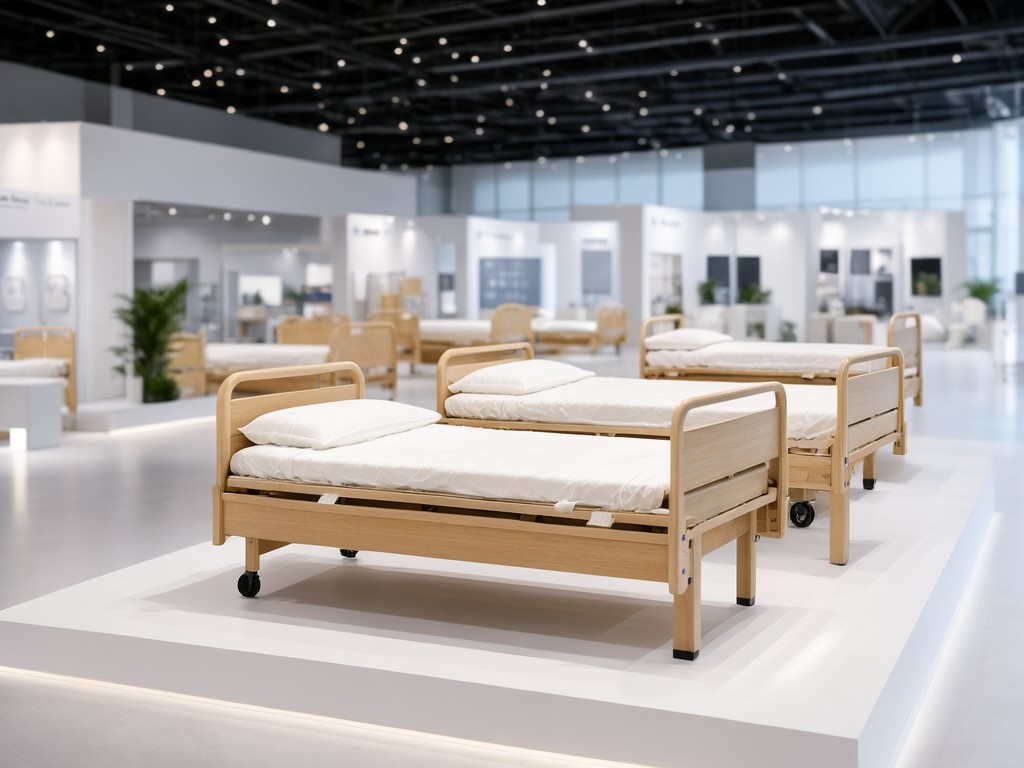
Tier 1: Long-Term Home Care (3–5 yr)
- Steel frame, powder-coated, 1.5 mm wall
- 2 actuators (head/knee), 5,000-cycle rated
- Thermofoil head/foot boards, sealed edges
- Beech slat deck, 68 mm spacing, 15 mm deflection
- 100 mm casters, central brake, 2 locking
- Manual CPR release on head section
Tier 2: High-Turnover Community Care (2–3 yr)
- Steel frame, 2.0 mm wall, reinforced corners
- 3 actuators (head/knee/foot), 10,000-cycle rated
- HPL head/foot boards, 3 mm radius edges
- Beech slat deck, 55 mm spacing, 12 mm deflection
- 125 mm casters, central brake, 4 locking
- Electric CPR with battery backup
Tier 3: Bariatric / Extended Stay (5+ yr)
- Steel frame, 2.5 mm wall, gusseted joints
- 4 actuators + Trendelenburg, 15,000-cycle rated
- Solid maple head/foot boards, mortise-and-tenon
- Reinforced steel mesh deck, 8 mm deflection
- 150 mm casters, independent brake, directional lock
- Integrated scale, bed-exit alarm, under-bed light
How to Choose Before Requesting a Quote
A decision-tree flow keeps the quotation round focused on the variables that move cost per unit sold rather than cost per unit bought. Walk the buyer through this sequence; each branch eliminates a tier of options and narrows the BOM.
- Define the care pathway. Palliative home (low articulation, high comfort priority) → Tier 1. Community rehabilitation (high articulation, frequent transfer) → Tier 2. Bariatric or complex wound (high load, Trendelenburg, monitoring) → Tier 3. Annotation: this single choice fixes actuator count, frame gauge, and deck construction.
- Confirm cleaning protocol. Quaternary ammonium only → thermofoil acceptable. Bleach or peroxide rotation → specify HPL or solid wood with marine-grade finish. Annotation: finish spec drives 12–18% of head/foot board cost.
- Measure the access route. Door clearances under 850 mm force 850 mm deck width or split-frame design. Stair-only access favours aluminium frame (-12 kg) or knock-down packaging. Annotation: split-frame adds two joint inspections at install; knock-down adds 15 min assembly labour.
- Select side rail strategy. Full-length split rails (entrapment-compliant gaps ≤ 60 mm / ≥ 318 mm) → standard. Half-length assist rails → lower cost, easier transfer, not a restraint. Integrated pivot rails → fastest caregiver operation, highest BOM. Annotation: rail choice determines head/foot board bracket pattern; change late = retool.
- Lock the mattress interface. Standard foam (150 mm) → 68 mm slat spacing. Alternating pressure overlay (200 mm) → 55 mm spacing or solid deck. Annotation: wrong spacing = mattress warranty void and pressure injury risk.
- Agree on service model. Factory service contract → specify modular actuator cassette (5 min swap). Buyer self-service → specify colour-coded wiring, tool-less deck removal. Annotation: modular cassette adds $18–22/unit but cuts field labour 70%.
Usage Scenarios and Buyer Segments
The procurement officer at a national home-care agency orders 200 Tier 1 units per quarter with thermofoil finish, 880 mm width, and central-lock casters. Their failure metric is finish delamination at month 18; they require 5,000-cycle wipe test data before PO release.
A regional DME distributor serving Medicaid waiver programs buys Tier 2 in mixed configurations. Their complaint pattern is caster stem fracture on threshold transitions; they mandate 125 mm casters with reinforced yokes and will pay the 3% premium to avoid field swaps.
A private-label brand supplying high-end retail showrooms specifies Tier 3 with solid maple headboards, mortise-and-tenon joinery, and concealed actuator covers. Their return driver is audible squeak at the knee articulation pivot; they require pre-shipment acoustic check below 35 dB at 1 m.
How Consistency Is Held Across Batches
Batch traceability starts at the lumber kiln. Each pallet of beech or maple carries a moisture-content certificate (target 6–8% for North America, 8–10% for EU) and a unique lot ID that follows the components through CNC routing, edge-banding, and final assembly. Frame welding fixtures are gauged weekly with go/no-go pins; any drift beyond 0.3 mm on critical hole centres triggers fixture requalification.
Actuator incoming inspection runs a 200-cycle functional test on 100% of units, not a sample. Force vs. displacement curves are logged; outliers beyond ±5% of nominal force at 180 kg load are quarantined. Finished bed articulation test: 50 full cycles under 135 kg distributed load, measuring deck deflection, rail gap stability, and current draw per actuator. Beds exceeding 15 mm deflection or 1.2× nominal current are held for root-cause.
Serviceability Checkpoint
Every production batch includes three units pulled for destructive teardown: actuator gear wear measurement, slat fatigue inspection, caster swivel torque after 2,000 cycles. Results feed back into the next BOM revision. Ask for the teardown report when qualifying a new supplier; its absence is a consistency red flag.
Export Packaging and Handling Protection
Fully assembled beds ship upright in custom steel stillages (four per 40 ft HC) to eliminate double-stack compression on headboards. Knock-down kits ship flat: frame sub-assembly in corrugated triple-wall, head/foot boards in foam-lined sleeves, actuator cassette in anti-static bag with desiccant. Both configurations include corner protectors rated for 1.5 g lateral shock.
Container loading plan accounts for centre-of-gravity shift when beds are raised to maximum height for door clearance. Stillages are chained to corner castings; knock-down pallets are stretch-wrapped with 25 µm film and edge boards. Humidity indicator cards (30/50/70% RH) are placed in each package; readings above 70% at receipt trigger finish inspection hold.
Ordering, Tooling and Lead-Time Questions
Minimum order quantity for a custom width or finish is 25 units — this covers the CNC fixture setup and the first-article inspection cycle. Standard Tier 1 configurations in stock finishes (maple thermofoil, walnut thermofoil, white HPL) ship in 15 business days from PO acknowledgement. Custom finish matching adds 10 days for panel approval; custom width adds 12 days for fixture cut.
Tooling ownership: fixtures for non-standard widths remain factory property but are dedicated to the buyer's part number. If the buyer forecasts 100+ units/year, the fixture cost is amortised into the unit price; below that threshold it appears as a one-time NRE line item. Actuator cassette moulds are always factory-owned; custom stroke lengths require a new mould at $4,500–$6,000 with 8-week lead.
- Sample approval: one pilot unit at 1.5× unit cost, 20-day lead, full test report included.
- Artwork for headboard branding: vector AI or EPS, 300 dpi minimum, bleed 3 mm. Pad-print or laser-etch options; laser adds 2 days, survives autoclave.
- Warranty baseline: 2 years frame, 1 year actuators/electronics, 6 months finish. Extended to 3/2/1 available at 4% surcharge.
- Spare parts stocking: recommend 2% actuator cassettes, 5% caster sets, 3% handset per 100 beds deployed.
Frequently Asked Technical Questions
- Can the bed articulate with the side rails fully raised? Yes on all tiers; the rail pivot geometry maintains ≤ 60 mm gap at all head-section angles. Verify with the specific mattress thickness — overlays above 200 mm can close the gap at 70° Fowler.
- What is the actual noise level during articulation at 3 m distance? Tier 1: 42–45 dB(A). Tier 2: 38–41 dB(A) with synthetic grease on pivot pins. Tier 3: 35–38 dB(A) with bronze bushings. Bedroom ambient is typically 30 dB(A); specify Tier 2+ for light sleepers.
- How does the manual CPR release work if the actuator fails? Pull the red cable at the head-section pivot; a cam disengages the actuator nut, allowing the section to fall by gravity to flat in < 3 s. Test force is 18 N — achievable by a 5th percentile female. Electric CPR (Tier 2/3) does the same via solenoid in 1.2 s.
- Are the casters field-replaceable without tipping the bed? Yes. Each caster stem has a captive retaining clip accessible from the side; a 13 mm spanner removes the bolt. The bed stays on its remaining three casters. Allow 4 min per caster for a single technician.
- What happens to the bed weight if we specify the aluminium frame option? Deduct 12 kg from the table weights. Centre of gravity shifts 15 mm toward the foot; stillage design must account for this. Aluminium frames use M8 threaded inserts instead of welded nuts — torque to 18 Nm on reassembly.
- Can we use a standard 150 mm foam mattress on the 55 mm slat spacing deck? Yes, but the mattress warranty may require ≤ 60 mm spacing. The tighter spacing supports the foam edges better; the trade-off is 8% less airflow, which matters for microclimate management in long-term immobilised patients.
Ready to Review Specifications?
Send us your care pathway, access constraints, and cleaning protocol. We return a marked-up specification sheet with tier recommendation, unit cost at your volume, and first-article timeline.
Request Specification Review