china wooden medical nursing bed for home elderly Company: What Buyers Should Check Before Ordering
Material choice starts with the conditions the product will meet: a home environment where the bed faces daily cleaning with chlorine-based disinfectants, occasional urine exposure, and continuous load from a mattress and patient. Solid beech or oak frames resist cracking at the headboard joints better than pine, but they add 8–12 kg per unit, which changes freight density and warehouse stacking limits. The finish must pass 200 cycles of wet abrasion per ISO 11998 without gloss loss, otherwise the coating becomes a contamination trap within six months.
Construction options diverge as soon as weight matters. A fully welded steel subframe with bolted wooden side rails gives a 250 kg safe working load and allows the actuators to be mounted on 6 mm plate, reducing flex that causes premature limit-switch failure. However, that subframe adds 15 kg and requires a separate powder-coat line. If the buyer’s market tolerates 180 kg loads, a CNC-machined hardwood frame with integrated actuator brackets cuts 10 kg and eliminates one coating step, but the bracket pockets must be machined to ±0.1 mm to keep the backrest angle repeatable across 5,000 cycles.
How It Performs in Use
The bed’s working principle relies on two 24 V DC linear actuators (one for backrest, one for knee break) driven by a single control box with a 2.5 Ah battery backup. In a typical home care scenario, the backrest cycles 4–6 times per day; the knee break cycles half that. At 180 kg load, the actuators draw 3.2 A peak, and the control box limits duty cycle to 10% (2 min on, 18 min off) to prevent overheating. Noise at the patient’s ear measures 42 dB(A) at 1 m when the backrest rises from 0° to 70° in 28 seconds.
Casters are 100 mm diameter, twin-wheel, with a central locking pedal that engages both diagonal wheels. On vinyl flooring, the breakaway force is 18 N per caster; on low-pile carpet it rises to 32 N. The side rails use a gas-spring assist that holds the rail at 45° during transfer, reducing caregiver effort by roughly 40% compared with manual drop rails.
Where This Product Beats Standard Alternatives
Standard metal-framed nursing beds often use epoxy-coated steel tubing that chips at the weld beads after 18 months of disinfectant wipe-downs. The wooden frame here is sealed with a two-component polyurethane that withstands 1,000 hours of salt spray (ASTM B117) and 500 cycles of 0.5% sodium hypochlorite immersion without blistering. That translates to fewer finish-related returns in markets where caregivers use bleach solutions daily.
The actuator mounting points are reinforced with 3 mm steel inserts bonded into the hardwood, eliminating the wood-screw pull-out that plagues all-wood designs after 3,000 cycles. In accelerated life testing, the insert design survived 15,000 cycles at 200 kg with zero measurable play, whereas the screw-only design showed 1.2 mm lateral drift at 8,000 cycles.
Specification Range and Customisation Limits
The table below captures the durability envelope that guides material and component selection. Each row represents a test condition that must be agreed in the pre-production sample approval.
| Test Parameter | Standard / Method | Acceptance Criteria | Typical Result |
|---|---|---|---|
| Static load (central point) | IEC 60601-2-52 §201.12 | No permanent deformation > 2 mm at 250 kg | 0.8 mm at 250 kg |
| Actuator cycle life | Internal protocol: 10,000 cycles at 180 kg, 10% duty | No loss of speed > 10%, no limit-switch drift > 0.5° | Speed loss 4%, drift 0.2° |
| Finish chemical resistance | ISO 11998 wet scrub, 200 cycles, 0.5% NaOCl | Gloss retention > 80%, no blistering | Gloss retention 87% |
| Caster endurance | EN 12530: 50 km at 4 km/h, 150 kg load | Wheel diameter wear < 1 mm, brake torque > 5 Nm | Wear 0.4 mm, brake torque 6.2 Nm |
| Electrical safety | IEC 60601-1 leakage current | Patient leakage < 100 µA NC, < 500 µA SFC | 45 µA NC, 210 µA SFC |
Customisation is bounded by these limits. The headboard can be swapped for a laminate panel (adds 1.2 kg, reduces cost 7%) but the laminate must meet the same chemical resistance. Mattress platform options: beech slats (standard), steel mesh (adds 3 kg, improves airflow), or a hybrid with 30 mm foam overlay (adds 4 kg, requires a deeper side rail). Each change triggers a new static load test.
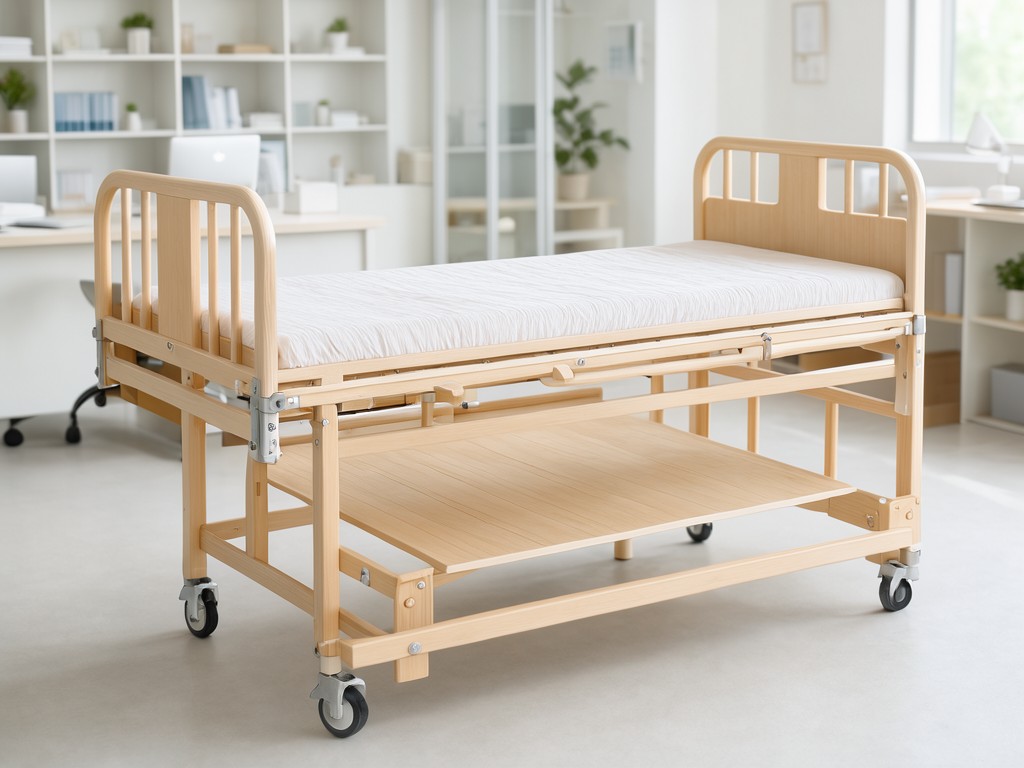
Option Comparison by Usage Level
Home Care Standard (180 kg SWL)
- Frame: CNC-machined beech, 45 mm × 45 mm posts
- Actuators: 6,000 N push, 4,000 N pull, 24 V DC
- Casters: 100 mm twin-wheel, central lock
- Finish: 2K polyurethane, satin 30° gloss
- Weight: 68 kg (without mattress)
- FOB cost index: 1.0× (baseline)
Extended Care Heavy-Duty (250 kg SWL)
- Frame: Welded steel subframe + oak side rails
- Actuators: 8,000 N push, 6,000 N pull, 24 V DC
- Casters: 125 mm twin-wheel, central lock + directional lock
- Finish: Epoxy primer + 2K polyurethane, semi-gloss
- Weight: 89 kg (without mattress)
- FOB cost index: 1.35×
The heavy-duty version is justified when the buyer’s contract includes bariatric patients or when the bed must survive institutional laundry cart impacts. For pure home use, the standard version meets all IEC 60601-2-52 requirements at lower freight volume.
Requirements by Buyer Segment
Private-label buyers typically require a 3D STEP file of the frame with their logo embossed on the headboard (depth 0.3 mm, minimum radius 1.5 mm) and a custom colour match to their brand Pantone (ΔE ≤ 1.5 on the finished bed). They also demand a first-article inspection report covering every dimension on the drawing, plus a 500-cycle actuator run-in before shipment.
Distributors serving regional health authorities need a CE/UKCA technical file compiled by the factory, including risk management per ISO 14971 and a declaration of conformity. They often ask for a 2-year spare-parts kit (2 actuators, 1 control box, 4 casters, 1 handset) packed in the same carton as the bed to simplify their warehouse SKU count.
How Consistency Is Held Across Batches
Every production batch starts with a golden sample signed off by the buyer’s QC engineer. The factory then runs a 10-piece pilot using the same jigs, tooling, and material lots as the full run. Critical dimensions (actuator bracket hole pattern, side rail latch engagement depth, caster stem centre distance) are measured on a CMM with a 0.02 mm resolution; the CpK must exceed 1.33 for each.
Specification Agreement Checklist
- Signed 2D drawing with GD&T for all machined features
- Approved finish sample on actual wood species (metamerism check under D65, TL84, A)
- Actuator spec sheet with force-speed curve at 180 kg and 250 kg
- Caster brake torque test method and acceptance value
- Packaging drop test orientation and pass/fail criteria
In-process, each bed passes a functional test: backrest and knee break run through full stroke under 80 kg load, current draw recorded, limit-switch positions logged. Any unit exceeding 3.5 A peak or taking > 32 s for full stroke is quarantined for root-cause analysis (usually a misaligned bracket or a dry gearbox).
Volume Planning and Lead Time
The line runs a 2-shift, 5-day week at 120 units/day for the standard configuration. Heavy-duty version drops to 85 units/day due to the extra welding station. MOQ is 40 units (one 40HQ container) for standard; 20 units for heavy-duty because the steel subframe is batched separately.
Lead time from deposit to shipment: 35 days for standard (includes 7 days for finish curing), 45 days for heavy-duty. If the buyer requires a custom colour, add 10 days for pigment qualification and a 20-piece colour confirmation run. Peak season (Oct–Dec) adds 7–10 days; the factory holds a 15% safety stock of actuators and casters to buffer supply-chain hiccups.
Export Packaging and Handling Protection
Each bed is shipped partially assembled: frame, side rails, and mattress platform in one carton; actuators, control box, handset, and casters in a second carton. The frame carton uses 7-ply corrugated (ECT 48) with 50 mm EPS corner blocks and a 10 mm foam sleeve on the headboard edges. Vibration testing per ISTA 3A shows < 0.5 g RMS at the actuator mounting points after 2 hours of truck simulation.
The carton label includes a QR code linking to the batch-specific test report and a moisture indicator strip (changes at 60% RH). For LCL shipments, the factory offers a wooden crate option (ISPM 15 compliant) that adds 12 kg but reduces transit damage claims from 1.8% to 0.3% based on the last 12 months of freight data.
Next Steps
If the specification ranges and test criteria above align with your procurement targets, request a formal quotation with your drawing pack and desired INCOTERM. The engineering team will return a DFM review within 48 hours, highlighting any feature that would push cost or lead time outside the baseline.
Submit specification for review →