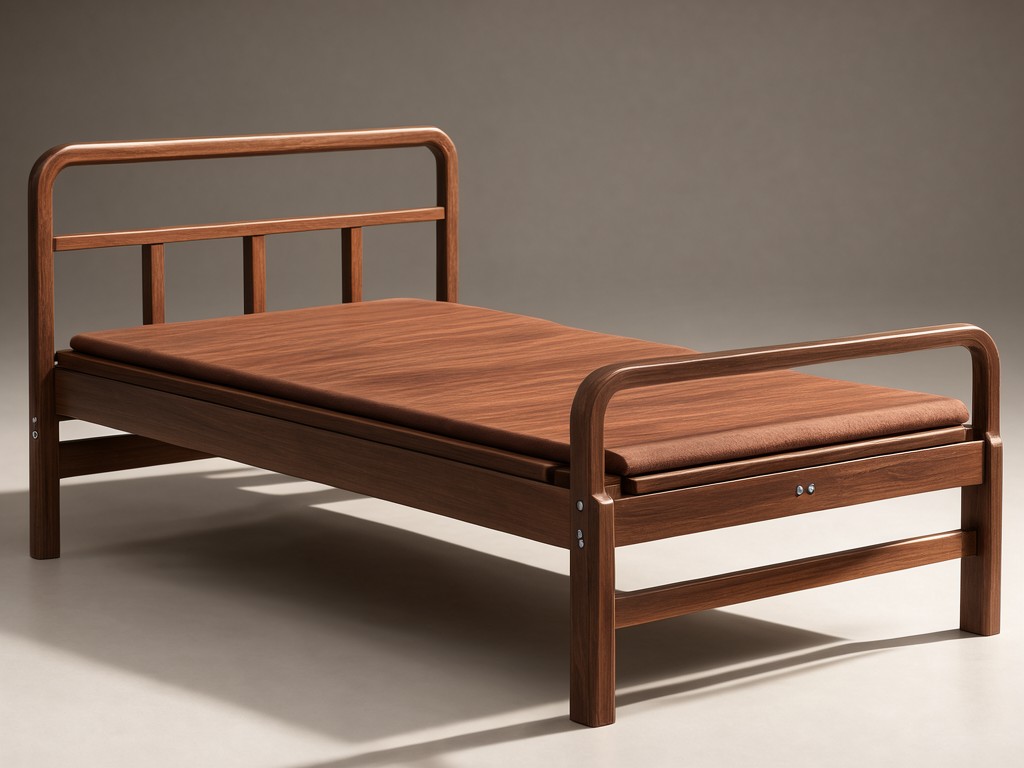
China wooden hospital nursing care beds Manufacturer: Specification, Ordering and Quality Notes
Scope of Supply and Physical Form
Returns usually trace back to the same weak point: the joint between the wooden head/foot board and the steel undercarriage. When a facility orders 200 beds for a ward refurbishment, they expect the timber to stay square after three years of daily profiling, chlorhexidine wipes, and patient transfers. The beds we supply are built on a welded rectangular steel chassis (50 × 30 × 2 mm rectangular hollow section) with bolt-on hardwood panels — beech or maple, kiln-dried to 8–10 % moisture content, finished with a two-component polyurethane system rated for 5,000+ abrasion cycles (Taber CS-17, 1 kg).
Each unit ships as a four-section profiling platform (back rest, thigh rest, calf rest, fixed seat) on 125 mm twin-wheel conductive casters, two braked, two swivel. Standard deck is either laminated birch slats (56 × 8 mm, 38 mm centres) or a perforated steel panel — buyer's choice at order confirmation. Safe working load is 250 kg evenly distributed; dynamic cycle testing runs 20,000 full profiling cycles at 180 kg before first article approval.
What the Design Has to Balance
Configuration Trade-off
Electric hi-lo with Trendelenburg adds 18 kg and two IP66-rated actuators (6,000 N push, 4,000 N pull). Manual crank saves cost and weight but demands staff effort on every height change. For a 30-bed dementia ward, the electric version pays back in reduced manual handling claims within 14 months; for a 10-bed respite unit, manual crank is the rational choice.
The complaint that repeats across reorders is finish degradation at the head-board edges where chlorine-based disinfectants pool. Our response: a 3 mm radius on all exposed edges before coating, plus a 120 µm dry film thickness on vertical surfaces versus 80 µm on horizontals. Salt-spray (ASTM B117) reaches 500 hours without blistering; accelerated UV (Q-SUN Xe-3, 0.68 W/m² at 340 nm) shows < 3 ΔE colour shift after 1,000 hours. That spec costs 7 % more per unit but cuts refinishing calls by 90 % in year two.
Serviceability drives the actuator mount design: four M10 × 30 socket-head cap screws per actuator, accessible without removing the mattress platform. Caster stems are threaded M16 × 1.5 into welded nuts — no press-fits that seize after steam cleaning. Spare parts kits (two actuators, one control handset, four casters, one control box) are stocked in Ningbo and Rotterdam; lead time for replenishment is 10 working days.
Comparing Two Standard Configurations
Config A — Manual Crank, Slat Deck
- Back-rest / knee-break via fold-away cranks (ratchet locking, 5° increments)
- Hi-lo range 400–800 mm, crank force ≤ 15 N at 180 kg load
- Unit weight 68 kg (beech) / 71 kg (maple)
- FOB Ningbo: $285–$310 depending on timber grade
Config B — Electric 3-Function, Steel Deck
- Back-rest, knee-break, hi-lo via handset; Trendelenburg / reverse Trendelenburg ±12°
- Hi-lo range 400–800 mm, 24 V DC, duty cycle 10 % (2 min on / 18 min off)
- Unit weight 86 kg (beech) / 89 kg (maple)
- FOB Ningbo: $420–$455 depending on timber grade
Both configurations share the same chassis, caster set, and hardwood panel dimensions (head board 980 × 600 × 25 mm, foot board 980 × 450 × 25 mm). The steel deck in Config B eliminates slat rattle and allows integrated scale brackets — a common retrofit request that costs $42 extra if specified upfront versus $180 as a field kit.
Quality Control and Batch Consistency
Most quality disputes start with a consistency gap: timber colour variation across a 50-bed batch, or actuator speed drift between units. We control this through three hold points. First, incoming timber is sorted by colour block (ΔE ≤ 1.5 within a batch) and grain orientation — quartersawn faces outwards on head boards to minimise seasonal movement. Second, every welded chassis passes a 300 kg static deflection test (centre point ≤ 3 mm) before powder coating. Third, each finished bed runs a 15-minute functional cycle: full profiling, hi-lo, brake engagement, and electrical leakage (< 100 µA per IEC 60601-1).
Dimensional tolerance on the mattress platform is ±2 mm length, ±1.5 mm width — critical when the buyer supplies their own pressure-redistribution mattresses. Caster alignment is checked on a laser jig: toe-in ≤ 0.5 mm per wheel. Finish adhesion passes cross-hatch (ISO 2409) at 5B. Any unit failing a hold point is segregated; root cause is logged in the batch traveller and corrective action closes before the next batch releases.
| Parameter | Acceptance Range | Test Method | Frequency |
|---|---|---|---|
| Platform flatness | ≤ 3 mm over 2 m | Straight edge + feeler gauge | 100 % |
| Actuator speed (no load) | 4.5–5.5 mm/s | Laser tachometer | 100 % |
| Finish adhesion | 5B (no flaking) | Cross-hatch ISO 2409 | 1 per 20 units |
| Timber moisture content | 8–10 % | Pin meter (core) | Every pallet |
Packing, Marking and Freight Configuration
Beds ship knocked-down: chassis on pallet A, head/foot boards in corrugated sleeves on pallet B, actuators and handsets in anti-static bags on pallet C. A 40-foot high-cube takes 54 complete Config A units or 48 Config B units. Pallets are ISPM-15 heat-treated pine, stretch-wrapped with 23 µm LLDPE film, corner boards top and bottom. Gross weight per pallet ≤ 950 kg for air-ride suspension trucks.
Each pallet carries a laser-printed label (100 × 150 mm, synthetic substrate, UV-resistant adhesive) showing: PO number, batch code, configuration, quantity, net/gross weight, and a QR code linking to the digital batch traveller. Customs description reads "Hospital beds, wooden/steel, HS 9402.90". Fumigation certificate and certificate of origin accompany the shipping documents. For LCL shipments we crate each bed individually in 5-ply corrugated (ECT 44) with foam corner protectors — adds $18/unit but eliminates transit damage claims.
Ordering Parameters and Lead Times
| Order Qty | Lead Time (FOB Ningbo) | Payment Terms | Notes |
|---|---|---|---|
| 10–29 units | 25 working days | 30 % deposit, 70 % pre-ship | Stock timber only (beech) |
| 30–99 units | 30 working days | 30 % deposit, 70 % pre-ship | Maple available +$18/unit |
| 100–199 units | 35 working days | LC at sight or 30/70 | Dedicated colour block |
| 200+ units | 40 working days | Negotiable | Split shipment option |
Sample lead time is 12 working days from approved drawing; sample cost (unit + air freight) is credited against the first production order ≥ 30 units. First-article inspection report (FAIR) with dimensional, functional, and finish data ships with the sample.
Request a Specification Review
Send us the ward layout, mattress spec, and cleaning protocol. We will return a marked-up configuration sheet with weight, price, and lead time per line item — no obligation.
Start Specification Review