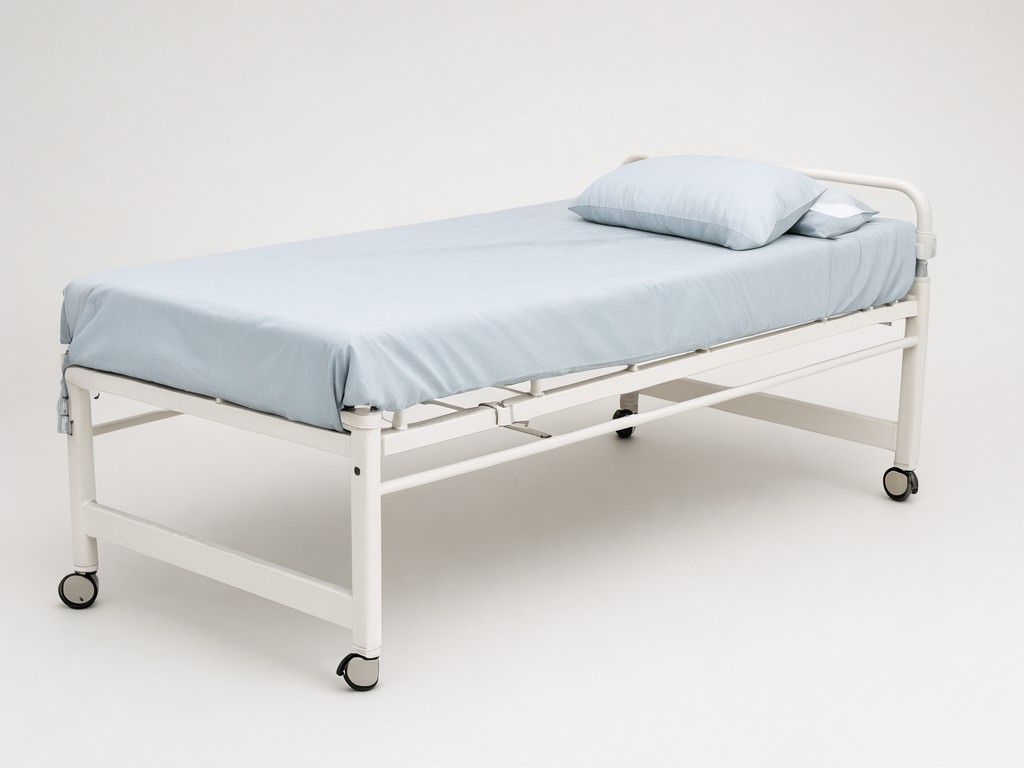
Specifying china patient beds for elderly at home manufacturer for Wholesale and OEM Orders
Scope of Supply and Physical Form
First-article tooling determines the dimensional envelope every subsequent unit must occupy. The bed frame ships as a knock-down kit: two side rails, head and foot boards, a four-section mattress platform (back, thigh, calf, foot), and a pair of foldable side rails with integrated latch. All steel components are powder-coated after welding; plastic parts are injection-moulded ABS. The actuator set — two linear drives for back-rest and knee-break, one for height — arrives pre-wired to a handset with lockout function. Casters are 100 mm diameter, dual-wheel, central-locking via a single pedal at the foot end. Net weight per unit: 48–52 kg depending on configuration.
Packaging is export-grade: frame components in reinforced corrugated cartons with corner protectors, actuators and handset in anti-static bags, hardware in labelled polybags. A 40-foot high-cube container holds 180 kits when palletised two-high. Retail-ready colour boxes are available for brands that ship direct to end users.
How It Performs in Use
The build method decides whether the bed survives three years of daily height cycles or fails at month eighteen. Our four-section platform uses a double-scissor linkage for back-rest (0–75°) and knee-break (0–40°) driven by 6000 N and 4000 N actuators respectively. Height adjustment runs 400–700 mm via a 8000 N column lift. All actuators are rated IPX4 and tested to 20,000 cycles at full load. The mattress platform is a welded steel mesh with 40 mm grid spacing; it supports 180 kg static load and 135 kg dynamic load (patient + caregiver) without permanent deflection exceeding 3 mm.
Side rails latch with a two-stage cam that requires 12 N to release — low enough for a caregiver, high enough to resist accidental disengagement by a restless patient. Casters withstand 50 km of rolling on vinyl flooring and 2000 brake engagements before torque drop exceeds 15%. Electrical leakage current stays below 0.1 mA under IEC 60601-1 conditions.
Material Options and Their Trade-offs
Frame: Q235B Steel vs. 6063-T5 Aluminium
Q235B with 80 µm epoxy-polyester powder coat: 12 kg heavier per unit, 2× the bending stiffness, salt-spray 500 h before first rust. Unit cost +18%.
6063-T5 anodised 15 µm: saves 12 kg, eases single-caregiver assembly, but deflection at 135 kg dynamic load reaches 5 mm. Salt-spray 300 h. Preferred for air-freight programmes.
Casters: PA66 vs. TPU Tread
PA66 core, PU tread: standard, 80 kg per caster, low rolling resistance on carpet, tread chunks after 2 years under ozone exposure.
TPU tread, precision ball bearing: 100 kg per caster, silent on hard floors, UV-stable 5 years, +22% cost. Chosen for hospital-at-home programmes.
Matching the Product to the Buyer's Need
| Usage Tier | Typical Daily Cycles | Recommended Actuator Rating | Frame Finish | Warranty Target |
|---|---|---|---|---|
| Home retail (occasional) | <5 | 4000 N / 6000 N | 60 µm polyester | 1 year electrical, 3 years frame |
| Community nursing (daily) | 15–25 | 6000 N / 8000 N | 80 µm epoxy-polyester | 2 years electrical, 5 years frame |
| Palliative / ICU@home (continuous) | 40+ | 8000 N / 10000 N | 80 µm + zinc primer | 3 years electrical, 7 years frame |
Select the tier that matches the end user's clinical protocol, not the distributor's price point. Over-specifying the actuator adds $12–$18 per unit but eliminates the single most common warranty claim: motor stall under obese patient loads.
What Can Be Customised and What Cannot
Customisation Boundaries
Freely configurable: powder-coat colour (RAL palette), head/foot board profile (flat, curved, with integrated IV pole sockets), side rail length (full, half, split), caster tread material, handset button layout and labelling language, mattress platform grid spacing (30, 40, 50 mm).
Locked by tooling: overall bed length (2120 mm ± 5 mm), width (965 mm ± 3 mm), height range (400–700 mm), actuator mounting hole pattern, central brake pedal position. Changing any of these requires new stamping dies and weld fixtures — minimum 12-week lead time and $18k–$25k tooling charge.
Private-label silk-screen on head board and handset is included at 500+ units. Custom moulded ABS parts (e.g., branded side rail end caps) need 3000-unit MOQ and 8-week mould trial.
Segment-Specific Requirements
| Buyer's Usage Condition | Typical Complaint / Failure | Preventive Specification |
|---|---|---|
| Daily chlorine-based disinfection (0.5% NaOCl) | Powder coat blisters at weld seams within 6 months | Zinc-rich primer + 100 µm epoxy-polyester; sealed weld seams |
| Bariatric patient (150–180 kg) with frequent repositioning | Platform mesh yields permanently; actuator stalls | Reinforced mesh (3 mm wire, 30 mm grid) + 10000 N lift actuator |
| Home with thick-pile carpet & narrow doorways | Casters bind; bed cannot turn through 800 mm door | 125 mm TPU casters + removable side rails reduce width to 890 mm |
| Paediatric / dementia patient — entrapment risk | Gap between side rail and mattress > 60 mm | Split rails with 45 mm gap; optional mesh infill panel |
| Air-freight replacement parts programme | Actuator shipping classified as dangerous goods (lithium battery) | Actuators ship without battery; handset uses 4×AA alkaline (UN3481 exempt) |
How Consistency Is Held Across Batches
Consistency is set at the forming stage. Every production lot begins with a first-article inspection (FAI) against a master sample retained in our metrology lab. Critical dimensions — frame diagonal squareness ± 1.5 mm, platform flatness ≤ 2 mm/m, actuator stroke ± 1 mm — are measured on a CMM. Powder coat thickness is verified at 12 points per frame (target 80 ± 10 µm). Actuator current draw at no-load and full-load is logged for each unit; any unit outside ±5% of the batch mean is quarantined.
A 10% random sample from each shipping lot undergoes a 500-cycle accelerated life test (height + back-rest simultaneous) at 135 kg. Failure to complete without error code triggers a full lot hold and root-cause analysis. Batch traceability links every serial number to steel heat number, powder lot, actuator firmware version, and FAI report. Records retained for 7 years.
| Order Type | MOQ (units) | Lead Time (weeks) | Sample Approval |
|---|---|---|---|
| Standard catalogue (stock colour) | 50 | 4–6 | Photo + spec sheet |
| Custom colour / handset label | 200 | 6–8 | Physical sample required |
| New side rail profile / IV pole integration | 500 | 12–14 | FAI + 500-cycle test report |
Setup, Use and Replacement Parts
Assembly requires two people, 13 mm and 17 mm spanners, 30 minutes. No special tools. All fasteners are M8×1.25 class 8.8 with nylon-insert lock nuts; torque to 18 N·m. Actuator connectors are keyed polarised plugs — mis-insertion impossible. Handset pairing is automatic on first power-up.
- Clean frame with pH-neutral detergent (pH 6–8); avoid quaternary ammonium > 0.2% — it attacks powder coat after 200 cycles.
- Lubricate caster bearings annually with NLGI 2 synthetic grease; wipe excess.
- Inspect side rail latch cam wear every 6 months; replace if release force drops below 8 N.
- Actuator and handset are field-replaceable (4 bolts, 1 plug). Stocking 2% spares covers 95% of 3-year service calls.
- Mattress platform mesh panels are not repairable; replace full section if any wire fractures.
We maintain a 5-year parts pipeline for every configuration shipped. Part numbers are laser-etched on each component; order via our B2B portal with serial number lookup.
Ready to Define Your Specification?
Send us the clinical protocol, target price, and annual volume. We will return a configured BOM, FAI plan, and landed-cost model within 3 business days.
Start a project discussion