Bulk wooden rotating medical patient bed factory: Specification, Ordering and Quality Notes
The core trade‑off is between frame rigidity and rotating‑mechanism clearance: a denser hardwood reduces flex under 250 kg loads but adds 12–15 % weight, which raises freight cost and can exceed the 180 kg ceiling of standard hospital‑floor lifts. Buyers who prioritize low warranty claims on the swivel bearing usually specify a reinforced steel‑core hub and accept the heavier frame.
Design Constraints Behind the Specification
Where chlorine, sweat or UV exposure is routine, the finish must survive 500 hours of salt‑spray testing without blistering; otherwise the rotating bearing housing corrodes and the bed develops a audible grind within six months. The factory therefore specifies a two‑coat polyurethane system (30 µm base, 20 µm top) on all exposed hardwood surfaces, and a zinc‑nickel plated bearing race for the swivel.
Construction options diverge as soon as weight matters. A solid beech frame (≈ 720 kg/m³) meets the 250 kg static load with a 30 mm side rail, but the resulting unit weighs 85 kg, pushing the shipping class to “heavy‑goods”. Switching to engineered birch plywood (≈ 560 kg/m³) with a 35 mm rail drops unit weight to 68 kg while keeping the same deflection limit of 3 mm under full load, but the plywood edge requires a bonded hardwood veneer to resist chip‑out during repeated cleaning.
| Material / Construction | Rotating Mechanism | Max Load (kg) | Typical Warranty Claims /100 units |
|---|---|---|---|
| Solid beech, 30 mm rail | Steel‑core hub, sealed ball bearing | 250 | 2–3 |
| Birch plywood + hardwood veneer, 35 mm rail | Steel‑core hub, sealed ball bearing | 250 | 1–2 |
| Solid beech, 30 mm rail | Aluminium hub, polymer bushing | 200 | 5–7 |
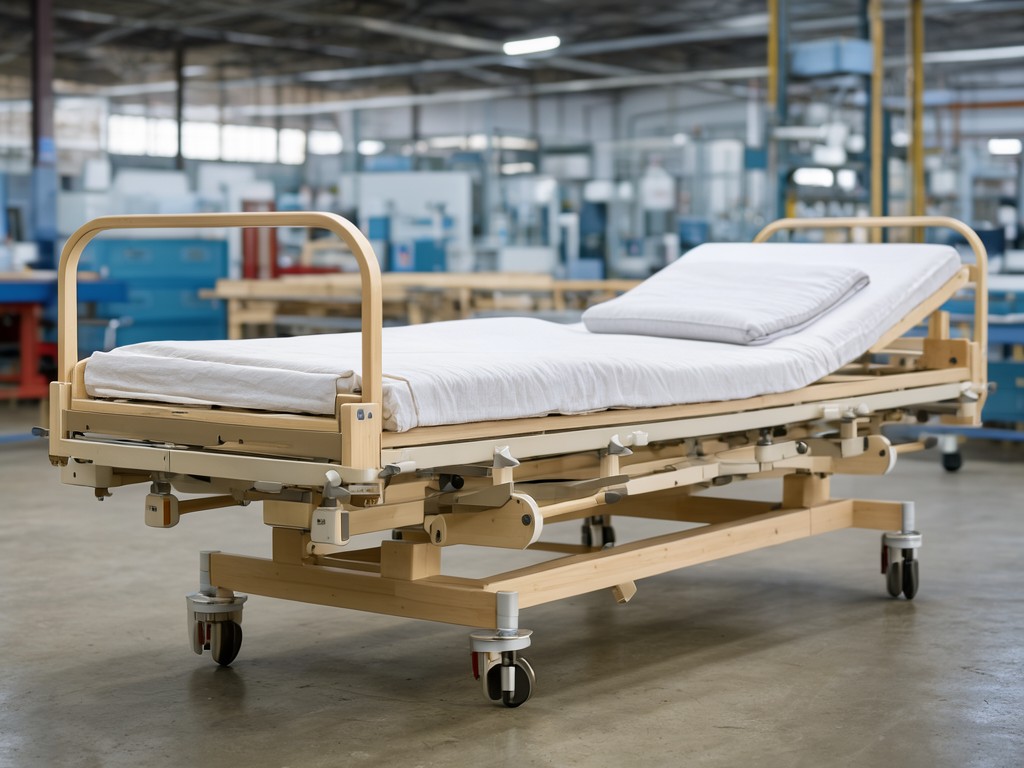
The data shows that the polymer‑bushing variant, while cheaper on the hub, generates three‑times the bearing‑related claims because the bushing cold‑flows under continuous 24/7 rotation. Buyers who have switched to the sealed ball bearing report a drop from 6 % to under 1 % return rate on the first year.
Matching the Product to the Buyer's Need
Distributors serving acute‑care hospitals usually order the solid‑beech, steel‑core configuration because the procurement spec mandates a minimum 10‑year frame life and a 250 kg safe‑working load. The heavier unit is absorbed by their existing pallet‑jack fleet, and the higher freight cost is offset by a 15 % lower warranty spend.
Private‑label brands targeting outpatient clinics and home‑care kits prefer the birch‑plywood version. The 17 kg weight saving reduces last‑mile delivery surcharges and allows a standard 120 cm × 200 cm pallet to hold 12 units instead of 9, cutting container utilization cost by roughly 8 %.
Club or academy purchasing managers who buy in lots of 30–50 for simulation labs often request a hybrid: solid beech head‑board for rigidity, birch‑plywood foot‑board for weight balance. The factory can accommodate this with a single CNC program change, adding only 2 % to unit cost.
Customisation Options and Their Limits
Material choice starts with the conditions the product will meet. The factory offers three finish tiers: standard polyurethane (30 µm/20 µm), antimicrobial‑additive polyurethane (same thickness, silver‑ion load 0.5 % wt), and a low‑VOC water‑based system for markets with strict VOC caps. The antimicrobial tier adds 4 % to material cost but reduces surface‑culture counts by 99 % in ISO 22196 testing, a figure that resonates with infection‑control committees.
Rotating‑mechanism options are limited to two bearing families: sealed deep‑groove ball bearing (rated 10 000 h at 30 rpm) and a maintenance‑free polymer bushing (rated 4 000 h). The bushing is only approved for loads ≤ 200 kg; any order specifying 250 kg must use the ball bearing.
- Head‑board logo emboss (max 120 mm × 40 mm, depth 0.8 mm)
- Integrated IV‑pole mount (adds 1.2 kg, requires reinforced side rail)
- Colour‑matched side‑rail caps (RAL palette, minimum 200 units per colour)
Custom dimensions beyond the standard 90 cm × 200 cm footprint require a new CNC fixture and add 3–4 weeks to lead time; the factory caps bespoke length at 210 cm to keep the rotating hub within the 180 kg lift limit.
Segment-Specific Requirements
Acute‑care tenders often demand a documented fatigue test: 50 000 rotation cycles at 250 kg with zero bearing play increase > 0.05 mm. The factory runs this on a dedicated test rig and supplies the raw data sheet with each batch.
Outpatient and home‑care segments require a “quick‑release” side‑rail for patient transfer; the factory integrates a spring‑loaded latch that passes a 150 N pull test without permanent deformation. This latch adds 0.6 kg and must be specified at order placement because it changes the rail extrusion profile.
Simulation‑lab buyers ask for a lockable swivel (0°/90°/180° detents) to standardise scenario set‑up. The detent mechanism uses a hardened steel indexing plate and adds 1.8 kg; it is only compatible with the steel‑core hub.
Export Packaging and Handling Protection
Each unit ships on a fumigated ISPM‑15 pallet, wrapped in 150 µm stretch film with corner protectors rated for 1 200 N edge crush. The rotating hub is locked in the 0° position by a removable steel pin to prevent bearing preload during transit.
For sea freight, the factory adds a desiccant sachet (30 g silica gel) per unit and a VCI‑treated cardboard sleeve to guard the polyurethane finish against humidity spikes. Air‑freight orders skip the VCI sleeve but retain the desiccant to meet airline dangerous‑goods limits on moisture‑sensitive cargo.
Container loading plans are supplied with the commercial invoice: 20‑ft GP holds 48 solid‑beech units (2 × 2 × 12 stack) or 60 birch‑plywood units (2 × 2 × 15 stack). The weight distribution keeps the centre of gravity below 1.2 m, satisfying most carrier stowage rules.
Ready to lock in a specification that cuts warranty claims on your next repeat order?
Request a specification review