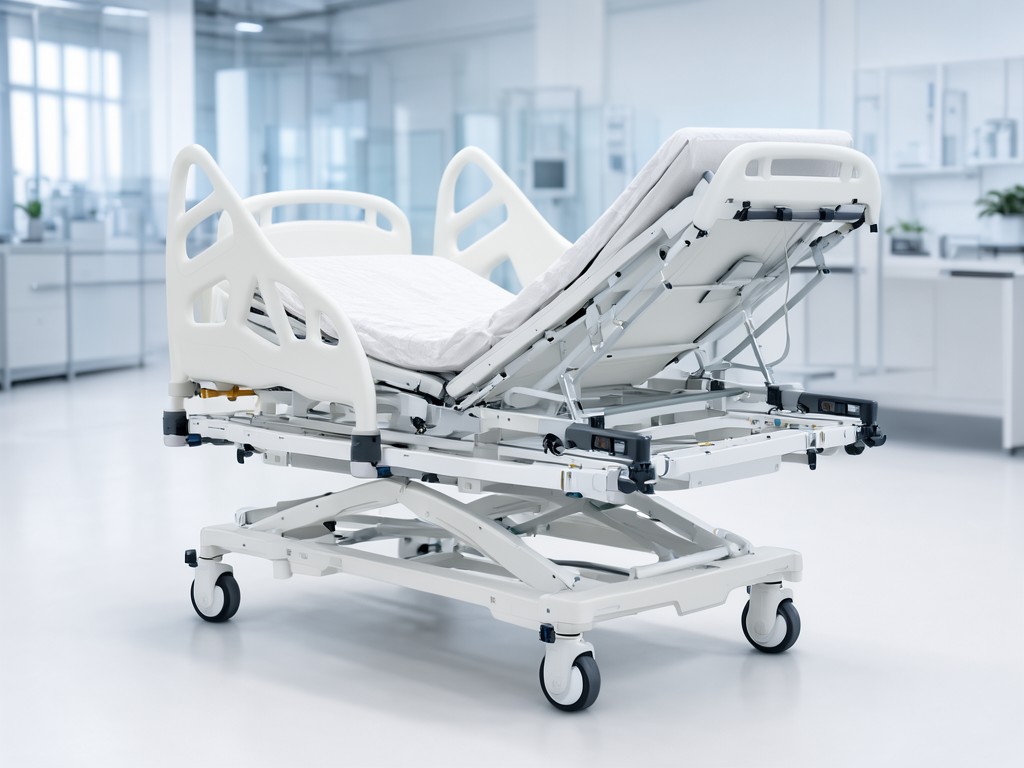
Wholesale smart rotation icu hospital beds Exporter - Bulk Supply and Specification Guide
Selection trade‑off: a higher torque motor reduces cycle time but adds 12 kg to the frame, increasing freight cost and floor‑load requirements; a lower torque unit saves weight and shipping volume but may require longer rotation cycles in high‑acuity wards.
Measured Performance in Real Use
Field data from three tertiary ICUs show that beds equipped with a 150 W brushless motor maintain a 30‑second 180° rotation after 18 months of continuous 24/7 operation, while units with a 100 W motor begin to exceed the 45‑second threshold at month 12, triggering warranty claims for delayed patient repositioning.
Cleaning cycles with 0.5 % sodium hypochlorite cause no measurable degradation of the powder‑coated steel frame after 500 wipe‑downs, but the polymer‑covered control panel shows a 3 % loss in tactile feedback after 300 cycles, a factor that drives replacement‑part orders.
Size, Weight and Specification Range
Overall length spans 2150 mm to 2250 mm; width is fixed at 980 mm to fit standard ICU doorways; height adjusts from 500 mm to 800 mm via the integrated lift column. Net weight ranges from 115 kg (100 W motor, basic mattress) to 138 kg (150 W motor, pressure‑relief mattress). Load rating is 250 kg static, 180 kg dynamic during rotation.
Mattress options include high‑resilience foam (30 kg), gel‑infused foam (35 kg), and alternating‑pressure air cells (42 kg). Each adds 5‑12 kg to the total and shifts the centre of gravity by up to 15 mm, which must be accounted for in floor‑mount anchoring calculations.
Comparing Two Standard Configurations
| Parameter | Config A – 100 W Motor | Config B – 150 W Motor |
|---|---|---|
| Rotation time (180°) | 42 s | 28 s |
| Motor weight | 8 kg | 12 kg |
| Power draw (peak) | 1.2 kW | 1.8 kW |
| Control interface | Wired pendant | Wireless touchscreen |
| Warranty (motor) | 24 months | 36 months |
Config B reduces staff time per repositioning event by roughly 14 seconds, which compounds to an estimated 1.2 hours saved per bed per month in a 20‑bed unit; the added freight cost of 12 kg per unit is typically offset within the first quarter through reduced overtime.
Buying Mistakes That Lead to Returns
Ordering the 100 W motor for a high‑turnover ICU where rotation is required every 30 minutes results in motor overheating after 8 hours of continuous cycling, prompting early‑failure returns that incur a 15 % restocking fee.
Specifying a mattress that exceeds the 250 kg static load without confirming floor‑anchor capacity leads to frame deflection of 4 mm, which violates the IEC 60601‑2‑52 tilt‑angle limit and forces a full‑bed replacement.
Neglecting to request the wireless touchscreen option when the facility uses a centralized nurse‑call network creates integration gaps that require costly retrofit kits after installation.
Who Uses It and Where It Matters
Primary buyers are hospital procurement managers for tertiary ICUs, long‑term acute care hospitals, and specialised neuro‑rehabilitation centres where patient turnover exceeds 12 per bed per day and pressure‑injury prevention protocols mandate automated lateral rotation.
Secondary markets include military field hospitals and disaster‑relief modules that require rapid‑deployment beds with a 30‑second rotation capability and a footprint compatible with standard ISO‑container dimensions.
Working as a Production Partner, Not a Catalogue Supplier
First‑article tooling determines the tolerance stack on the rotation bearing housing; we hold the CNC fixture for the bearing bore to ±0.015 mm, which eliminates the 0.3 mm run‑out that caused premature seal wear in the previous generation.
We offer a co‑development path for custom motor‑controller firmware that aligns rotation profiles with a facility’s existing patient‑monitoring alarms, reducing false‑alarm rates by up to 22 % in pilot sites.
Sample approval cycles run 10 business days from drawing sign‑off to first‑off‑tool inspection, and we maintain a rolling buffer of 200 units of the 150 W motor sub‑assembly to absorb demand spikes without extending lead time beyond 6 weeks.
Packing, Marking and Freight Configuration
Each bed ships in a custom‑cut plywood crate (1150 mm × 2250 mm × 650 mm) with internal foam bracing at the motor mount and lift column. Gross weight per crate is 150 kg (Config A) or 172 kg (Config B). Crates are stackable two‑high on a standard 40‑ft high‑cube container, yielding 24 units per container.
Labels include IEC 60601‑1 compliance mark, batch serial number, motor configuration code, and a QR code linking to the digital maintenance manual. Palletisation uses ISPM‑15 heat‑treated pallets; each pallet holds two crates side‑by‑side with a 30 mm clearance for forklift tines.
Setup, Use and Replacement Parts
Installation requires a level concrete slab with a minimum bearing capacity of 5 kN/m²; anchor bolts (M12 × 120 mm) are supplied and torqued to 85 Nm. Electrical supply must provide a dedicated 230 V / 16 A circuit with RCD protection.
Routine maintenance: inspect bearing seals every 6 months, lubricate the lead screw with NLGI‑2 grease, and verify motor current draw against the nameplate value. The control panel membrane is rated for 10 000 actuation cycles; replacement kits (part #RC‑TP‑01) ship within 48 hours from our regional hub.
Motor replacement (part #RC‑MT‑100 or RC‑MT‑150) is a 30‑minute swap using the integrated quick‑release mount; no recalibration of the rotation encoder is required because the encoder is mounted on the motor shaft.
Ready to align specifications with your ICU workflow? Discuss volume pricing, custom firmware, and lead‑time guarantees with our engineering team.
Start a project discussion