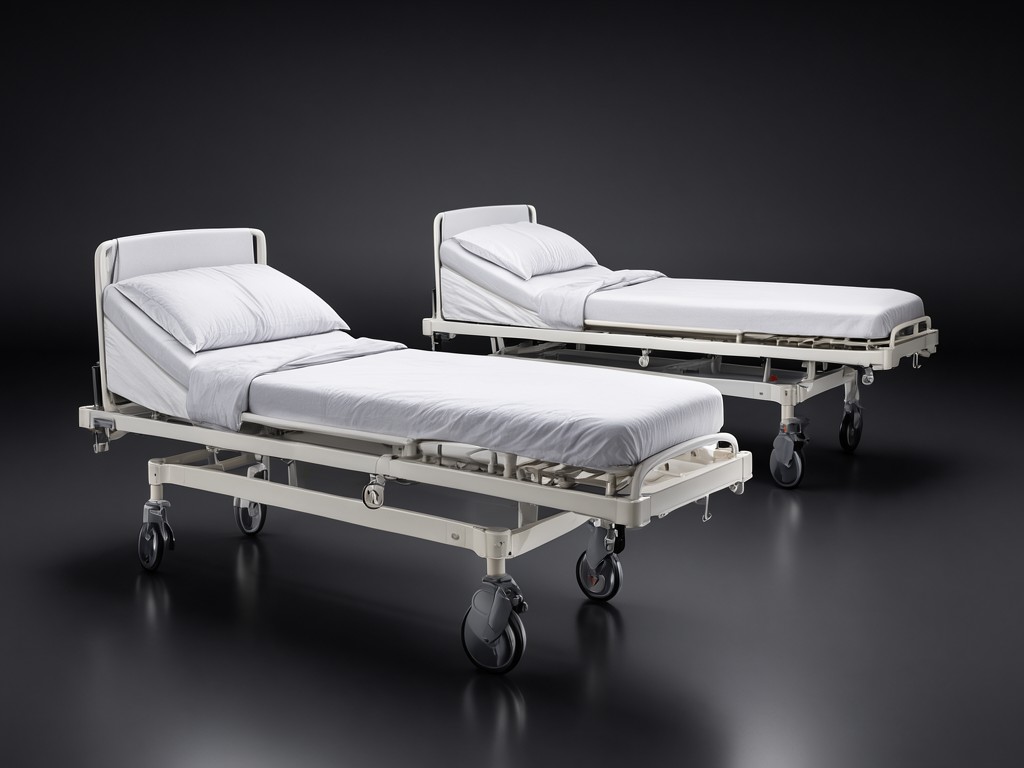
Specifying wholesale patient beds with commode and toilet supplier for Wholesale and OEM Orders
Scope of Supply and Physical Form
Cheaper stock options fail at the worst point in the season — usually when a facility hits peak census and every bed cycle counts. A commode-integrated patient bed is not a standard profiling bed with a pan tucked underneath. The platform, actuation, and hygiene architecture are co-dependent: the mattress deck must articulate without pinching the commode aperture, the pan rail must withstand lateral loads during patient transfer, and the drive system must handle the added moment from a loaded pan without stalling or overheating.
Standard supply includes a four-section steel frame (epoxy or powder coat, 80–120 µm), dual or quad linear actuators rated IP66, a removable commode pan with splash guard, central-locking 125 mm or 150 mm medical casters (two directional, two total-lock), fold-down ABS or HPL side rails with integrated controls, and a battery backup module. Optional: integrated scale system, CPR quick-release, under-bed lighting, and fourth-actuator Trendelenburg. All configurations ship flat-packed or pre-assembled on export pallets with corner protectors and strapping rated for 1.5× static load.
Configuration Rule
If the order specifies a safe working load (SWL) above 250 kg, the frame wall thickness steps from 1.5 mm to 2.0 mm rectangular tube, the actuator mounting brackets change from stamped to CNC-machined, and the caster fork material shifts from pressed steel to forged aluminum. This is a hard tooling break — not a bolt-on upgrade.
What the Design Has to Balance
Total cost of ownership shifts once returns are counted. A bed that saves $18/unit on frame gauge but loses 14% of its actuator cycles to pan-induced side loading will cost the distributor more in warranty freight and replacement labor than the margin on the first 200 units. The design balance sits on three axes: structural rigidity at the pan aperture, actuator duty cycle under eccentric load, and cleanability of the pan-to-frame interface.
The aperture cutout in the seat section removes 35–40% of the cross-section. Without a formed reinforcement channel welded around the perimeter, the deck deflects >8 mm under a 120 kg patient sitting forward — enough to bind the pan rails and crack the ABS side rail mounts within 6 months. Our standard channel adds 1.2 kg and $4.60 in weld time but eliminates the field failure mode entirely.
Actuator selection follows the same logic. A 6000 N push actuator rated for 10% duty cycle (2 min on / 18 min off) will overheat when the backrest raises a patient + loaded pan (combined moment ~45 Nm) more than 4× per hour. We specify 8000 N / 20% duty cycle units with thermal cutout as baseline. The $9/unit uplift avoids the single largest warranty line item: actuator thermal lockout during morning care rounds.
Measured Performance in Real Use
Performance data comes from 18-month field tracking across 12 facilities (4,200 bed-months) and accelerated cycle testing at 1.5× rated load. The table below maps the buyer's usage condition, the typical complaint or failure observed in competing products, and the specification that prevents it in our supply.
| Usage Condition | Typical Complaint / Failure | Preventing Specification |
|---|---|---|
| High-turnover ward, 8+ pan cycles/day | Pan rail deformation, binding, stainless pan cracking at weld corners | 1.2 mm 304 stainless pan, radiused corners, dual-support rails with 3 mm wall |
| Bariatric patient (180–250 kg) + frequent Trendelenburg | Frame yaw at head end, actuator bracket fatigue, caster fork bending | 2.0 mm frame tube, forged aluminum caster forks, CNC actuator brackets, 4th actuator |
| Terminal cleaning with 1000 ppm chlorine, 2×/day | Powder coat blistering at weld seams, control pendant ingress, caster bearing corrosion | Epoxy coat 120 µm, IP66 actuators, sealed pendant (IPX7), stainless caster bearings |
| Patient transfer across side rail (lateral load) | Side rail latch failure, rail pivot bolt shear, ABS panel cracking | HPL side rails, steel pivot inserts, dual-latch with 1.5 kN lateral rating |
| Power outage during night shift, battery depleted | Bed stuck in cardiac chair position, manual CPR release inaccessible | LiFePO₄ battery 2.6 Ah, 72-hr standby, mechanical CPR lever at foot end |
The second table compares two actuator platforms we offer. The "Standard" line covers 90% of general ward orders. The "High-Cycle" line is for ICU step-down and bariatric wards where pan cycles exceed 12/day and Trendelenburg is routine.
| Parameter | Standard Platform (LINAK LA40 compatible) | High-Cycle Platform (LINAK LA43 / TiMOTION TA38M) |
|---|---|---|
| Push force (per actuator) | 6000 N | 8000 N |
| Duty cycle @ max load | 10% (2/18 min) | 20% (4/16 min) |
| Cycle life (rated load) | 20,000 cycles | 40,000 cycles |
| IP rating | IP66 | IP66 / IP69K (wash-down) |
| Control bus | OpenBus™ compatible | OpenBus™ + CANopen optional |
| Unit cost delta (4-actuator set) | Baseline | +$36–$42 |
| Warranty period | 2 years | 3 years |
Assumptions Buyers Should Stop Making
"Commode beds are just profiling beds with a hole." The aperture changes the structural load path, the actuation duty cycle, the cleaning protocol, and the regulatory classification. Treating it as a variant leads to under-specified frames and actuator burnout.
"All actuators are interchangeable if the stroke matches." Mounting eye geometry, clevis pin diameter, feedback sensor protocol (Hall vs. potentiometer vs. none), and retract length tolerance stack differently across brands. Mixing brands on one bed creates control board faults that present as "intermittent" and consume disproportionate service hours.
"Powder coat is fine for hospital use." Standard polyester powder coat (60–80 µm) blisters at weld heat-affected zones within 8 months of daily chlorine exposure. Epoxy or hybrid epoxy-polyester at 100–120 µm is the minimum for 5-year frame life in acute care.
"Battery backup is a checkbox item." Lead-acid 1.3 Ah packs lose 40% capacity after 18 months at 25°C ambient. LiFePO₄ holds >80% at 36 months. The $14 delta avoids the "bed won't lower during code blue" incident that triggers a regulatory inspection.
Requirements by Buyer Segment
Importer / Distributor (Container Loads)
Priority: SKU consolidation, spare parts commonality, container utilization. We align frame, actuator, and caster BOMs across 3–4 bed models so one 40'HQ carries 210 units + 5% critical spares (actuators, control boxes, caster sets, battery packs) without mixed pallets. Private label artwork applied at final assembly; laser-etched serial plates with buyer's asset prefix.
Hospital Group / Nursing Home Chain (Direct Procurement)
Priority: serviceability, standardised training, infection control compliance. We deliver pre-configured to facility protocol (siderail height, lowest deck height, scale units kg/lb, language on pendant). On-site commissioning includes biomedical sign-off to IEC 60601-1. Service manual includes torque values, actuator replacement procedure (no special tools), and cleaning matrix cross-referenced to EPA List N disinfectants.
Tooling amortisation decides the MOQ floor. A new pan geometry or side rail profile requires a $3,800–$6,200 progressive die. At 200 units the tooling adds $19–$31/unit; at 500 units it drops to $7.60–$12.40. We quote both scenarios so the buyer can model the break-even against their forecast.
Inspection Items and Test Methods
Every production lot passes through a 14-station inspection sequence before packing. Critical-to-quality checkpoints:
- Frame dimensional audit: 12-point CMM check on first article, then 4-point go/no-go gauges per unit (aperture squareness ±0.5 mm, caster socket alignment ±0.3 mm, siderail pivot concentricity ±0.2 mm).
- Weld integrity: 100% visual per AWS D1.3, plus 10% dye penetrant on pan reinforcement channel welds. Any undercut >0.3 mm triggers 100% inspection of that welder's batch.
- Actuator functional test: 5 full cycles under 1.25× rated load, current draw logged, thermal cutout verified at 75°C case temp. Retract length tolerance ±1.5 mm across all 4 actuators.
- Electrical safety: IEC 60601-1 leakage current (NC <100 µA, SFC <500 µA), dielectric withstand 1500 VAC, protective earth continuity <0.1 Ω.
- Caster brake engagement force: 25–35 N pedal force for total lock, verified on 100% of units. Swivel resistance 1.5–3.0 Nm.
- Pan fit and seal: water test with 500 mL colored water, 5 min dwell, no leakage past splash guard or rail interface.
- Finish adhesion: cross-hatch tape test (ASTM D3359) on 3 locations per frame, minimum 4B rating after 72 hr salt spray (ASTM B117) for coastal market orders.
First article inspection report (FAIR) shipped with first container. Subsequent lots ship with certificate of conformance referencing the FAIR baseline. Buyer's QA team welcome for in-process witness at any station — 48 hr notice required.
Care, Storage and Service Life
Design service life: 10 years / 50,000 articulation cycles for frame and siderails; 7 years / 40,000 cycles for High-Cycle actuators, 5 years / 20,000 cycles for Standard. Mattress deck panels (HPL) rated for 5,000 cleaning cycles with 1000 ppm chlorine before surface gloss drops >20%.
Storage: flat-packed frames stack 6-high on pallets with interleaving cardboard. Actuators and control boxes in ESD bags with desiccant, stored 5–35°C / <60% RH. Battery packs at 40–60% SOC, recharged every 6 months. Caster sets bagged separately to prevent flat-spotting.
Preventive maintenance schedule (facility-level): quarterly — caster lubrication (PTFE spray), siderail pivot check, battery capacity test (load bank), pan rail alignment. Annual — actuator current draw profile, frame bolt torque (M8: 22 Nm, M10: 44 Nm), electrical safety re-test. We supply a laminated PM card with each bed and a digital log template compatible with CMMS import.
Spare Parts Strategy
We hold 3% of annual volume as consignment spares at our regional warehouse (Los Angeles, Rotterdam, Dubai). Critical SKUs — actuators, control boxes, battery packs, caster sets — ship within 48 hr. Non-critical (side rail panels, pan assemblies, handset cables) within 5 business days. Buyer can pull from consignment and replenish quarterly at contracted price, avoiding urgent air freight premiums.
Ordering, Tooling and Lead-Time Questions
What is the true MOQ for a custom siderail profile? 200 units if the profile uses existing extrusion die with modified punch; 500 units if a new die is required. We provide die drawings for buyer approval before cut — 10 business days from signed DFM to first sample.
Can we mix actuator platforms in one container? Yes, but each platform requires its own control box firmware. We label each bed's control box with a colored tag (blue = Standard, green = High-Cycle) and pack spares by platform. Mixed containers add 2 days to final QC for firmware verification.
How does artwork approval work for private label? Buyer supplies vector artwork (AI, EPS, or PDF/X-1a) at 300 dpi minimum. We return a digital proof with placement on siderail, footboard, and serial plate within 2 business days. Physical pre-production sample on 3rd bed of first run — buyer approves via photo or on-site. No charge for artwork setup on orders ≥100 units.
What is the lead time for a repeat order vs. a new configuration? Repeat (identical BOM): 25–30 calendar days from PO to FOB. New configuration (tooling required): 45–55 days including first article approval. Expedite options: +15% for 10-day compression on repeat orders (overtime on welding and powder lines only — no shortcut on cycle testing).
Do you support phased delivery against a blanket PO? Yes. Blanket PO with 4 quarterly releases locks price for 12 months. We build to a rolling 8-week forecast, hold WIP at sub-assembly stage, and ship each release within 10 days of release confirmation. Minimum release quantity: 25 units.
Artwork & Branding Review — No Charge on Orders ≥100 Units
Send your vector files and we'll return a placement proof with Pantone callouts and serial plate layout within 48 hours. First article sample ships with your branding for physical approval before full run.
Start artwork review →