Specifying Wholesale hospital recliner chair bed for patient Exporter for Wholesale and OEM Orders
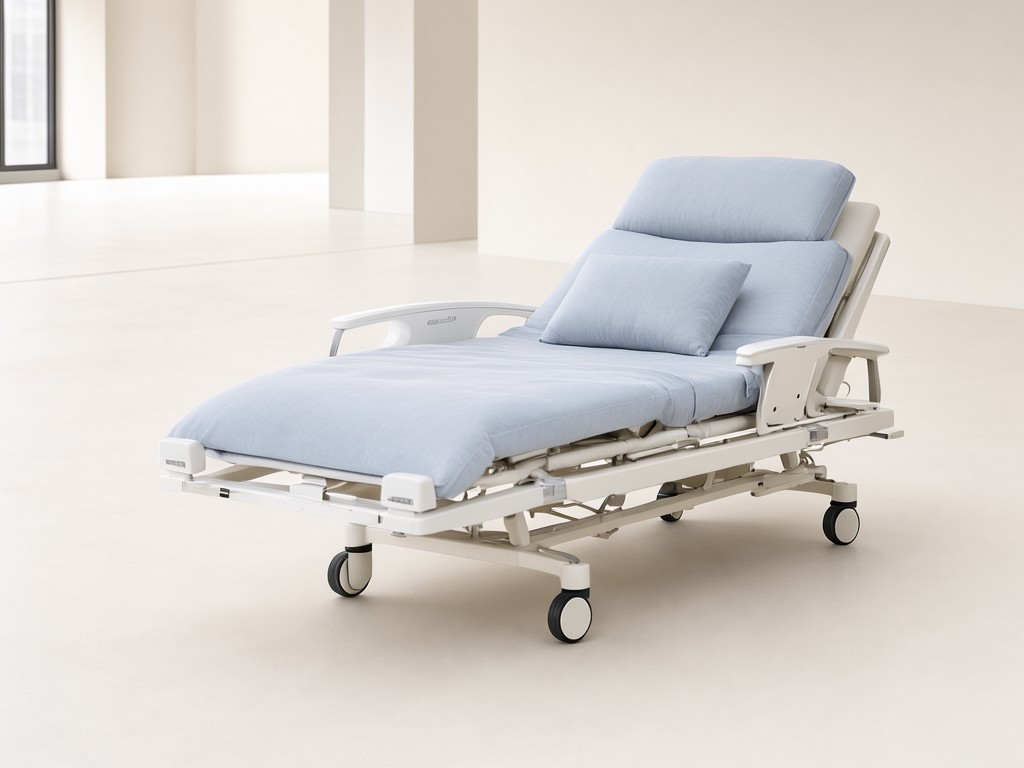
The interface between parts determines the service life of a hospital recliner chair bed. A rigid frame, a reliable recline mechanism, and a cleanable upholstery must all survive daily cleaning cycles, patient weight shifts, and frequent repositioning without developing play or noise.
Scope of Supply and Physical Form
- Frame: powder‑coated steel tube, 30 mm × 1.5 mm wall, welded and stress‑relieved
- Recline mechanism: gas‑spring assisted, 0‑180° continuous adjustment, rated 150 kg static load
- Upholstery: medical‑grade PVC or polyurethane, 1.2 mm thickness, welded seams
- Castors: 100 mm twin‑wheel, lockable, conductive tread for static control
- Packaging: flat‑packed in reinforced corrugated cartons, each unit shrink‑wrapped, palletised for container loading
Materials and Construction Trade-offs
Consistency depends on the choice of frame alloy and the method of joint preparation. Steel tube offers higher stiffness per kilogram, while aluminum reduces shipping weight but requires thicker walls to meet the same deflection limit.
Critical spec: maximum mid‑span deflection under 120 kg must not exceed 4 mm. This governs tube wall thickness and weld spacing.
Steel tube frame
Yield strength 355 MPa, 30 mm × 1.5 mm tube, 12 kg per unit. Welded joints inspected by ultrasonic test.
Aluminum alloy frame
6061‑T6, 35 mm × 2.0 mm tube, 8 kg per unit. Requires additional gussets to meet deflection target.
How to Choose Before Requesting a Quote
Deflection under load governs the decision between frame materials. If the ward layout demands frequent relocation, the lighter aluminum frame saves handling cost but adds tooling expense for gussets. For fixed‑position bays, steel delivers lower unit cost and simpler QC.
Upholstery selection follows cleaning protocol: PVC tolerates chlorine‑based disinfectants; polyurethane offers softer feel but limits chemical exposure to quaternary ammonium compounds.
Castor lock type must match floor finish: conductive tread for anti‑static vinyl, standard polyurethane for sealed concrete.
Customisation Options and Their Limits
Logo embossing on the headrest is limited to 30 mm × 30 mm due to the gas‑spring clearance zone. Colour matching follows the RAL 9010/9003 palette; custom hues require a minimum 500‑unit run to amortise the pigment batch.
Side‑rail height can be specified in 25 mm increments up to 300 mm; beyond that the recline mechanism interferes with the rail bracket.
Who Uses It and Where It Matters
Acute‑care wards, rehabilitation centres, and long‑term care facilities specify this platform for patients who require frequent position changes. The chair‑bed must endure 12‑hour shift cycles, repeated disinfectant wipe‑downs, and occasional bariatric loads up to 180 kg without frame fatigue.
Mobile clinics value the flat‑pack format; a 40‑ft container holds 120 units, reducing freight cost per bed by roughly 18 % compared with fully assembled shipment.
Working as a Production Partner, Not a Catalogue Supplier
We allocate dedicated fixture sets for each OEM project, enabling first‑article approval within two weeks of tooling release. Design changes after PPAP are accommodated through a change‑order system that tracks revision impact on unit cost and lead time.
Batch traceability is maintained by laser‑etched serial numbers on the frame cross‑member, linked to a digital build sheet accessible via QR code on the carton label.
Quality Control and Batch Consistency
Every production lot passes a three‑stage inspection: incoming material verification, in‑process dimensional audit, and final functional test. The table below maps the clinical setting to the most common field complaint and the specification that prevents it.
| Clinical Setting | Typical Failure | Spec Guard |
|---|---|---|
| ICU / High‑dependency | Gas‑spring drift after 6 months | Spring force tolerance ±5 % at 20 °C, life‑tested 50 k cycles |
| General ward | Upholstery seam delamination | RF‑weld seam strength ≥ 250 N/25 mm, peel test per batch |
| Bariatric unit | Frame permanent set under 180 kg | Mid‑span deflection ≤ 4 mm at 180 kg static load |
Volume Planning and Lead Time
Tooling amortisation drops sharply after 300 units; a 500‑unit order reduces per‑unit frame cost by 12 % and shortens lead time from 8 weeks to 5 weeks because the fixture set runs continuously. Orders below 150 units incur a low‑volume surcharge and a 10‑week lead time due to shared fixture scheduling.
Container loading optimisation (mixed frame material pallets) can add 5 % more units per 40‑ft container, directly lowering landed cost for high‑volume distributors.
Ready to lock in specifications and secure production slots? Request a quotation review and we will return a detailed cost breakdown within two business days.