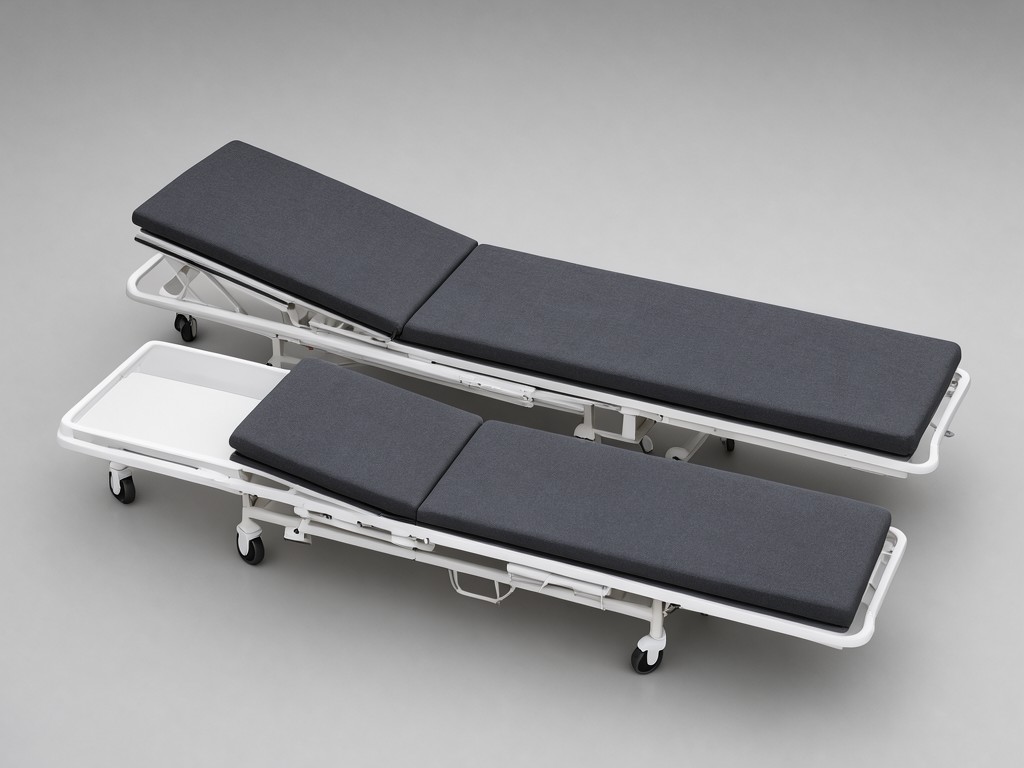
Specifying wholesale five function manual hospital beds with casters supplier for Wholesale and OEM Orders
How It Performs in Use
The five‑function crank system moves the backrest, knee break, overall height, Trendelenburg and reverse Trendelenburg positions through a single‑shaft gear train that delivers a 1:12 mechanical advantage. Under a 250 kg static load the crank torque stays below 3 Nm, so nursing staff can reposition patients without excessive effort.
Caster roll resistance is the next decisive factor. Polyurethane wheels on a sealed ball‑bearing hub keep the push force under 15 N on vinyl flooring, but the same wheels generate 22 N on carpeted corridors. The central brake on Config A locks two wheels simultaneously, while Config B provides independent brakes on all four wheels for tighter maneuvering in narrow bays.
Material Options and Their Trade-offs
Frame and Caster Material Choices
Powder‑coated cold‑rolled steel (2.0 mm wall) gives a smooth surface for silk‑screen branding and resists chipping for up to 500 h of salt‑spray exposure. Galvanised steel (2.5 mm wall) adds a zinc layer that survives 1000 h salt‑spray, essential for coastal hospitals where chlorine‑based cleaners accelerate corrosion. The 125 mm PU caster suits standard 1200 mm door clearances; the 150 mm version clears 30 mm thresholds without wheel bind.
Mattress platform options include welded steel mesh (load rating 300 kg, 12 kg weight) and replaceable hardwood slats (load rating 250 kg, 9 kg weight). Mesh eliminates slat‑creep noise but adds 3 kg per bed; slats simplify on‑site replacement when a single slat fractures.
Comparing Two Standard Configurations
| Parameter | Config A – Powder‑Coated Steel Frame, 125 mm PU Casters | Config B – Galvanised Steel Frame, 150 mm PU Casters |
|---|---|---|
| Static load rating (kg) | 250 | 300 |
| Caster wheel diameter (mm) | 125 | 150 |
| Caster swivel lock type | Central brake on two wheels | Individual brake on all four wheels |
| Frame wall thickness (mm) | 2.0 | 2.5 |
| Weight (kg) | 85 | 98 |
| Typical service interval (cycles) | 12 000 crank cycles | 15 000 crank cycles |
Config A reduces freight volume by 12 % and fits standard pallet dimensions, making it the default for high‑volume distributors. Config B’s higher load rating and individual wheel brakes justify the 13 kg weight penalty when the bed must serve bariatric patients or navigate uneven flooring.
Usage Scenarios and Buyer Segments
Public Hospital Ward
High turnover, frequent cleaning with chlorine‑based agents. Config B’s galvanised frame resists corrosion; 150 mm casters roll over threshold strips without binding.
Private‑Label Distributor
Needs a bed that can be branded with minimal re‑tooling. Config A’s lighter weight reduces freight cost; powder‑coat accepts silk‑screen logos without adhesion issues.
Both segments benefit from the common crank geometry, so a single service manual covers the entire line.
Packing, Marking and Freight Configuration
Export Carton
Each bed shipped in a double‑wall corrugated carton (L 2100 mm × W 1000 mm × H 600 mm). Corner protectors and foam blocks secure the frame; caster wheels locked with zip ties.
Label & Traceability
Barcode label on carton side includes model, batch, manufacture date, and load rating. Inner label on frame repeats batch for warranty claims.
Palletised loads of four cartons (2 × 2) stay within a 1200 mm × 1000 mm footprint, allowing standard 20‑ft container stacking without over‑height surcharge.
Request a Sample
To evaluate the crank feel, caster roll resistance, and frame finish on your line, request a pre‑production sample through our contact form.
Request Sample