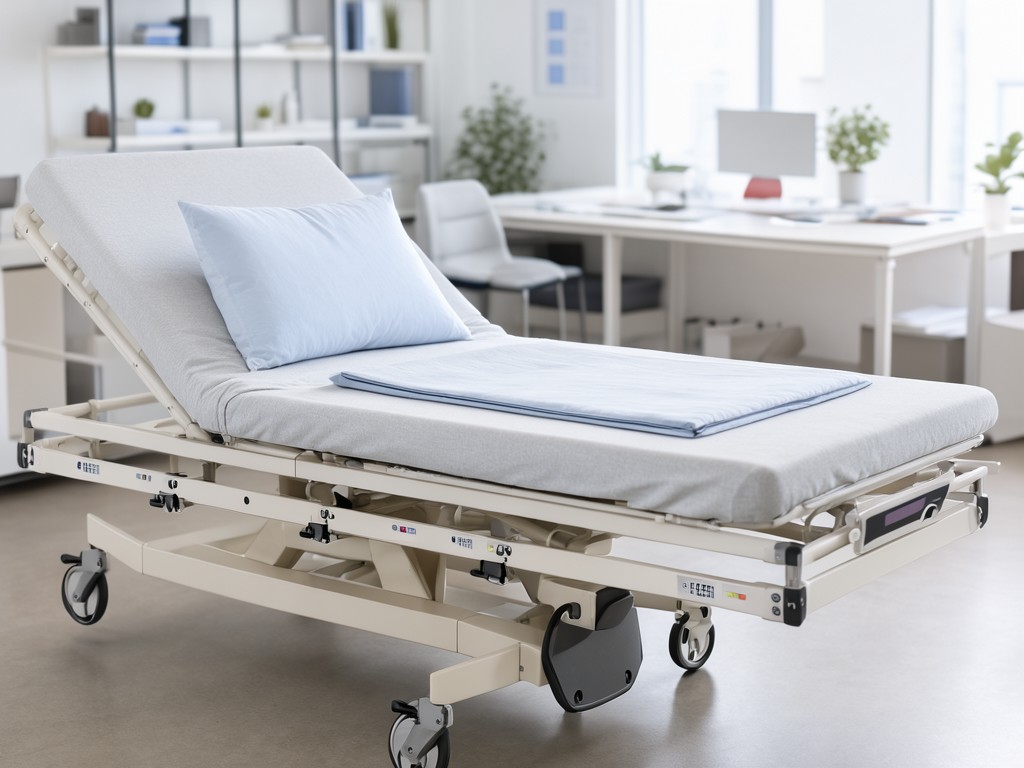
OEM turn over swiveling side rest nursing bed Manufacturer: Specification, Ordering and Quality Notes
What This Product Is and Where It Fits
Deflection under load governs the choice of frame profile for a turn‑over swiveling side‑rest nursing bed. The bed serves acute‑care wards, long‑term facilities, and home‑care programs where patients must be repositioned without caregiver strain. Buyers typically order in container lots of 20‑40 units and expect a service life of 7‑10 years under daily articulation cycles.
The core assembly combines a powder‑coated steel chassis, a dual‑bearing swivel hub, and a gas‑spring assisted turnover mechanism. Side‑rest panels lock at 0°, 45°, and 90° to support lateral transfers. Failure points reported by distributors include bearing seize after 12 months, latch‑pin deformation, and powder‑coat chipping at weld seams.
Material Options and Their Trade-offs
The interface between parts determines whether the bed meets the 250 kg static load rating required by most procurement specs. Two frame alloys dominate: cold‑rolled SPCC steel (1.2 mm wall) and 6063‑T5 aluminum extrusion (2.0 mm wall). Steel adds 8 kg per unit but yields a deflection of 3 mm at full load; aluminum cuts weight by 30 % but deflection rises to 6 mm.
Specification callout: choose steel when floor‑loading limits are tight; choose aluminum when manual handling by a single caregiver is a priority.
Swivel hub bearings are offered in sealed deep‑groove ball (C3 clearance) or tapered roller. Ball bearings cost 15 % less and survive 150 k cycles; rollers survive 300 k cycles but add 0.5 kg and require a 2 mm larger hub bore.
Side‑rest panels use 12 mm high‑pressure laminate (HPL) bonded to a 15 mm plywood core. HPL resists disinfectant wipe‑down (ISO 11925‑2) but can delaminate if edge sealing is omitted. An optional 3 mm polypropylene edge band eliminates that failure mode at a 2 % cost increase.
Matching the Product to the Buyer's Need
Consistency depends on a clear decision tree that aligns configuration with the clinical workflow. The following nested list walks a buyer through the critical choices.
- Define patient weight band – select 150 kg or 250 kg static rating; the higher rating forces steel frame and roller bearings.
- 150 kg → aluminum frame, ball bearings, 0‑90° side‑rest.
- 250 kg → steel frame, roller bearings, 0‑180° side‑rest.
- Choose actuation – manual gas‑spring turnover (no power) or 24 V DC motorised turnover (adds 3 kg, requires bedside outlet).
- Manual → lower BOM, simpler service.
- Motorised → reduces caregiver force by 40 % but adds wiring harness.
- Select side‑rest lock positions – three‑position (0/45/90) or five‑position (0/30/45/60/90). Five‑position adds a secondary latch pin and 10 mm extra panel width.
- Three‑position covers 90 % of transfer protocols.
- Five‑position needed for bariatric lateral slide.
What Can Be Customised and What Cannot
Customisation is limited to items that do not alter the structural certification envelope. The table below summarises the adjustable parameters and the hard limits.
| Parameter | Range / Options | Fixed Constraint |
|---|---|---|
| Frame finish | Powder coat RAL 9016, 7016, 9005; optional antimicrobial additive | Coating thickness 60‑80 µm |
| Side‑rest laminate | HPL 12 mm, colour palette 12 standards; edge band PP 3 mm optional | Core thickness 15 mm plywood |
| Swivel bearing type | Sealed ball (C3) or tapered roller | Hub bore diameter 45 mm (ball) / 47 mm (roller) |
| Turnover actuation | Manual gas‑spring or 24 V DC motor | Stroke 180 mm fixed |
| Mattress platform | Slatted (38 mm spacing) or solid phenolic | Platform size 900 × 2000 mm |
Items not open to change: overall bed footprint (1020 × 2150 mm), maximum articulation angle (180°), and the IEC 60601‑2‑52 test envelope. Any deviation requires a new design review and tooling investment.
OEM and ODM Programme Structure
The OEM route locks the buyer into the standard bill of materials; the factory supplies private‑label cartons, serial‑number laser etching, and a single‑page compliance summary. ODM projects start with a 3‑D concept review, followed by a rapid‑prototype run of 3 units for dimensional verification. Tooling cost for a new side‑rest latch geometry is typically 12 k USD and amortises over 500 units.
Sample approval gate: first article inspection (FAI) report, bearing torque test, and a 48‑hour salt‑spray exposure on coated parts. Buyer signs off before the production release order is cut.
What Gets Checked Before Shipment
Every lot passes a three‑stage gate. Stage 1: dimensional audit of 10 % of frames (laser tracker, ±0.5 mm). Stage 2: functional cycle test – 5 000 swivel rotations and 2 000 turnover strokes at rated load. Stage 3: cosmetic inspection – powder‑coat adhesion (cross‑hatch 5B), laminate edge seal integrity, and label legibility. Defect rate target is <0.5 % per container.
Buyers may request a dedicated QA witness for the FAI; the factory allocates one engineer for the day at no extra charge.
Volume Planning and Lead Time
Standard MOQ is 20 units for steel‑frame configurations and 30 units for aluminum‑frame configurations. Lead time from PO to ex‑works is 45 days for repeat orders; first‑article ODM adds 20 days for tooling validation. Peak‑season (Q4) adds 10 days due to powder‑coat line saturation.
Container loading: 20‑ft holds 12 steel beds or 16 aluminum beds; 40‑ft holds 24 steel or 32 aluminum. Freight cost per unit drops 12 % when a full 40‑ft is booked.
Questions Buyers Ask Before Ordering
- What is the maximum safe working load for the swivel hub under continuous use? The hub is rated for 250 kg static; dynamic testing shows 180 kg at 0.5 Hz for 100 k cycles.
- Can the side‑rest latch be retro‑fitted to an existing fleet? Only if the frame bore matches the 45 mm ball‑bearing spec; otherwise a new hub assembly is required.
- Which disinfectants are compatible with the HPL surface? Quaternary ammonium, hydrogen peroxide ≤ 3 %, and sodium hypochlorite ≤ 0.5 % are approved; phenolics cause surface haze.
- What documentation accompanies each shipment? FAI report, material certificates for steel/aluminum, bearing life test summary, and a packing list with serial numbers.
- Is there a warranty on the turnover gas spring? 24 months or 30 k cycles, whichever occurs first; replacement springs are stocked for 5 years.
Request a Sample or Technical Pack
To evaluate fit for your program, request a pre‑production sample or the full technical data pack through the contact form.
Submit a sample request