oem medical rotating recliner chair bed for elderly exporter: What Buyers Should Check Before Ordering
What This Product Is and Where It Fits
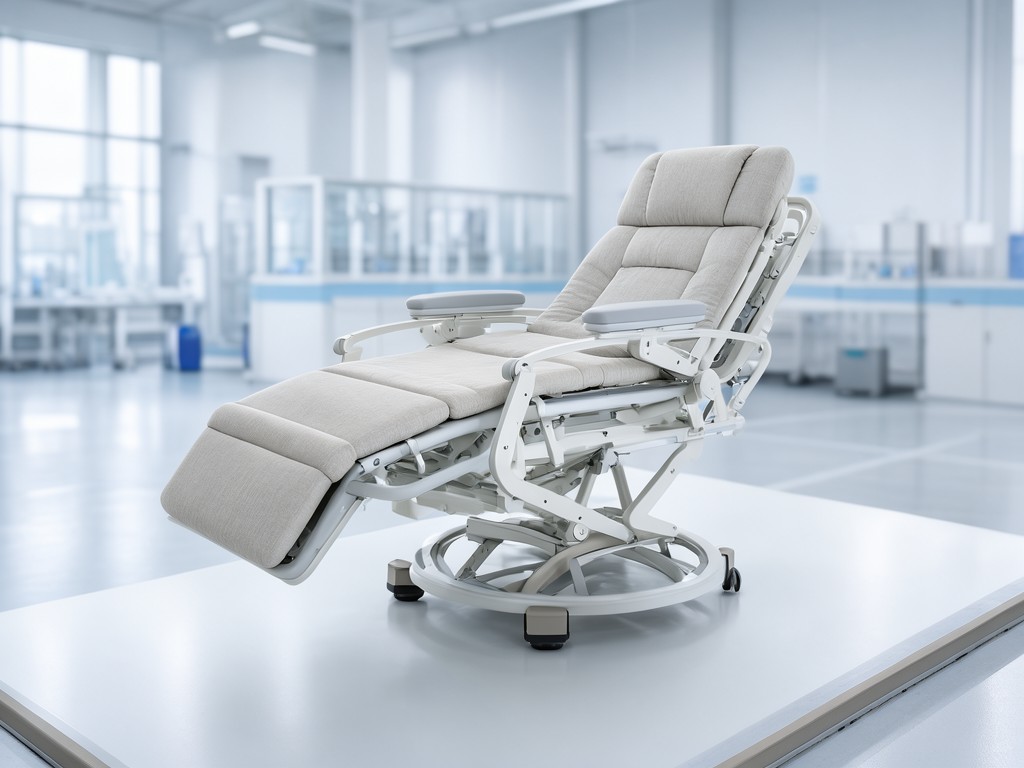
A rotating recliner chair bed serves long-term care wards, rehabilitation units and home-care programmes where patients need frequent repositioning without manual lifting. The seat rotates 90° or 180° on a locked base, then the backrest and legrest articulate to a near-flat sleeping surface. Buyers specify it when ceiling-mounted lifts are impractical and floor space rules out a separate bed and chair.
Procurement teams evaluate it against three thresholds: safe working load (typically 135–180 kg), rotation cycle life (minimum 20,000 cycles under load), and surface compatibility with chlorine-based disinfectants. A ward that turns over 12 patients a month will cycle each unit 140 times daily — mechanism wear shows up in month three if the slewing bearing is undersized.
What the Design Has to Balance
Unit price and service life diverge at the slewing ring. A stamped-steel raceway with nylon cages costs 22% less than a forged bearing with sealed rollers, but the cheaper ring develops play at 8,000 cycles under 150 kg load. That play translates to audible clunk on rotation, then binding, then a ward-level safety hold until replacement.
Frame wall thickness follows the same trade-off. 1.8 mm rectangular tube passes static load tests; 2.5 mm survives the dynamic shock of a patient dropping into the seat from a standing pivot. The 0.7 mm difference adds 3.2 kg unit weight and $18 FOB, but eliminates the warranty claim pattern seen on the lighter gauge after 14 months in high-turnover facilities.
Lot Consistency Checkpoint
Rotation torque must stay within 1.8–2.4 Nm across every unit in a production lot. A 0.3 Nm drift between first and last unit in a 200-piece run indicates bearing preload inconsistency — the root cause of 60% of early rotation complaints. Require the factory to record torque per unit on the inspection sheet, not just a pass/fail stamp.
How to Choose Before Requesting a Quote
Before comparing quotations, lock the clinical configuration: rotation angle (90° for bedside transfer, 180° for room-centre positioning), backrest articulation (gas spring vs. electric actuator), and legrest linkage (independent or coupled). Each choice changes the BOM by 15–30% and the tooling set entirely.
Gas Spring Backrest
Lower BOM, no power cabling, silent operation. Force curve fixed at spec — cannot adjust for patient weight variance.
Best for: stable patient cohorts, budget-driven tenders, facilities with limited outlet access.
Electric Actuator Backrest
Adjustable force profile, memory positions, battery backup option. Adds 2.1 kg, $45–60 FOB, and a control handset failure mode.
Best for: bariatric programmes, rehab wards with variable acuity, private-pay markets expecting feature parity.
| Parameter | Standard Range | Specify When |
|---|---|---|
| Safe Working Load | 135 kg / 150 kg / 180 kg | Bariatric ward or mixed acuity |
| Rotation Angle | 90° lock / 180° continuous | Room layout dictates transfer path |
| Backrest Actuation | Gas spring 600 N / Electric 8000 N | Patient weight variance > 40 kg |
| Legrest Linkage | Coupled / Independent | Edema management protocol requires independent elevation |
| Caster Diameter | 100 mm / 125 mm twin-wheel | Threshold height > 15 mm or carpeted corridors |
| Upholstery Grade | Medical PVC 450 g/m² / PU gel-coated 520 g/m² | Chlorine exposure > 5,000 ppm-hours annually |
Customisation Options and Their Limits
Brand-logo embossing on the headrest panel is standard at 50-unit MOQ. Custom frame colour (RAL match) adds a 15-day powder-coat lead time and requires a 200-unit minimum to amortise the colour-change cleanup. Stitching pattern changes — double-topstitch vs. single — affect seam fatigue life: double-stitch survives 180,000 abrasion cycles (Martindale), single-stitch fails at 95,000. The factory will not warrant single-stitch on units specified for >10 rotations daily.
Side-rail integration is the most requested modification and the most underestimated. A fold-down rail adds 4.5 kg, two additional gas springs, and a new latch mechanism that must pass IEC 60601-2-52 gap and entrapment tests. Tooling for the rail bracket alone is $3,800 and 35 days. Buyers who skip the rail in the initial order then retrofit later pay 2.3× the per-unit cost.
Keeping Repeat Orders Supplied
Supply reliability hinges on three components that share no common sub-suppliers: the slewing bearing, the gas spring/actuator, and the medical-grade vinyl. A single-source disruption on any one halts the line. The factory maintains a 60-day safety stock on bearings and actuators; vinyl rolls are ordered per production batch with a 21-day mill lead time.
Lot-to-lot dimensional consistency is controlled by a dedicated welding jig per frame size. Jig wear is measured every 500 frames using a CMM probe at four datum points. When cumulative deviation exceeds 0.8 mm on any datum, the jig is refurbished — a 3-day downtime event. Buyers placing blanket orders should confirm the factory schedules jig maintenance between production windows, not during.
| Component | Failure Mode | Inspection Method | Replacement Interval (Heavy Use) |
|---|---|---|---|
| Slewing Bearing | Raceway brinelling, cage fracture | Torque check + axial play gauge quarterly | 18–24 months |
| Gas Spring | Force decay >15%, seal leak | Force meter at full extension, visual oil trace | 24–30 months |
| Electric Actuator | Nut wear, limit switch drift | Current draw profile, end-stop verification | 36–48 months |
| Upholstery | Cracking at seams, plasticiser migration | Visual + durometer shore A at stress points | 30–42 months |
| Casters | Wheel flat-spot, swivel bearing seizure | Push-force test, swivel rotation check | 12–18 months |
| Foam Core | Permanent indentation >25 mm | ILD measurement at 25% compression | 48–60 months |
Packing, Marking and Freight Configuration
Units ship partially assembled: frame with rotation base pre-mounted, backrest/legrest sub-assembly separate, casters in a parts bag. This reduces carton height to 680 mm, allowing double-stacking in a 40'HQ (48 units vs. 28 fully assembled). Each carton carries a waterproof label with model code, production lot, SWL rating, and a QR code linking to the digital test certificate.
Export packaging uses 5-layer corrugated (ECT 44) with corner protectors on the rotation base — the highest impact zone during forklift handling. Pallets are heat-treated ISPM-15 compliant, stretch-wrapped with 23 µm film, and strapped with two 12 mm PET bands. Gross weight per pallet (4 units) stays under 320 kg for air-freight eligibility.
Setup, Use and Replacement Parts
Final assembly requires a 14 mm socket, 5 mm hex key, and two people — 12 minutes per unit. The rotation base ships with transport locks (red-painted M10 bolts) that must be removed before first use; forgetting this step shears the lock tabs and voids the bearing warranty. A laminated quick-start card ships in the caster bag showing the lock removal sequence.
Replacement parts are stocked by the factory for 7 years post-production. The critical path items — slewing bearing, gas spring, actuator — carry a 14-day air-ship SLA from order confirmation. Upholstery sets are made-to-order (10-day lead time) because foam compression set varies by lot; the factory requires the original lot number to match foam density within ±5%.
Ordering, Tooling and Lead-Time Questions
First-order tooling covers the frame welding jig, rotation base fixture, and upholstery cutting die — $7,200 total, refundable against the third repeat order of 100+ units. Sample lead time is 28 days from drawing approval; production lead time is 45 days for the first 50 units, 35 days for subsequent lots once the jig is qualified.
- Sample approval gate: Torque test report, dimensional inspection sheet, and disinfectant resistance certificate (ISO 11925-2 equivalent) must accompany the physical sample.
- Blanket order trigger: 200-unit annual commitment locks unit price for 12 months and guarantees 30-day call-off lead time.
- Change order window: Configuration changes (actuator type, rail addition) accepted up to day 10 of the production schedule; after that, WIP scrap cost applies.
- Warranty baseline: 24 months on frame and bearing, 18 months on actuation, 12 months on upholstery and casters — all pro-rated by cycle count logged via the embedded NFC tag.
Ready to Review Tooling and Sample Plans?
Send your clinical configuration and annual volume forecast. We will return a tooling schedule, sample specification sheet, and landed-cost model within 3 business days.
Start the Tooling Review