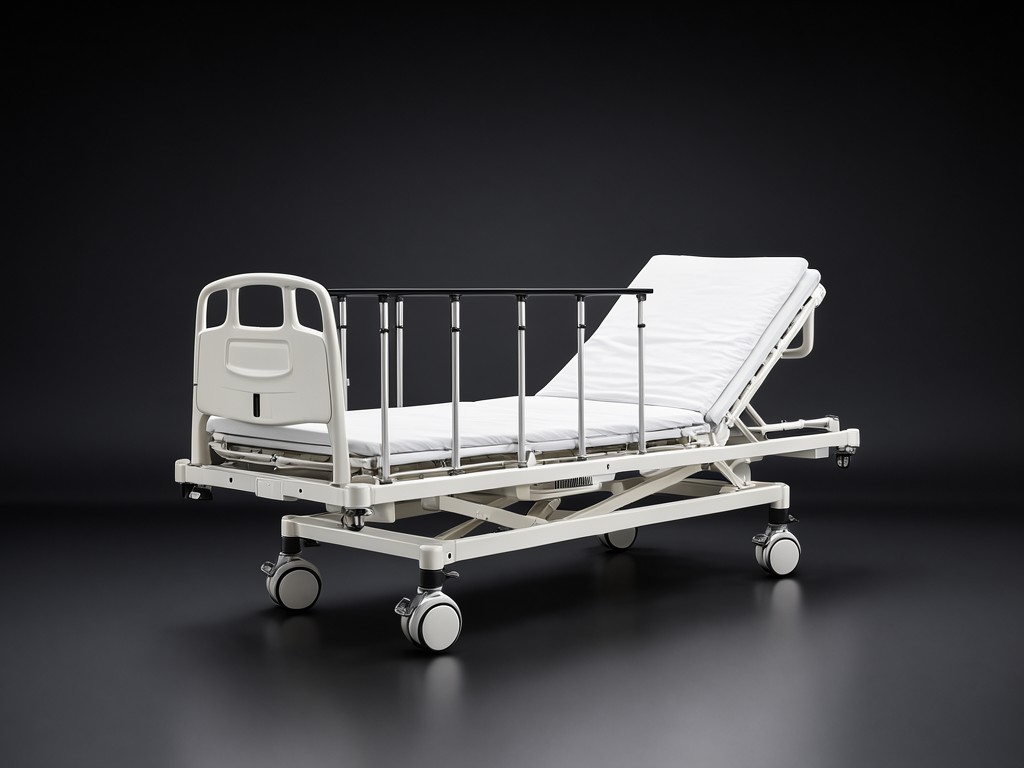
OEM double function manual hospital beds with casters Supplier - Bulk Supply and Specification Guide
Scope of Supply and Physical Form
| Parameter | Standard Range | Customisation Window |
|---|---|---|
| Frame tube | 40 × 40 × 1.5 mm rectangular steel | 30–50 mm square, 1.2–2.0 mm wall |
| Finish | Epoxy powder, 80–100 µm, RAL 9016 | Any RAL, anti-microbial additive optional |
| Crank mechanism | Dual worm-gear, stainless output shafts | Rack-and-pinion on request |
| Caster set | 4 × 125 mm, central brake, two directional | 100–150 mm, individual or central, conductive tread |
| Platform sections | Four-section: back, seat, thigh, foot | Two-section or five-section available |
| Safe working load | 210 kg (patient + mattress + accessories) | 180–250 kg by tube gauge |
| Backrest angle | 0–75° | 0–80° with gas-spring assist |
| Knee-break angle | 0–40° | 0–45° |
| Overall dimensions | 2150 × 980 × 500 mm (L × W × H to platform) | ±20 mm length, ±10 mm width |
| Side rails | Split ABS, 400 mm high, two-handed release | Full-length steel, 300–500 mm height, colour-matched |
The double-function designation means two independent crank handles at the foot end — one drives the backrest, the other the knee break. Both shafts run in acetyl bushings with a grease reservoir sealed by a nitrile lip seal. Casters mount on M12 × 1.5 threaded stems pressed into the frame legs; the central brake linkage runs through a 6 mm Bowden cable housed in a polypropylene conduit clipped to the frame underside.
The Problem Buyers Keep Paying For
Most quality disputes start with a consistency gap in the crank mechanism. The worm gear meshes with a bronze wheel pressed onto the platform pivot shaft. When the gear blank is hobbed on worn tooling, the lead error accumulates — typically 0.03–0.05 mm over one revolution. That feels smooth on the test bench but after 300–400 cycles the backlash grows to 1.5–2 mm at the handle, and the backrest drifts under patient weight. Nurses report the bed "won't hold position" and the facility logs a warranty claim.
The second complaint that repeats across reorders is caster failure. Standard 125 mm twin-wheel casters with a 32 mm tread width carry roughly 75 kg per wheel at 4 km/h on vinyl flooring. In a 30-bed ward with 12 moves per bed per day, the raceway brinells at 18–24 months. The wheel develops a flat spot, vibration transfers to the IV pole, and the brake cam wears into the housing so the pedal no longer engages. We specify a 38 mm tread, double-ball raceway with a hardened thrust washer, and a polyurethane tread bonded to a nylon core — adds €3.20 per caster but pushes MTBF past 5 years.
Specification rule: if the tender calls for "central locking casters" without stating tread width or raceway type, the low bidder will supply 32 mm tread, single-ball race casters. Write the 38 mm / double-ball requirement into the technical schedule or the replacement cycle becomes a budget line item.
Third weak point: side-rail latch fatigue. The two-handed release uses a stamped steel cam that rotates in a nylon sleeve. After 1,200–1,500 cycles the cam edge rounds off, the spring preload drops, and the rail can be pulled down with one hand — a fall-risk citation in most jurisdictions. We stamp the cam from 3 mm S355MC, case-harden to 55 HRC, and run the sleeve in a PTFE-impregnated polyamide. Cost delta is €1.80 per rail; the latch passes 10,000 cycles without measurable wear.
Where This Product Beats Standard Alternatives
The comparison below isolates the two configuration choices that drive total cost of ownership: crank transmission type and caster brake architecture.
Worm-gear crank (standard)
- Self-locking under load — no drift when crank released
- 12:1 ratio, 45 Nm input torque at 210 kg SWL
- Bronze wheel replaceable without removing platform
- Adds 1.8 kg per bed vs. rack-and-pinion
Rack-and-pinion crank (option)
- 8:1 ratio, 30 Nm input torque — easier for low-strength staff
- Requires detent pawl to prevent back-drive; pawl spring is a wear item
- Rack teeth exposed to cleaning fluids — corrosion risk if chrome plating < 15 µm
- 1.2 kg lighter, €4.50 lower BOM
Central-brake casters with a single pedal at the foot end are standard. The Bowden cable runs 1.8 m; over that length a 2 mm diameter cable stretches 0.8–1.2 mm under 150 N actuation force. We pre-stretch cables to 80% of yield and fit a turnbuckle adjuster at the pedal bracket. Individual-brake casters eliminate the cable but require staff to reach two pedals — adds 4–6 seconds per move. For high-acuity wards where beds move 15+ times per shift, the time savings justify central brake; for long-term care with 3–4 moves per shift, individual brakes reduce failure modes.
Stock Availability and Reorder Planning
| Usage tier | Typical annual volume | Stocked configurations | Lead time (ex-works) | MOQ for custom colour |
|---|---|---|---|---|
| Tier 1 — Acute / ICU step-down | 200–500 beds/yr | Central brake, worm gear, split ABS rails, 125 mm conductive casters | 10–15 working days | 10 units |
| Tier 2 — General ward / rehabilitation | 500–1,200 beds/yr | Central brake, worm gear, split ABS rails, 125 mm standard casters | 15–20 working days | 20 units |
| Tier 3 — Long-term care / nursing home | 1,000+ beds/yr | Individual brake, rack-and-pinion, full steel rails, 100 mm casters | 20–25 working days | 50 units |
We hold 120 Tier 1 frames in semi-finished state (welded, shot-blasted, primer-coated) at the Jiangsu facility. Final powder coat, crank fitment, and caster assembly take 3 days per batch of 20. Tier 2 and 3 frames are made-to-order; the 15-day lead assumes RAL 9016 powder in stock. Custom colours add 5 days for powder procurement and a minimum 200 kg batch run — that drives the MOQ column. Blanket orders with quarterly call-offs lock the price for 12 months and guarantee 4-week replenishment on stocked SKUs.
Setup, Use and Replacement Parts
Beds ship knock-down: frame base, four platform sections, two crank assemblies, caster set, side rails, and hardware kit in a single triple-wall carton (1,250 × 650 × 420 mm, 48 kg gross). Two-person assembly takes 18 minutes with a 13 mm socket and 5 mm hex key. Critical torque values: caster stem nuts 35 Nm, crank bracket bolts 18 Nm, side-rail pivot bolts 12 Nm. Over-torquing the caster stems crushes the polypropylene conduit and kinks the brake cable.
Preventive maintenance schedule
- Monthly: wipe crank shafts, apply 2 g NLGI 2 synthetic grease via nipple on each worm housing
- Quarterly: check brake cable free play (target 3–5 mm at pedal), adjust turnbuckle if > 8 mm
- Semi-annually: remove casters, inspect raceway for brinelling, repack with calcium-sulfonate grease
- Annually: load-test backrest and knee break to 110% SWL for 30 seconds, verify no permanent deformation > 2 mm
Spare parts kit (PN: SPK-DB2F-01) covers 50 beds for 24 months: 10 bronze worm wheels, 20 acetyl bushings, 10 nitrile lip seals, 20 caster wheels (PU/nylon), 10 brake cables with turnbuckles, 20 side-rail cam assemblies, 50 M12 flange nuts. Kit weighs 14 kg, fits in a 400 × 300 × 200 mm carton. Individual parts available with 5-day lead; no minimum order.
Questions Buyers Ask Before Ordering
Can the crank handles be mounted on the head end instead of the foot end?
Yes. The worm housings are symmetrical; we rotate the crank brackets 180° and supply longer Bowden cables (2.3 m) for the central brake. Adds €6.80 per bed for cable and conduit. Lead time unchanged.
What is the actual torque required at the handle with a 120 kg patient?
Measured on production units: backrest crank 18–22 Nm, knee-break crank 14–17 Nm. The range reflects grease condition and cable drag. A 95th-percentile female caregiver exerts ~25 Nm peak; both functions stay within single-hand capability.
Are the casters compatible with conductive flooring in operating theatres?
Standard 125 mm casters measure 2.5 × 10⁴ Ω — too high for OR use. Specify the conductive tread option (carbon-black PU, 1 × 10³ Ω) and we fit stainless axles to avoid galvanic corrosion. Adds €4.10 per caster.
How do you handle mattress retainer clips for non-standard mattress widths?
Platform side rails have 8 mm slots on 50 mm centres. We supply adjustable polyamide clips that slide in the slots and clamp mattress edges from 80–110 mm thick. For 70 mm paediatric mattresses, order the narrow clip set (PN: MRC-NAR-01).
What documentation ships with each batch for regulatory filing?
Each pallet includes: Declaration of Conformity (MDR 2017/745 Class I), EN 60601-2-52 test summary, material certificates for frame tube (EN 10219 S355J2H), powder-coat adhesion report (ISO 2409 cross-cut, rating 0), caster load-test certificate (ISO 22878), and a batch traceability sheet linking serial numbers to production date, powder lot, and crank torque verification log.
Request a tooling and sample review
We will send a pre-production sample with full FAI report, crank torque curves, and caster endurance data. You approve the sample, we cut the blanket-order POs.
Start the qualification pack