OEM cold rolled steel hospital bed top factory - Bulk Supply and Specification Guide
How It Performs in Use
| Usage Level | Typical Gauge | Static Load Rating | Articulation Cycles | Coating Spec |
|---|---|---|---|---|
| Standard ward | 1.2–1.5 mm CR4 | 250 kg uniform | 30,000+ | 60–80 µm epoxy-polyester |
| ICU / bariatric | 1.5–2.0 mm CR4 / HSLA | 350–450 kg uniform | 50,000+ | 80–100 µm epoxy + antimicrobial topcoat |
| Emergency / transport | 1.5 mm CR4 with formed ribs | 300 kg dynamic | 40,000+ | 80 µm epoxy, 500 h salt spray |
The complaint that repeats across reorders is coating failure at the articulation pivot holes — not the flat deck. When the bed articulates, the hole edges see cyclic flex and fretting. If the pretreatment misses the hole ID or the coating bridges the edge, rust creeps in within 18 months. We stamp, deburr, and pretreat the holes before the final coat so the film builds on the radius, not the burr.
Flatness tolerance holds at ±1.5 mm over 2 m on the deck. That number matters because mattress manufacturers spec their foam compression curves against a flat reference. A 3 mm bow changes the feel enough to trigger comfort complaints from nursing staff. We hold the tighter tolerance by nesting the formed deck in a fixture during the cure cycle, not by over-engineering the gauge.
Where This Product Beats Standard Alternatives
Most quality disputes start with a consistency gap between the FAI sample and the 500th unit. Job shops that laser-cut and weld sub-assemblies accumulate stack-up tolerance at every joint. Our line runs coil-fed progressive stamping: the perimeter, the rib pattern, the pivot holes, and the mattress retainer slots all hit in one die. That locks the hole-to-hole pitch to ±0.15 mm across the batch.
Progressive Stamp + Inline Weld
Single coil feeds the line. Forming, piercing, and rib drawing happen in sequence. Robotic MIG welds the head/foot end caps in the same cell. No part leaves the cell until CMM checks the critical hole pattern.
- Hole pitch repeatability ±0.15 mm
- Zero secondary fixture welding
- Weld distortion controlled to <0.5 mm
Fabricated Sub-Assembly (Job Shop Route)
Laser-cut blanks, press-brake ribs, manual fixture welding. Each step adds tolerance. Hole patterns drift. Weld heat input varies by operator. Coating must bridge gaps at joint lines.
- Hole pitch typically ±0.5–0.8 mm
- 3–4 separate fixtures minimum
- Weld distortion 1–2 mm common
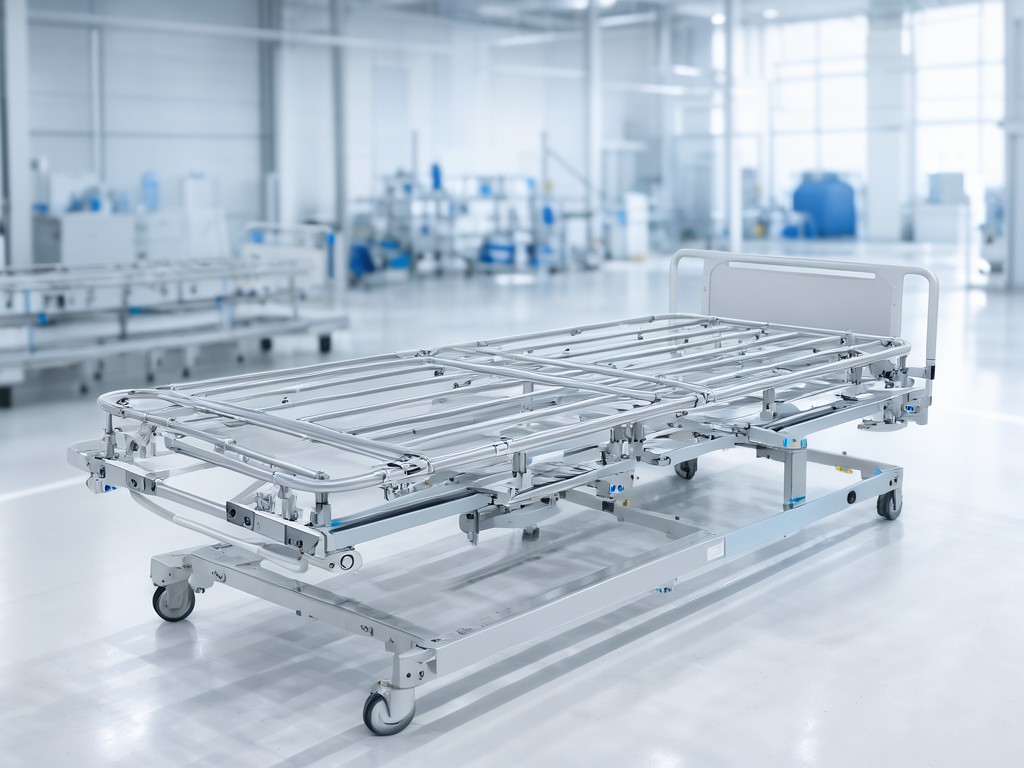
The cost delta is real — progressive tooling runs $45k–$75k depending on rib complexity. But at 2,000 units/year the per-part savings on labor, scrap, and rework pays the tool in 14–18 months. More importantly, the warranty claim rate drops from ~3% to under 0.4% because the failure mode (hole-edge corrosion) is designed out.
Specification Range and Customisation Limits
Deck dimensions are driven by the frame you mate to. We run 880–1050 mm wide × 1900–2100 mm long as standard envelope. Anything outside needs a new blank size and possibly a wider coil, which adds 3–4 weeks to tooling lead time. Gauge selection is the main lever for load rating vs. weight:
- 1.2 mm CR4: 18–20 kg/deck, 250 kg static, standard ward only
- 1.5 mm CR4: 23–25 kg/deck, 300 kg static, ICU standard
- 2.0 mm HSLA 350: 30–32 kg/deck, 450 kg static, bariatric — adds $4–6/deck material cost
Rib pattern is the hidden variable. A 25 mm pitch trapezoidal rib on 1.5 mm gives the same deflection as a plain 2.0 mm sheet but saves 5 kg. We model the rib geometry in FEA for each new frame interface — the tooling insert for the rib pattern is a $2k–$3k change, not a full die rebuild.
Compatibility Warning
If your frame uses welded pivot bosses instead of bolted brackets, the deck hole pattern must match the boss centerlines ±0.2 mm. Send the frame drawing before we cut tooling. A 1 mm mismatch forces oversized holes, which loses the fretting protection at the hole edge and voids the coating warranty on that feature.
Customisation Options and Their Limits
Surface finish is where brand managers differentiate. We offer three coating systems, each with a different cost/service-life trade-off:
- Epoxy-polyester hybrid (60–80 µm): Baseline. 500 h neutral salt spray, passes ISO 15223-1 biocompatibility. $0 premium.
- Pure epoxy (80–100 µm) + silver-ion antimicrobial topcoat (15 µm): ICU standard. 1000 h salt spray, log-4 reduction on S. aureus/E. coli per JIS Z 2801. Adds $3–4/deck.
- Electrophoretic epoxy primer (20 µm) + polyester TGIC topcoat (60 µm): Transport/emergency. Best chip resistance, 750 h salt spray. Adds $2/deck but requires racking fixtures that limit batch density.
Laser etching of logos or QR codes for asset tracking happens after coating, before cure. The mark survives autoclave cycles only on the pure epoxy + antimicrobial system — the hybrid topcoat yellows and the mark fades at 134°C. If you need UDI compliance, specify the epoxy system upfront.
Mattress retainer slots: standard 4 per deck (two head, two foot). Custom slot patterns for proprietary mattress clips add a pierce station in the die. One-time insert cost $1,800, no per-part adder.
Quality Control and Batch Consistency
Wear shows up at the same point every season: the pivot hole edge, the weld toe on the end cap, the mattress retainer slot radius. Our IPQC gates target those three features.
- First-off CMM: 100% critical dimensions (hole pattern, overall L/W, rib height, flatness) on the first 5 pieces per coil lot.
- In-process coating thickness: Eddy current gauge at 4 points per deck (center, two corners, one hole edge) every 50th piece. Target ±10 µm on spec.
- Cross-hatch adhesion (ISO 2409): Every color change and every 500th piece. Minimum 4B rating.
- Salt spray surveillance: 2 decks per month to 1000 h NSS, evaluated per ISO 4628. Blister density <2 (S2), creep from scribe <2 mm.
- Fatigue spot check: 1 deck per 2,000 run to 50,000 articulation cycles on a hydraulic test rig. Zero crack propagation at hole edges or weld toes.
Batch traceability links coil heat number → stamping press shift → weld cell operator → coating booth recipe → cure oven profile. The QR code on the deck edge (if specified) resolves to that chain. When a hospital biomedical engineer calls with a photo of a rust spot, we trace to the exact 50-piece sub-lot in 10 minutes.
Volume Planning and Lead Time
Tooling lead time: 6–8 weeks for progressive die (T0 sampling at week 5). Coil procurement runs parallel — 2 weeks for standard CR4, 4 weeks for HSLA 350. First coated FAI ships at week 8–9.
Production rate: 120–150 decks/shift on the progressive line (including weld and coat). Two-shift capacity ~2,500 decks/week. At 5,000 decks/month we add a weekend coat shift; the bottleneck is cure oven throughput, not stamping.
MOQ per release: 500 decks (one coil minimum). Smaller calls incur a $350 setup charge for coil changeover and coating booth flush. Blanket orders with quarterly releases get price protection and priority coil allocation.
Packaging: decks stack 25 high on steel stillages (returnable) or 15 high in export crates with VCI film. Stillages cut freight damage to near zero and save $1.20/deck on rework — but require a return logistics loop. Most private-label buyers switch to stillages after the second container.
Next Step: Tooling Review
Send the frame drawing (STEP or DXF) with your target load spec, articulation cycle life, and coating requirement. We return a marked-up deck drawing with the rib pattern, hole layout, and gauge recommendation within 3 business days — plus a tooling cost breakdown and FAI timeline.
No charge for the engineering review. If the geometry fits an existing die insert library, we can quote a 4-week T0.
Start the tooling review →