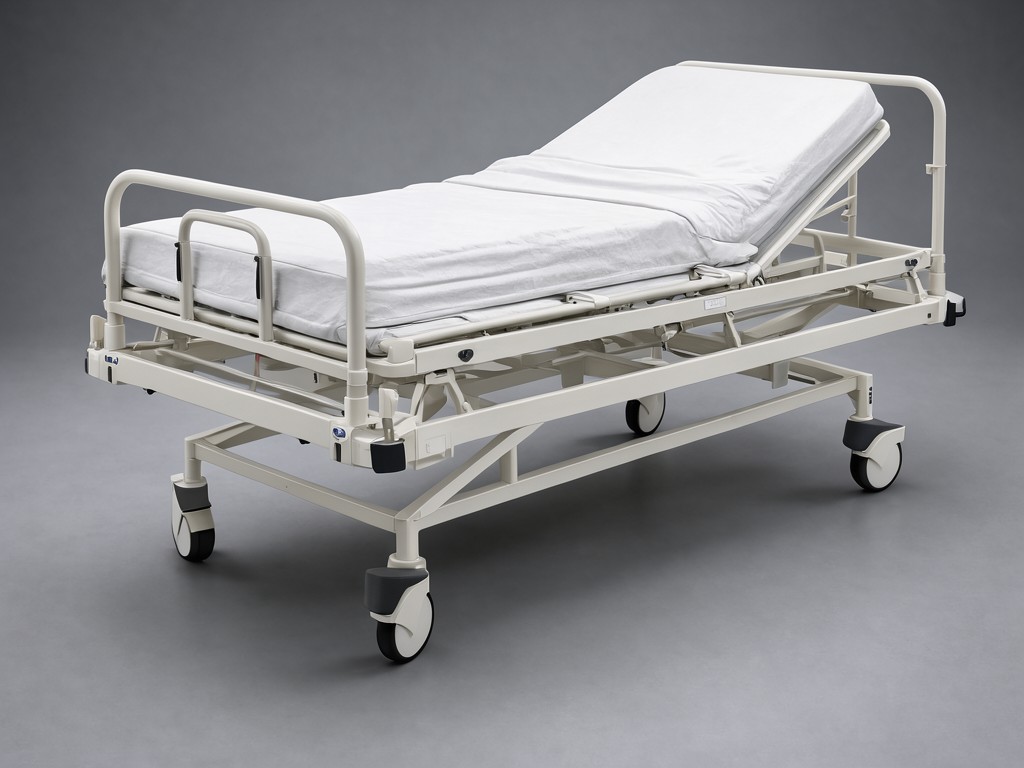
oem 3 function manual hospital beds with wheels and mattress factory: What Buyers Should Check Before Ordering
Repeat loading drives the failure on three-function manual beds long before the rated cycle count. The crank mechanism, the mattress deck linkage, and the caster stem all see eccentric loads every time a caregiver raises the backrest, lifts the knee break, or adjusts overall height. A factory that only validates static load ratings will ship frames that develop play at the riveted joints within six months of ward service.
The limiting factor is rarely the headline specification. It is the tolerance stack between the crank housing bore, the worm gear shaft, and the stamped deck brackets. When those three dimensions drift by 0.15 mm each, the crank torque jumps from 4 Nm to 9 Nm — enough to cause staff injury and trigger warranty returns. Our tooling holds the stack to 0.08 mm total, but only when the order volume justifies the dedicated fixture set.
Scope of Supply and Physical Form
A complete unit ships as a knockdown kit: head/foot board panels, side rail assemblies, crank handle, four 125 mm twin-wheel casters (two braked, two swivel), and a 1900 × 900 × 140 mm high-density foam mattress with welded PVC cover. The frame uses 30 × 50 × 2 mm rectangular tube for the main rails and 25 × 25 × 1.8 mm for the deck lattice. All steel receives epoxy-polyester powder coat, 80–100 µm dry film thickness, salt-spray rated to 500 hours per ASTM B117.
Casters mount via M12 × 1.5 threaded stems into welded nutserts — not press-fit sockets. Press-fit sockets loosen after 3,000 km of corridor transit; nutserts hold torque to 18 Nm indefinitely. The mattress cover carries a 250 g/m² PVC laminate with RF-welded seams; zipper closures are omitted because they clog with disinfectant residue and fail fluid-ingress testing at the head-end corner.
What Actually Determines Performance
Fatigue appears at the stress concentration where the knee-break pivot bracket meets the main rail. Stamped brackets with 3 mm corner radius crack at 18,000 cycles under 135 kg distributed load. CNC-machined brackets with 6 mm radius and shot-peened surfaces pass 50,000 cycles. The cost difference is $4.20 per bed, but the tooling amortisation requires 1,200 units per release. Below that volume, we supply the stamped version and flag the reduced cycle life in the quotation.
Caster swivel resistance must stay below 0.8 Nm after 10,000 rotation cycles on vinyl flooring. We specify double-ball-race bearings with nitrile seals; cheaper single-race bearings seize at 4,000 cycles when floor stripper penetrates the seal lip. The $0.90 per caster premium pays for itself in reduced replacement labour within the first quarter.
Where This Product Beats Standard Alternatives
Competitive three-function beds in the same price band use 1.5 mm deck lattice and 100 mm casters. The thinner lattice deflects 12 mm under 135 kg centre load, creating a hammock effect that increases pressure injury risk. Our 1.8 mm lattice holds deflection to 6 mm. The 125 mm casters reduce push force by 22% on carpet tile and eliminate the "caster flutter" that occurs at 100 mm diameter when crossing elevator thresholds.
The mattress core density is 32 kg/m³ versus the typical 26 kg/m³. Higher density resists bottoming-out at the sacral zone — the primary cause of mattress replacement claims. Cover weld strength tests at 180 N/25 mm; industry minimum is 120 N. This margin survives the sodium hypochlorite wipe-down protocol without delamination.
Assumptions Buyers Should Stop Making
"All manual cranks feel the same." They do not. A 12-tooth worm gear with 2 mm module transmits 30% more torque per turn than a 10-tooth 1.5 mm module, but it requires a larger housing that adds 1.8 kg to the foot-end weight. We offer both; the choice depends on whether the buyer prioritises crank effort or shipping density.
"Powder coat is powder coat." Film thickness below 60 µm chips at the caster stem within 90 days of chemical cleaning. We measure every batch with a magnetic gauge at four points per frame. Batches outside 80–100 µm are re-coated — a step that adds two days to lead time but eliminates the number-one cosmetic complaint.
"Mattress cover material doesn't matter if it passes fluid ingress." PVC plasticiser migration onto sheets creates a sticky surface that increases shear forces on patient skin. Our formulation uses a non-migrating plasticiser system; migration loss is <0.3% after 72 hours at 70°C per ISO 175. Standard covers lose 1.2–1.8%.
What Can Be Customised and What Cannot
Customisation follows a decision tree driven by tooling amortisation and minimum run quantity:
- Frame colour — any RAL from stock powder inventory (minimum 50 units). Non-stock RAL adds $180 setup and 5-day lead extension.
- Head/foot board panel material — ABS (standard), HPL (+$22/unit, MOQ 200), or powder-coated steel (+$15/unit, MOQ 100). HPL resists impact better; steel matches existing fleet aesthetics.
- Caster specification — 125 mm twin-wheel (standard), 150 mm central-locking (+$38/unit, MOQ 300), or 100 mm conductive (-$4/unit, MOQ 500). Central-locking requires redesigned fork geometry; tooling cost $4,200 amortised over first run.
- Mattress cover — welded PVC (standard), polyurethane-coated nylon (+$31/unit, MOQ 150), or antimicrobial PVC (+$9/unit, MOQ 100). PU nylon passes ISO 10993 cytotoxicity; antimicrobial PVC uses silver-ion additive that survives 200 wash cycles.
- Crank handle — folding steel (standard), fold-away composite (+$6/unit, no MOQ), or removable aluminium (+$14/unit, MOQ 200). Composite reduces weight by 0.4 kg; aluminium eliminates entanglement risk in MRI suites.
| Option | Unit Cost Delta | MOQ | Tooling Amortisation | Lead Time Impact |
|---|---|---|---|---|
| Non-stock RAL colour | $0 (setup only) | 50 | $180 one-time | +5 days |
| HPL panels | +$22 | 200 | $0 (stock tooling) | +0 days |
| 150 mm central-locking casters | +$38 | 300 | $4,200 / run | +15 days first run |
| PU nylon cover | +$31 | 150 | $0 (existing die) | +7 days |
| Removable Al crank | +$14 | 200 | $1,800 / run | +10 days first run |
Fixed elements: frame tube gauge, crank gear ratio, mattress core density, deck lattice pitch. Changing these requires new weld fixtures, gear hobbing programmes, and foam mould tooling — minimum 2,500 units to justify.
Requirements by Buyer Segment
Brand Product Manager
Needs consistent crank torque across the SKU range so the IFU torque spec matches every lot. We provide a torque histogram with each shipment — median, 95th percentile, and pass/fail against the 4.5 Nm threshold. Lot traceability links to the gear hobbing batch and the bracket machining cell.
Colour consistency across head boards, side rails, and frame matters for showroom photography. We run all panels for a given order through the same powder booth pass. Mixed-batch orders (e.g., 50 beds now, 50 in six months) get a retained powder sample for touch-up matching.
Importer / Distributor
Container utilisation drives landed cost. A 40-ft high-cube holds 132 knockdown kits with standard casters; 118 kits with 150 mm central-locking casters due to fork height. We provide loading diagrams and strap-point markings on the pallet base. Each pallet carries a QR-coded label linking to the mill certificate, powder batch, and crank torque report.
Warranty administration requires clear failure-mode definitions. We classify claims as: crank mechanism (gear wear, bracket crack), caster (bearing seize, stem loosen), mattress (cover delamination, core compression set >15%), frame (weld crack, coating chip >25 mm²). Each category has a distinct root-cause flowchart and a 15-day replacement SLA for in-stock components.
Call To Action
Send the target annual volume, the required customisation set, and the destination port. We return a costed BOM, a tooling amortisation schedule, and a first-article inspection plan within three business days. Start the quotation review here.