direct factory reclining hospital bed chairs for elderly factory sale: What Buyers Should Check Before Ordering
Design Constraints Behind the Specification
Fatigue appears at the stress concentration where the backrest pivot meets the seat frame. Every recline cycle loads that joint with a moment arm proportional to patient weight plus the cantilever of the legrest. A 135 kg static rating on the datasheet does not guarantee the pivot bushings survive 30,000 cycles at 45° Trendelenburg.
Weight and stiffness trade off against each other in the chassis. Thicker 2.5 mm rectangular tubing adds 4 kg per unit but reduces frame deflection under a 100 kg occupant from 6 mm to under 2 mm. That deflection shows up as audible creak in quiet wards and accelerates bolt loosening on the actuator mounts.
Specification callout: verify the pivot uses sintered bronze bushings with a grease zerk, not press-fit nylon. Nylon cold-flows under sustained load, widening the clearance until the backrest develops 3–4 mm of free play — enough to trigger a service call within 18 months.
How It Performs in Use
Repeat loading drives the failure mode most buyers miss: the gas spring or linear actuator end-fittings. A 6000 N actuator rated for 10,000 cycles at room temperature drops to 6,000 cycles at 40 °C ambient — typical for non-climate-controlled storage. The chair that passes incoming inspection in January may sag by July.
Pressure redistribution depends on the seat deck geometry, not just the foam. A flat plywood deck creates a 45 mmHg peak at the ischial tuberosities within 30 minutes. A profiled deck with 15 mm central relief and 8 mm lateral buildup cuts peak pressure to 28 mmHg, but adds CNC machining cost and reduces stack height for container loading.
Noise profile matters in multi-bed rooms. Actuators above 48 dB(A) at 1 m draw complaints. Dual-motor systems with synchronized control boards run quieter than single-motor linkages because the load splits, but the control board becomes a single point of failure — stock spares accordingly.
Materials and Construction Trade-offs
Powder-Coated Steel Frame
80–100 µm epoxy-polyester coating survives 500 h salt spray per ASTM B117. Chips at caster mounts expose substrate; specify zinc-rich primer underneath for coastal facilities.
Adds 2.5 kg vs. aluminum but costs 40% less per metre. Acceptable for fixed-wing wards; avoid for mobile ICU units where every kilogram reduces patient capacity.
Aluminum 6063-T5 Frame
Anodized 25 µm clear or colour. No red rust, but galvanic corrosion at steel fastener interfaces without isolating washers. 35% lighter, 2.5× material cost.
Preferred for bariatric models where frame weight eats into safe working load. Verify the extrusion wall thickness ≥ 3 mm at pivot bosses; thinner walls ovalize under cyclic moment.
Upholstery selection drives infection-control compliance. Four-way stretch polyurethane (PU) with 300 g/m² backing withstands 10,000 Martindale cycles and 0.5% sodium hypochlorite wipe-down. Vinyl at 550 g/m² lasts longer but traps heat — surface temperature rises 3 °C above ambient after 2 hours of occupancy, increasing shear risk.
Seam construction: high-frequency welded seams eliminate stitch holes but require ±0.5 mm fabric thickness consistency. Stitched seams with sealed tape tolerate ±1 mm variance but add 15 minutes per unit labour. Choose based on your fabric supplier's capability, not marketing claims.
Measured Performance in Real Use
Lot-to-lot consistency determines reorder friction. A 5 mm variance in seat height across production batches forces the facility to recalibrate bedside tables and transfer boards. Our process holds seat height to ±3 mm by fixturing the frame jig to the caster stem centerline, not the floor pads.
Actuator speed drift: first-article test shows 18 mm/s at no load, 14 mm/s at 4000 N. After 5,000 cycles, speed drops to 11 mm/s under load due to brush wear. Specify brushless DC motors if the facility runs > 8 recline cycles per bed per day; the 22% unit cost premium pays back in reduced actuator replacements within 14 months.
Caster swivel force must stay below 12 N for single-hand steering. We test each batch on a calibrated force gauge at 30° caster angle. Batches exceeding 14 N get reworked — new raceway grease and bearing preload adjustment — before release. This gate prevents the "shopping cart drift" complaint that triggers returns.
Specification Range and Customisation Limits
Seat Width
460–610 mm
Seat Depth
480–530 mm
Backrest Angle
0–75°
Trendelenburg
0–12°
Safe Working Load
135–250 kg
Unit Weight
42–58 kg
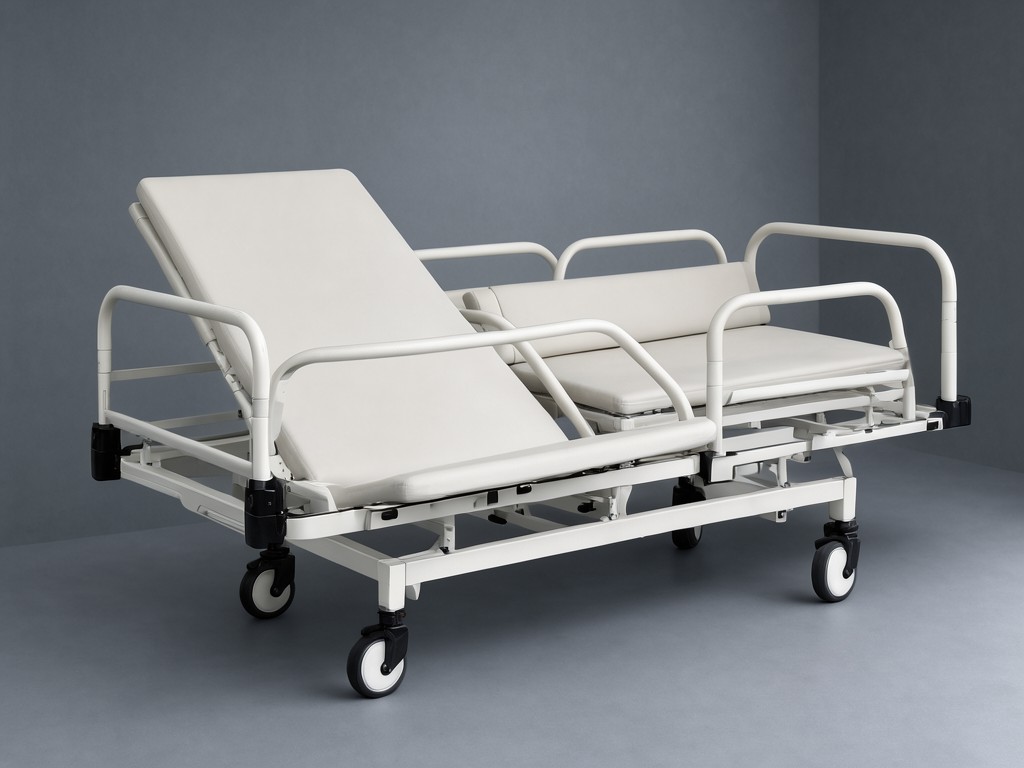
Customisation stops at the chassis. Width and depth adjust via bolt-on seat rails; backrest angle range changes by swapping actuator stroke length (200 mm, 250 mm, 300 mm). Colour, logo embossing, and fabric grade are line-item options. Structural modifications — wider frame, integrated IV pole, scale system — require new tooling and 90-day lead time.
Electrical configuration: 100–240 VAC universal input with IEC 60320 C14 inlet, or 24 VDC battery backup module (2 Ah sealed lead-acid, 48 h standby). North American plugs need UL 60601-1 listing; EU needs EN 60601-1. We ship with the destination-market cord set installed — confirm at order.
Buying Mistakes That Lead to Returns
- Ordering bariatric-rated frames (250 kg) with standard 100 mm casters. The combined load exceeds caster dynamic capacity at 4 km/h impact — caster stems bend. Specify 125 mm dual-wheel casters with precision bearings for any SWL > 180 kg.
- Selecting vinyl upholstery for long-term care without verifying the facility's cleaning protocol. Quaternary ammonium disinfectants plasticize vinyl, causing surface tack and cracking within 6 months. PU withstands quats; vinyl does not.
- Assuming "factory sale" pricing includes bedside cabinet mounting points. The frame has M8 threaded inserts on 32 mm centers only on the bariatric SKU. Standard SKU requires retrofit brackets — 20 minutes labour per bed, not in the quote.
- Skipping the first-article inspection (FAI) on actuator noise. A 3 dB(A) increase over the approved sample means brush misalignment. Catch it at FAI; field replacement requires tilting the bed and removing the seat deck — 45 minutes downtime per unit.
Stock Availability and Reorder Planning
Standard configurations (460 mm width, steel frame, PU upholstery, 135 kg SWL, dual motor) hold 40–60 units in bonded warehouse. These ship within 5 business days of PO receipt. Custom widths, aluminum frames, or vinyl upholstery trigger made-to-order with 25–30 day lead time from material release.
Reorder consistency: we maintain a digital twin of each approved BOM. When you reorder SKU HBC-460-S-PU-DM, the frame jig, fabric roll, and actuator batch are traceable to the original FAI report. Dimensional drift across 12-month reorder cycles stays within ±2 mm on critical interfaces — seat height, backrest pivot center, caster stem location.
Buffer stock recommendation: hold 5% of annual volume as safety stock for actuators and control boards. These are the only components with single-source lead times > 8 weeks. Frame parts, casters, and upholstery kits are multi-sourced at 2-week lead time.
Export Packaging and Handling Protection
| Packaging Element | Specification | Purpose |
|---|---|---|
| Outer carton | 5-ply double-wall corrugated, 450 g/m² burst strength, 1200 × 680 × 1100 mm | Stacks 3-high in 40'HQ without crushing frame rails |
| Internal bracing | EPS corner blocks (40 kg/m³) at four frame nodes; 12 mm polyethylene foam wrap on actuator rod | Prevents pivot bending and rod scoring during forklift handling |
| Moisture barrier | 0.15 mm PE vapor bag + 2 × 50 g silica gel desiccant units per carton | Keeps RH < 60% during 45-day sea transit; prevents surface rust on unpivot pins |
| Labeling | GS1-128 barcode with GTIN, batch, PO, and net/gross weight; "This Side Up" and "Do Not Double Stack" pictograms | Enables warehouse WMS receiving; prevents inverted stacking that bends backrest frame |
| Container loading | 24 units per 40'HQ (3 × 4 × 2 orientation); weight 1,150 kg max per container | Optimizes freight cost per unit; stays under 27 t payload limit |
Each carton includes a pull-out installation sheet with torque values: pivot bolts 25 Nm, caster stems 40 Nm, actuator clevis pins 18 Nm. Missing this sheet is the top cause of field-assembly damage — over-torqued pivot bolts strip the aluminum boss threads.
Next Steps: Artwork and Branding Review
Private-label programmes require artwork approval before fabric cutting. Submit vector logos (AI, EPS, or PDF) with Pantone references. We provide a digital mock-up on the actual upholstery grain within 48 hours. Embroidery on PU requires a stabilizer backing — adds 0.3 mm thickness, factor into seat depth tolerance.
First production run includes a pre-shipment inspection (PSI) to AQL 2.5/4.0 (critical/major/minor). You may appoint a third-party inspector or rely on our internal QC report with photos of pivot clearance, actuator current draw, and fabric tension measurements. Confirm your preference at PO.
Ready to validate your specification? Send the target SKU, annual volume, and destination market to our technical sales team. We return a marked-up BOM with lead times, unit cost at your volume tier, and the FAI checklist your receiving team can use.