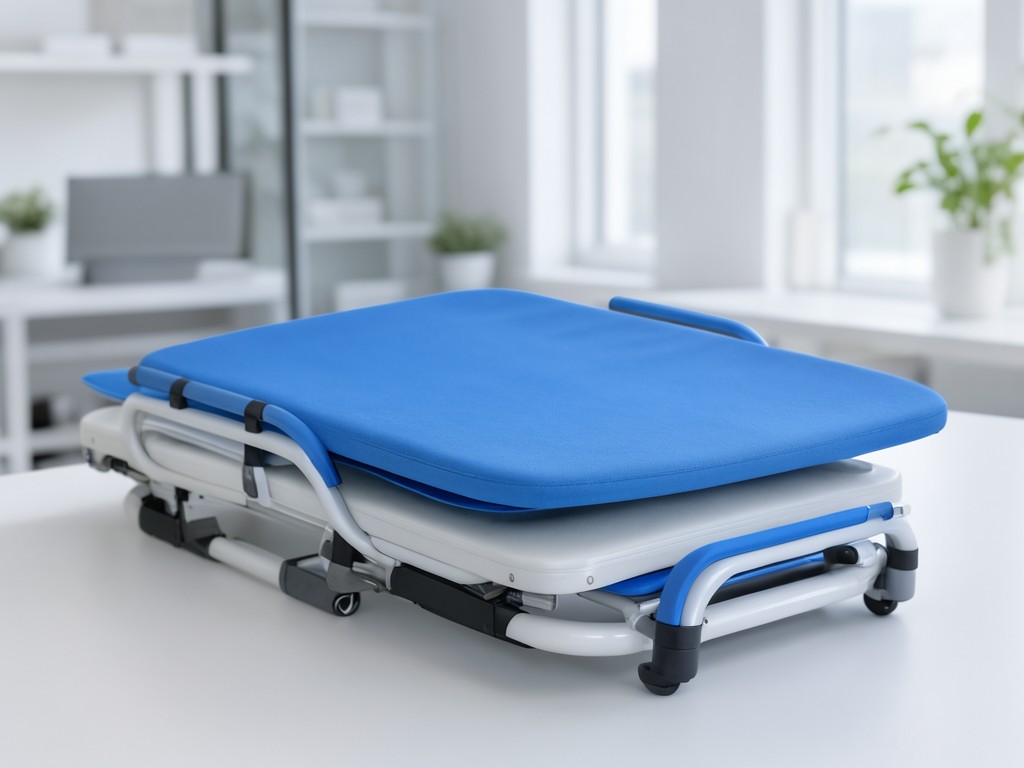
Key Selection Trade-off
Balancing fold mechanism durability with patient comfort: heavier steel frames survive more cycles but increase freight cost and reduce ward maneuverability; lighter aluminum alloys cut weight by 15-20% but require reinforced pivots to maintain 50,000-cycle ratings.
direct factory folding hospital attendant chair beds exporter - Bulk Supply and Specification Guide
Scope of Supply and Physical Form
When a hospital procurement team moves from sample orders to container loads, the first thing that changes is the packaging density. A standard 40-foot high-cube container fits 180 units when the chairs are shipped fully assembled with the backrest folded flat, but that number drops to 140 if the mechanism ships pre-tensioned with the seat cushion attached. The frame folds to a 620 mm × 580 mm × 210 mm envelope, and the mattress — 80 mm high-density foam wrapped in PVC-coated polyester — compresses 30% under vacuum sealing. Buyers who specify loose-packed frames and separate mattress cartons gain 12% more units per container but add a kitting step at the destination warehouse.
Materials and Construction Trade-offs
The frame is offered in two grades: 1.2 mm cold-rolled steel with epoxy-polyester powder coat (RAL 9016) or 6063-T5 aluminum alloy with anodized finish. Steel frames weigh 14.8 kg and pass 80,000 fold cycles in accelerated testing; aluminum frames weigh 11.9 kg but require a 30% thicker pivot wall to reach 50,000 cycles. The seat and back use 35 kg/m³ CMHR foam with a 1.5 mm polyurethane skin — this skin resists alcohol-based cleaners for 200 wipe cycles before showing gloss loss, whereas a 0.8 mm vinyl skin fails at 80 cycles. Caster selection is another lever: 75 mm twin-wheel nylon with precision bearings rolls 40% quieter on vinyl flooring than 50 mm single-wheel polypropylene, but the larger casters add 18 mm to the folded height and 0.6 kg per unit.
| Parameter | Steel Frame (Standard) | Aluminum Frame (Lightweight) |
|---|---|---|
| Frame material | 1.2 mm cold-rolled steel, epoxy-polyester coat | 6063-T5 aluminum, anodized 15 µm |
| Unit weight | 14.8 kg | 11.9 kg |
| Fold cycle rating (accelerated) | 80,000 cycles | 50,000 cycles |
| Static load capacity | 180 kg | 150 kg |
| Caster option (standard) | 75 mm twin-wheel nylon, precision bearing | 75 mm twin-wheel nylon, precision bearing |
| Mattress foam density | 35 kg/m³ CMHR | 35 kg/m³ CMHR |
| Cover material | PVC-coated polyester, 1.5 mm PU skin | PVC-coated polyester, 1.5 mm PU skin |
| Folded dimensions (L×W×H) | 620 × 580 × 210 mm | 620 × 580 × 210 mm |
| Container load (40' HQ, assembled) | 180 units | 180 units |
Buying Mistakes That Lead to Returns
On a club programme that reorders twice a season, the most common return reason is caster failure after six months of daily folding — usually because the procurement spec called for 50 mm polypropylene wheels to save $0.40 per unit, but the facility's epoxy-coated concrete floors generate point loads that crack the wheel hub. Another frequent issue: specifying the aluminum frame for weight savings without confirming the pivot reinforcement addendum; the factory ships the standard pivot wall thickness, and the chairs develop 3-4 mm play at the hinge within 8,000 cycles. A third pattern appears when buyers request custom vinyl colours without providing a Pantone reference and a 50 m minimum roll commitment — the resulting shade drift between batches triggers rejection at goods-in inspection.
Quality Control and Batch Consistency
Every production lot undergoes a three-stage gate. First, incoming steel coil or aluminum extrusion is checked for tensile strength (σb ≥ 370 MPa for steel, ≥ 205 MPa for aluminum) and wall thickness tolerance ±0.05 mm. Second, each assembled frame runs a 200-cycle fold test on a pneumatic rig; torque at the pivot must stay within 2.5-3.2 N·m throughout. Third, a random 5% sample from each batch receives a 24-hour salt spray (ASTM B117) and a 72-hour UV exposure (ISO 4892-2) to verify coating adhesion and foam skin colour fastness (ΔE ≤ 2.0). Mattress foam density is verified by cutting one unit per 50 and weighing the core; covers are pull-tested at 50 N for seam integrity. Records are linked to the container seal number so any field complaint can be traced to a specific production shift.
Questions Buyers Ask Before Ordering
What is the minimum order quantity for custom frame colours? 200 units for powder-coat change; 500 units for anodized aluminium because the anodizing tank requires a minimum batch volume.
Can the mattress cover be swapped for a breathable mesh? Yes, a 3D spacer fabric (180 gsm) is available; it adds 0.3 kg and reduces surface temperature by 2 °C in 22 °C ambient, but the mesh fails the 200-cycle alcohol wipe test — expect replacement every 12 months in high-turnover wards.
How are the chairs protected for sea freight? Each unit is wrapped in 50 µm LDPE film, corner protectors on all four frame edges, and strapped two-high on a fumigated plywood pallet (1100 × 1100 mm). Desiccant sachets (2 × 500 g) are placed inside the pallet hood for voyages exceeding 35 days.
What warranty terms apply to the fold mechanism? 24 months or 30,000 cycles, whichever comes first, provided the chair is used on level indoor surfaces and cleaned only with approved quaternary ammonium solutions. Damage from impact loads (e.g., dropping the chair folded) is excluded.
Lead time from sample approval to first container? 45 days for standard steel frames; 60 days for aluminum frames due to anodizing queue. Custom colours add 15 days for powder-coat curing validation.
Request a Specification Review
Send us your ward layout, expected daily fold cycles, and cleaning protocol. We will return a marked-up spec sheet with frame grade, caster, and packaging recommendations within two business days.
Start Specification Review