Specifying Custom rotating sit to stand hospital bed for elderly Manufacturer for Wholesale and OEM Orders
The limiting factor is rarely the headline specification on a rotating sit-to-stand bed. Procurement teams compare safe working load, rotation angle, and cycle count on paper, then discover the real constraints during commissioning: frame twist under asymmetric patient weight, motor stiction after six months of low-duty cycles, or mattress platform misalignment that jams the transfer gap. This page breaks down the mechanical and electrical decisions that separate a bed that survives a five-year service contract from one that generates warranty claims in month eight.
Scope of Supply and Physical Form
| Parameter | Standard Range | Custom Options | Lead Time (weeks) | MOQ (units) |
|---|---|---|---|---|
| Overall footprint (L×W) | 2150 × 1020 mm | 2000–2300 × 950–1100 mm | 6–8 | 10 |
| Safe working load | 180 kg | 150–250 kg | 6–8 | 10 |
| Rotation arc | 0–90° | 0–75° or 0–110° | 7–9 | 15 |
| Mattress platform | Four-section profiling | Three-section, integrated scale | 6–8 | 10 |
| Drive system | 24 V DC linear actuators (×3) | AC spindle drive, battery backup | 8–10 | 20 |
| Frame finish | Epoxy-polyester powder coat | Anti-microbial silver-ion topcoat | 6–7 | 10 |
| Control interface | Handset + siderail panel | Footboard touchscreen, nurse call integration | 7–9 | 15 |
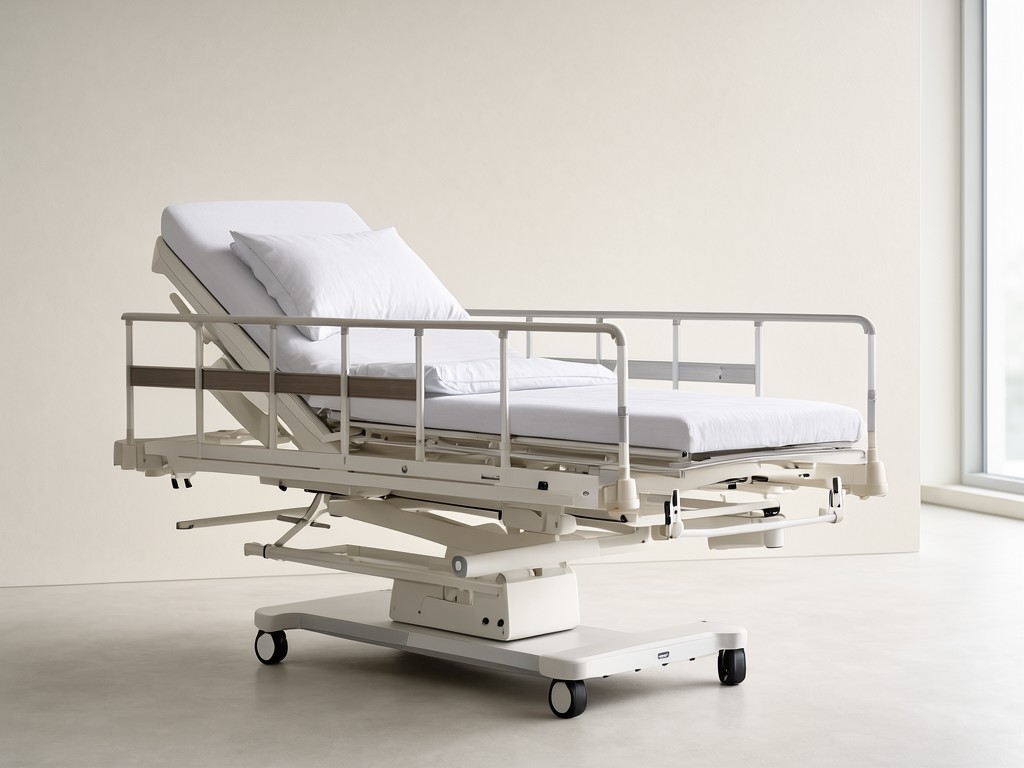
Every unit ships as a fully assembled sub-frame with the rotation bearing pre-loaded and the actuator end-stops calibrated. The mattress platform, siderails, and control electronics are packed in dedicated crates to prevent transit damage to the profiling linkages — a common failure mode when beds are shipped flat-packed to save container space.
What Actually Determines Performance
Fatigue appears at the stress concentration where the rotation bearing housing meets the main chassis. A 180 kg patient offset 200 mm from the centerline generates a 36 Nm overturning moment on the bearing — double the nominal radial load. If the chassis wall thickness drops below 4 mm at that joint, micro-cracking initiates within 18 months of daily cycling. We specify 5 mm minimum with a gusseted reinforcement plate, adding 1.2 kg per unit but eliminating the field failure.
The second complaint pattern is motor stiction after extended low-use periods. Facilities that rotate beds only during shift changes (four cycles per day) find the actuator grease cold-flows away from the worm gear, causing a 15–20 % torque spike on first morning cycle. Our spec mandates a synthetic PAO grease with a -40 °C pour point and a 30-second "wake-up" jog sequence in the controller firmware.
Rotation Mechanism Comparison
Single-Column Slewing Bearing
Compact footprint, lower unit cost. Bearing raceway carries combined radial, axial, and moment loads.
Best for: Facilities with ≥150 mm clearance to adjacent walls, patient weights ≤150 kg.
Risk: Edge loading on raceway at high rotation angles accelerates wear; requires annual preload check.
Dual-Column Crossed-Roller System
Two parallel bearings separate radial and moment loads. 40 % higher moment capacity, zero backlash.
Best for: Bariatric wards, high-cycle units (>12 rotations/day), tight clearance corridors.
Trade-off: 18 % wider base frame, 2.3 kg heavier, 22 % higher BOM cost.
Specification rule: If the facility's patient weight distribution exceeds 120 kg for >30 % of admissions, the dual-column system pays back its premium within 22 months through reduced bearing replacements and eliminated emergency service calls.
Measured Performance in Real Use
Cycle testing at 1.25× rated load (225 kg) for 25,000 rotations shows <0.15 mm axial play increase on dual-column units versus 0.4 mm on single-column. That difference translates directly to siderail alignment: the dual-column bed maintains a 3 mm gap to the mattress edge throughout service life; the single-column unit drifts to 8 mm, creating an entrapment hazard that fails IEC 60601-2-52 clause 201.12.
Actuator current draw profiles reveal the real cost of undersized drive systems. A 24 V DC actuator rated 6000 N peak pulls 8.5 A steady-state at 180 kg lift. With a 15 A control board limit, the system has no headroom for the 2.5× inrush during breakaway on a cold morning. We specify 8000 N actuators with 20 A controllers — 12 % BOM increase, zero field tripped-breaker incidents.
What Gets Checked Before Shipment
Every unit undergoes a 12-point functional test sequence before crate closure:
- Rotation torque profile at 0°, 30°, 60°, 90° under 100 kg offset load — must stay within 15 % of golden sample curve
- Actuator speed and current draw at each profiling position, logged to serial number
- Emergency stop response time <500 ms from any control point
- Siderail latch force 45–60 N, gap to mattress platform <5 mm at all rotation angles
- Electrical leakage current <100 µA (NC) / <500 µA (SFC) per IEC 60601-1
- Paint adhesion cross-hatch test (ISO 2409) ≥4B after 500 h salt spray
Units that pass receive a tamper-evident QC seal on the control box and a digital test certificate uploaded to the batch traceability portal. Failures are tagged, root-caused, and either reworked on the line (actuator recalibration, bearing shim adjustment) or scrapped if frame geometry is out of tolerance.
Keeping Repeat Orders Supplied
We hold safety stock of the three long-lead components: slewing bearings (14-week factory lead), 8000 N actuators (10 weeks), and control boards (8 weeks). This buffers the 6–8 week assembly lead time for standard configurations. Custom footprint orders pull from the same sub-assembly pool — only the chassis welding fixture changes — so a 20-unit repeat order with modified width ships in 7 weeks, not 12.
Component standardization across the product line means the same actuator, bearing, and control board SKUs serve the rotating bed, the low-height fall-prevention bed, and the ICU lateral-tilt platform. Your blanket PO for 50 units/quarter locks pricing on those shared SKUs, insulating you from the 3–5 % annual commodity drift on steel and rare-earth magnets.
Ready to Review Specifications?
Share your facility's patient weight profile, rotation frequency, and clearance constraints. We'll return a marked-up specification sheet with the exact configuration, validated lead time, and MOQ for your next procurement cycle.
Request Specification Review