custom multi-section adjustable nursing care bed with side rails factory: What Buyers Should Check Before Ordering
The Problem Buyers Keep Paying For
| Failure Mode | Typical Root Cause | Cost Impact |
|---|---|---|
| Side rail latch fatigue | Zinc-alloy castings instead of stamped steel; no cycle-life validation | Full rail replacement + labor within 18 months |
| Frame corrosion at welds | Pre-weld phosphating skipped; powder coat <60 µm | Bed condemned at 3-year audit; total loss |
| Actuator drift under load | Undersized DC motor (≤4000 N) on 4-section deck; no duty-cycle derating | Unplanned downtime; patient transfer delays |
| Deck warping | Single-skin blow-molded PP panels; no internal ribbing | Mattress fit failure; pressure injury risk |
The complaint that repeats across reorders isn't about feature lists — it's about the same four failure modes eating warranty budgets and delaying ward handovers. Most quality disputes start with a consistency gap: the sample bed passes inspection, but the production run drifts on coating thickness, latch spring force, or actuator current draw because the factory treats them as assembly variables instead of controlled parameters.
Returns usually trace back to the same weak point: cleaning chemical resistance. Hospital-grade quaternary ammonium and hydrogen peroxide vapor cycles attack powder coat at weld heat-affected zones and degrade ABS side rail housings. If the factory can't show salt-spray ≥500 hours per ISO 9227 and a 30-day chemical immersion log on actual production parts, the bed will fail in service before the invoice is paid.
How It Is Built and What That Changes
Frame construction defines everything downstream. Cold-rolled SPHC steel, 1.5–2.0 mm wall, robot-welded with 100% penetration on load-bearing joints — that's the baseline. Anything less and you're buying frame fatigue measured in months, not years. Post-weld, a zinc-phosphate conversion coat followed by 80–100 µm epoxy-polyester powder coat survives the disinfectant regime; 60 µm does not.
The articulation system splits into two tiers. Entry-tier uses two actuators (back + knee/calf ganged) with 6000 N peak force — adequate for 180 kg safe working load if the duty cycle is capped at 10% (2 min on / 18 min off). Clinical-tier runs four independent actuators (back, thigh, calf, height) at 8000 N each, 20% duty cycle, with Hall-sensor position feedback so the control box knows actual angle, not just runtime. That difference shows up in Trendelenburg smoothness and CPR release speed — both audited during procurement trials.
Entry-Tier Actuation
- 2 actuators (back + combined knee/calf)
- 6000 N peak, 10% duty cycle
- Potentiometer feedback only
- CPR: manual crank, 15–20 sec
- Best for: low-acuity wards, budget tenders
Clinical-Tier Actuation
- 4 independent actuators (back, thigh, calf, height)
- 8000 N peak, 20% duty cycle
- Hall-sensor position feedback
- CPR: single-lever pneumatic, <3 sec
- Best for: ICU, step-down, bariatric-capable
Side rails are where cleaning damage concentrates. Stamped 1.2 mm steel rails with electrophoretic undercoat + powder coat outlast aluminum extrusions with anodizing — the anodize etches under peroxide vapor. Latch mechanism must be stainless 304 spring + POM cam, cycle-tested to 50,000 operations. Plastic housings? Only if they're medical-grade PC/ABS with UL94 V-0 and documented resistance to VHP (vaporized hydrogen peroxide) 250 ppm cycles.
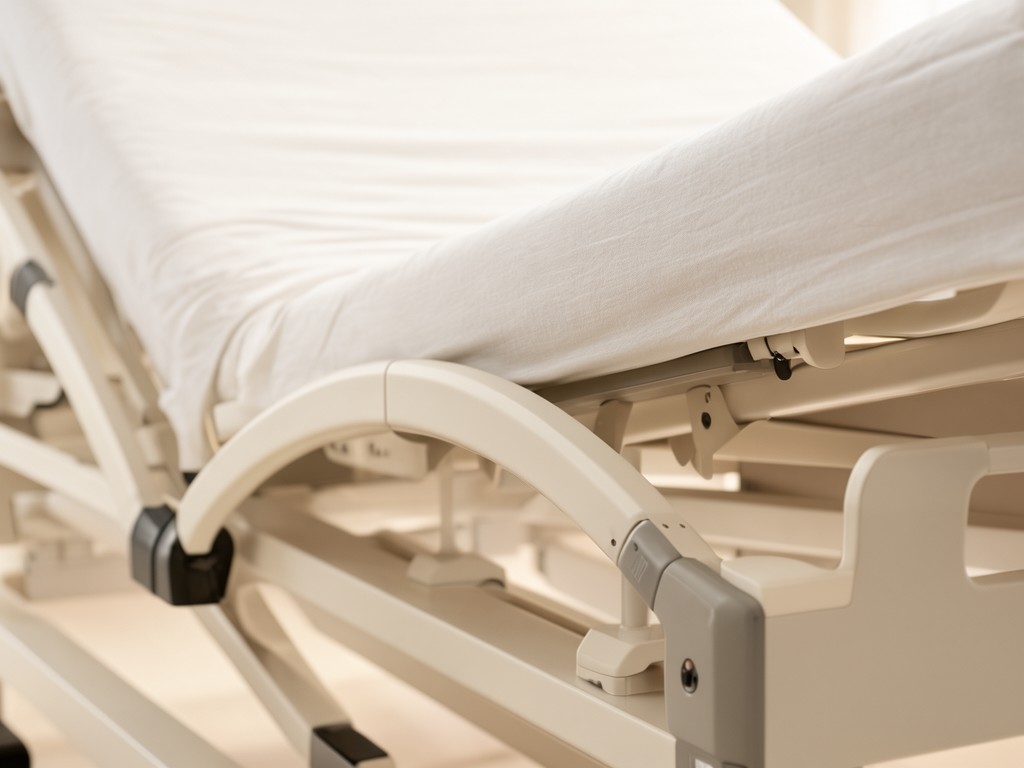
Deck sections: four-piece (back, seat, thigh, calf) with integrated CPR board in the back section. Dual-skin blow-molded PP with internal honeycomb ribs — 3 mm skin, 25 mm core — resists 150 kg point load without permanent deflection. Single-skin decks deflect permanently at 90 kg; we've seen it in returned units.
How to Choose Before Requesting a Quote
Match the bed to the ward's actual workflow, not the tender spec sheet. A geriatric ward with 80% dementia patients needs split side rails (upper fixed, lower drop) with one-hand release — full-length rails become restraint devices. ICU needs four-section articulation with auto-contour (thigh rises as back raises) to prevent shear; that's a firmware feature in the control box, not a mechanical upgrade.
| Ward Type | Articulation | Side Rail Config | Actuator Tier | Mattress Interface |
|---|---|---|---|---|
| General Medical | 3-section (back, knee/calf ganged) | Full-length, two-hand release | Entry (2×6000 N) | Standard foam / hybrid |
| Geriatric / Dementia | 3-section + auto-contour | Split rail, one-hand lower release | Entry (2×6000 N) | Pressure-redistribution foam |
| ICU / Step-Down | 4-section independent + Trendelenburg | Split rail, IV pole integration | Clinical (4×8000 N) | Dynamic air / low-air-loss |
| Bariatric (≤250 kg) | 4-section reinforced, wider deck (105 cm) | Reinforced split, central lock | Clinical + height assist | Bariatric-rated support surface |
Caster selection gets overlooked. Twin 125 mm medical-grade casters (central-lock + directional-lock + free) with sealed precision bearings and polyurethane tread — that's the only spec that survives hospital corridors and elevator thresholds. Single-ball-bearing casters flat-spot in 6 months; the 15 € savings per bed costs 200 € in replacement labor per ward per year.
Customisation Options and Their Limits
Colour: RAL 9016 (traffic white) and RAL 7035 (light grey) are stocked. Custom RAL adds 3 weeks lead time and requires 200-unit MOQ for powder-coat batch consistency. Anything below 200 units gets spray-touch-up — visible at weld seams under fluorescent light.
Scale system: load-cell based (±0.5 kg accuracy) integrates into the control box. Adds 1.2 kg per bed, requires recalibration after every mattress change. Hydraulic scale option exists but drifts ±2 kg over 6 months — not acceptable for fluid-balance monitoring.
Bed-exit alarm: three-zone capacitive sensor mat plugs into nurse-call port. Factory-fitted adds 4 days; retro-fit kit ships loose. False-alarm rate drops from 12% to <2% when the control box firmware includes patient-weight baseline learning (clinical-tier only).
IV pole: two-stage stainless, 4-hook, mounts to head-end frame lugs. Standard. Five-hook or pump-specific brackets are CNC-machined — 50-unit MOQ, 4-week tooling. Under-bed lighting (RGBW, motion-activated) is a 12 VDC strip; draws from control box auxiliary port. Adds 0.3 A standby — check your facility's leakage-current budget.
Customisation Limit Checklist
- Deck width: 90 cm standard, 105 cm bariatric — no intermediate sizes without new frame jig (12-week tooling)
- Height range: 40–80 cm fixed by actuator stroke; 30 cm low-position requires different actuator + base frame (separate SKU)
- Control pendant: 6-button handset standard; 10-button with memory positions clinical-tier only
- Battery backup: 24 VDC 2.3 Ah NiMH (40 cycles) standard; LiFePO4 (200 cycles) +50 €, 3-week lead
Stock Availability and Reorder Planning
Standard configurations (3-section, entry-tier, RAL 9016, full rails, 125 mm casters) hold 40–60 units in EU warehouse — ships within 5 working days. Clinical-tier 4-section beds are build-to-order: 6-week lead from PO, 20-unit MOQ per configuration. Bariatric frames add 2 weeks (weld fixture changeover).
Spare parts strategy: actuators, control boxes, handsets, casters, and side rail latch kits are stocked for 7 years post-production. Deck panels and side rail assemblies are not — they're welded/riveted sub-assemblies. If your tender requires 10-year parts availability, specify clinical-tier with bolted deck sections (adds 15% unit cost, enables field replacement).
Container loading: 24 beds per 40'HQ (knocked-down: head/foot boards, side rails, deck sections flat-packed). Assembled beds: 14 per 40'HQ. Freight cost difference is 35 €/bed — but assembled reduces on-site labor by 45 min/bed and eliminates transit damage claims on powder coat. For orders >100 beds, we pre-assemble frame + deck, ship side rails separate — best compromise.
Warranty baseline: 5 years frame, 2 years electronics, 1 year wear items (casters, latch springs, handset cable). Extended to 3 years electronics if preventive maintenance log (actuator current draw, latch force, coating adhesion cross-hatch) is submitted annually. No warranty coverage for chemical damage from non-approved disinfectants — we publish the approved agent list with every shipment.
Next Step: Specification Review
Every project starts with a 30-minute technical call — ward type, patient acuity, cleaning protocol, tender deadline. We'll send a marked-up spec sheet with line-item options, lead times, and the exact test reports your procurement team will ask for. No generic catalogues.
Ready to lock the spec? Email your ward requirements and target ship date to [email protected] or book a slot via the link below. We'll return a configuration sheet with pricing tiers, MOQ breaks, and the test data package within 24 hours.