Custom hospital bed with commode and toilet Factory: Specification, Ordering and Quality Notes
Selection Trade‑off Summary
Choosing between a welded steel frame and an aluminium extrusion frame shifts the load rating by ~15 % and changes the bed’s shipping weight by 12‑18 kg. The steel version tolerates higher static loads and repeated cleaning cycles; the aluminium version reduces freight cost and eases manual handling but requires a reinforced commode mount to avoid fatigue at the joint.
What This Product Is and Where It Fits
Fatigue appears at the stress concentration where the commode bracket meets the frame. In a high‑turnover ward the bracket sees 30‑40 load cycles per shift, and a 0.2 mm weld‑toe crack can propagate to failure within six months if the heat‑affected zone is not normalized.
The bed is specified for acute‑care and long‑term facilities that need a single‑patient unit with integrated waste management. Buyers typically order 20‑200 units per PO and require traceable lot numbers for infection‑control audits.
Material Options and Their Trade-offs
The limiting factor is rarely the headline specification; it is the corrosion‑resistance of the powder coat after 500 h of salt‑spray exposure. A 60 µm epoxy‑polyester coat on 2 mm cold‑rolled steel holds 95 % adhesion, while a 30 µm polyester on aluminium drops to 88 % after the same test.
Stainless‑steel 304 fasteners add $0.12 per unit but eliminate galvanic corrosion at the commode hinge. For budgets under $180 per bed the standard zinc‑plated grade is acceptable if the facility runs a quarterly torque‑check program.
Comparing Two Standard Configurations
Configuration A – Steel Frame
Frame: 2 mm cold‑rolled steel, welded. Load rating: 250 kg static. Shipping weight: 78 kg. Commode mount: reinforced gusset.
Configuration B – Aluminium Frame
Frame: 6063‑T5 extrusion, bolted. Load rating: 210 kg static. Shipping weight: 62 kg. Commode mount: bolted bracket with lock‑nut.
Weight and stiffness trade off against each other; the aluminium version saves 16 kg per unit but requires a torque‑spec of 12 Nm on the commode bolts to keep the joint from loosening under repeated cleaning vibration.
Assumptions Buyers Should Stop Making
Assuming the commode pan can be swapped without re‑validating the frame‑to‑pan interface. The pan’s rim geometry changes the load path by up to 8 % and a new pan design forces a re‑run of the static‑load test.
Assuming the same powder‑coat spec works for both steel and aluminium substrates. The aluminium surface requires a chromate conversion pre‑treatment; skipping it cuts coating life by 40 % in humid wards.
Customisation Options and Their Limits
Colour matching to a hospital’s branding palette is limited to RAL 9010, 7035, 5015 and 3020; custom RAL adds a 3‑week lead time and a minimum 50‑unit MOQ because the coating line must be flushed.
Adjustable back‑rest angle can be set in 5° increments from 0° to 70°. Beyond 70° the gas‑spring stroke exceeds the frame clearance and the commode door interferes with the patient’s thighs.
Side‑rail height can be ordered at 350 mm, 400 mm or 450 mm. The 450 mm rail adds 2 kg and requires a longer packaging crate, increasing freight volume by 4 %.
Segment-Specific Requirements
Acute‑care wards demand a 30‑second commode removal for infection control; the quick‑release latch must survive 10 000 cycles without play. Our test rig runs 12 000 cycles at 0.5 Hz and records latch torque drift.
Long‑term care facilities prioritize low‑noise casters; we spec 75 mm polyurethane wheels with a 0.15 N·m rolling resistance, tested on vinyl flooring for 500 km of simulated travel.
Working as a Production Partner, Not a Catalogue Supplier
We allocate a dedicated process engineer to each new PO. The engineer reviews the buyer’s cleaning‑chemical list, confirms compatibility with the coating system, and signs off the first‑article inspection report before the line runs.
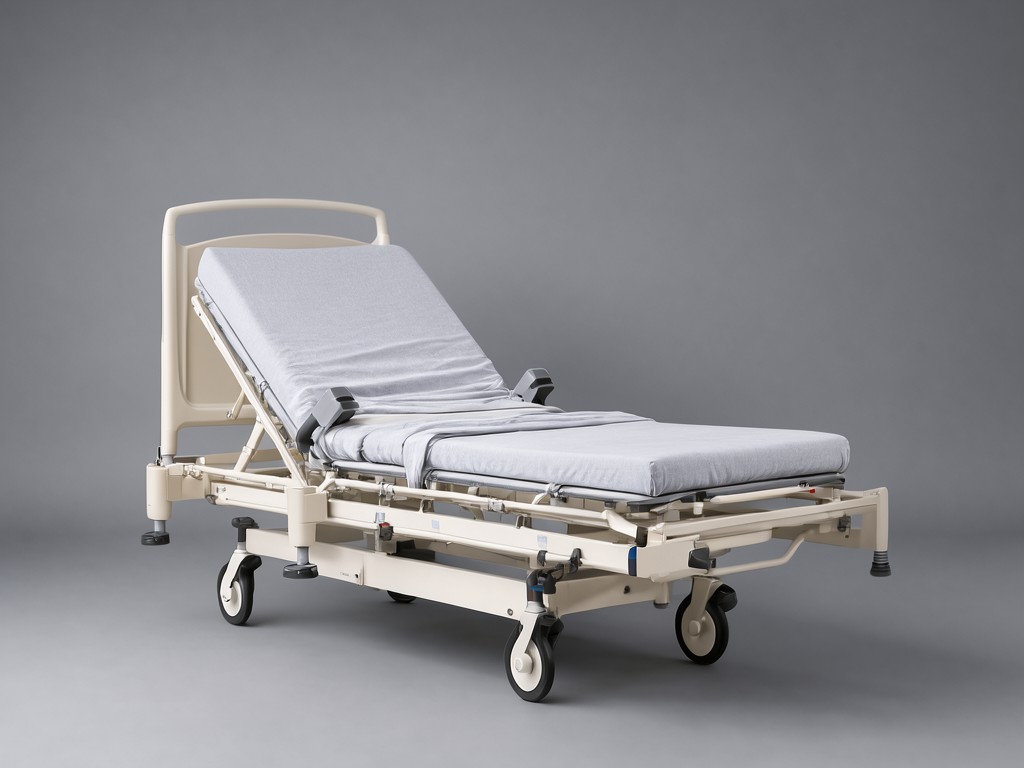
Lot traceability is baked into the MES: each bed carries a QR‑coded serial that links to material heat‑lot, coating batch, and torque‑audit data. Buyers can pull the data via a secure API for their quality portal.
Sample approval follows a three‑step gate: dimensional check (±2 mm on overall length), functional cycle test (200 commode cycles), and coating adhesion (cross‑hatch 5B). Only after gate‑3 pass does the batch release.
Size and Weight Range
| Parameter | Min | Max | Typical |
|---|---|---|---|
| Overall length (mm) | 2000 | 2150 | 2075 |
| Overall width (mm) | 900 | 950 | 925 |
| Height to mattress deck (mm) | 500 | 560 | 530 |
| Shipping weight (kg) | 60 | 80 | 70 |
Artwork and Branding Review
Final graphics must be supplied as vector PDF (CMYK, 300 dpi) with a 3 mm bleed. We run a colour‑proof on the actual powder‑coat line; any shift >ΔE 2.0 triggers a re‑run before full production.