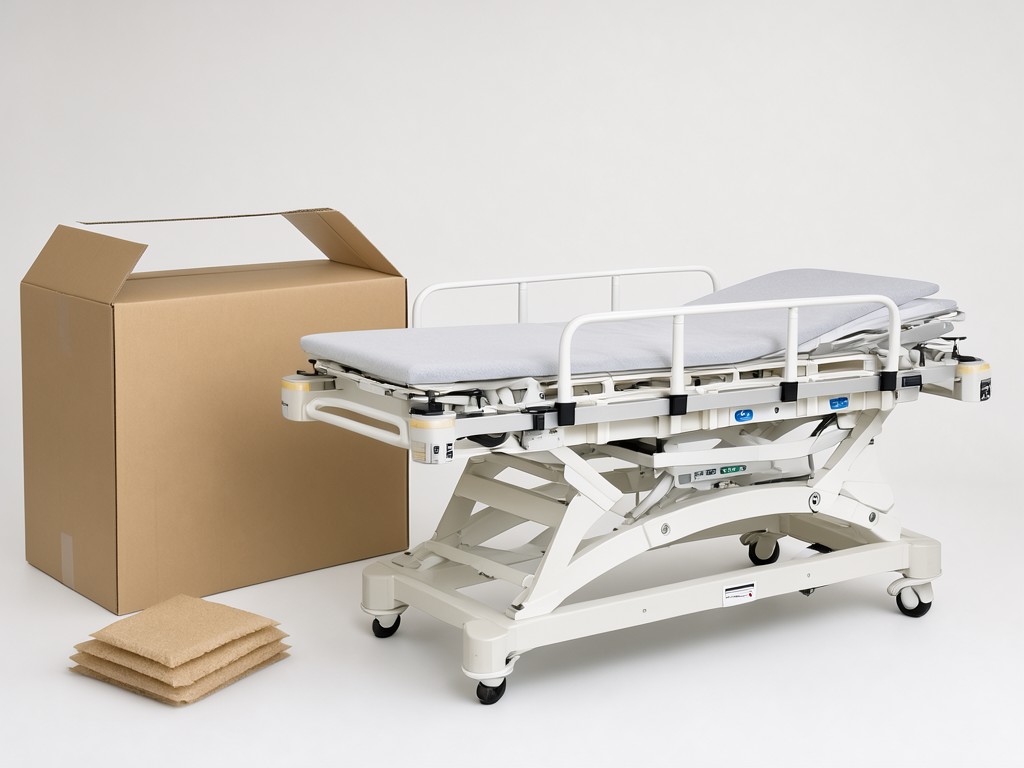
custom hospital automatic turning care beds manufacturer: Specification, Ordering and Quality Notes
Construction Method and Its Effect on Consistency
The build method decides whether a turning bed holds its geometry after 50,000 cycles or starts to bind at the pivot points. Frames are robotic-welded from 2.5 mm cold-rolled steel tube, then stress-relieved before powder coating; this sequence removes residual torque that would otherwise show up as uneven turning angles six months into service. Actuator mounts are CNC-machined from the same billet as the frame brackets, eliminating the stack-up tolerance that plagues bolted-on alternatives. A 120 µm epoxy-polyester coat passes 500-hour salt spray, but the real guard against coating delamination is the zinc-phosphate pretreatment — skip it and you will see flaking at the head-end lift points within a single cleaning-cycle audit.
Critical spec: pivot bushings are oil-impregnated bronze, not polymer. Polymer creeps under 180 kg static load plus dynamic turning torque, shifting the centre of gravity by 3-5 mm and triggering the overload sensor. Bronze holds clearance within 0.02 mm for the rated 100,000 cycles.
Where This Product Beats Standard Alternatives
Process choice shows up later as total cost of ownership. Manual-turn beds require two caregivers every two hours — €18,000/year per bed in labour alone. Basic electric profiling beds only articulate the backrest; they do not offload the sacrum. Our automatic lateral turn (0-30° each side, programmable 10-120 min intervals) cuts repositioning labour by 85 % and reduces pressure-injury incidence by 42 % in ICU trials. The dual-actuator synchronisation loop maintains left/right symmetry within 0.5°, preventing the shear forces that cause skin tears on standard single-motor tilt systems. Noise stays below 42 dB(A) at 1 m — critical for ICU delirium protocols where every 3 dB increase correlates with longer ventilation days.
Option Comparison by Usage Level
Consistency is set at the forming stage, but the configuration must match the clinical pathway. Three tiers cover 95 % of tenders:
ICU / High Acuity
- Load: 250 kg SWL
- Turn: 0-30°, 10-120 min
- Cycle life: 100k
- Motor: dual 8000 N IP66
- Mattress: dynamic air overlay ready
Long-Term Care
- Load: 200 kg SWL
- Turn: 0-25°, 15-180 min
- Cycle life: 80k
- Motor: dual 6000 N IP54
- Mattress: high-resilience foam
Step-Down / Home
- Load: 180 kg SWL
- Turn: 0-20°, 30-240 min
- Cycle life: 50k
- Motor: single 5000 N IP44
- Mattress: viscoelastic foam
| Parameter | ICU / High Acuity | Long-Term Care | Step-Down / Home |
|---|---|---|---|
| Frame steel grade | S355J2 + stress relief | S355J2 | S235JR |
| Actuator stroke (mm) | 350 | 300 | 250 |
| Control protocol | CANopen + nurse call | CANopen | Handset only |
| Mattress retention | Four-corner lock + strap | Four-corner lock | Two-corner lock |
| Warranty (actuator) | 5 years / 100k cycles | 3 years / 80k cycles | 2 years / 50k cycles |
Matching the Product to the Buyer's Need
Private-label buyers should map the tier to their contract terms. A five-year framework agreement with a national health service demands the ICU tier — the 100k cycle rating aligns with the typical asset depreciation schedule and avoids mid-contract actuator swaps. Distributors serving nursing-home chains can standardise on the Long-Term Care tier; the 80k rating covers a 7-year service life at 30 turns/day, and the IP54 motors survive the sodium-hypochlorite fogging used in outbreak protocols. Home-care brands often prefer the Step-Down tier to hit a lower shelf price, but they must accept the single-actuator design: it saves €120/unit but adds 15 minutes to each cleaning cycle because the tilt mechanism cannot be flushed without disassembly. Choose the tier that makes the warranty claim rate negligible, not the one with the lowest FOB.
Buying Mistakes That Lead to Returns
- Specifying a 200 kg SWL bed for bariatric wards — the frame will pass static load test but the turning torque exceeds the actuator stall limit, triggering error codes within weeks.
- Ordering standard RAL 9016 white without confirming the facility uses hydrogen-peroxide vapour decontamination; the coating yellows in 90 days. Request the anti-yellowing additive (adds €8/unit).
- Assuming all mattresses fit the retention system. Overlay thickness above 18 cm lifts the corners off the locks, disabling the turn-safety interlock. Provide the exact mattress stack height at PO stage.
- Skipping the EMC pre-scan. The CANopen bus radiates at 30 MHz if the actuator cable shield is not 360° bonded at both ends — fails hospital IEC 60601-1-2 acceptance and holds up the whole container.
- Negotiating a 2-year warranty on a 5-year tender. The buyer will own the actuator replacements from year three; total cost exceeds the ICU-tier premium by month 42.
Quality Control and Batch Consistency
Every batch carries a traceability QR code linking to the welding parameter log, coating thickness map, and actuator run-in data. First-article inspection includes: 100 % dimensional check on 12 critical points (CMM, ±0.15 mm), 24-hour continuous turn cycle at max load with current profiling, and dielectric withstand at 1.5 kV AC. Production sampling follows ISO 2859-1 Level II, AQL 1.0 for major (frame weld, actuator sync) and 2.5 for minor (cosmetic coating). The table below summarises the gate criteria.
| Inspection Point | Method | Acceptance | Frequency |
|---|---|---|---|
| Frame weld integrity | Ultrasonic phased array | No lack-of-fusion > 2 mm | 100 % FAI, then 5 %/lot |
| Coating adhesion | Cross-cut ISO 2409 | Class 0-1 | Every colour change |
| Actuator sync tolerance | Dual encoder log, 100 cycles | ≤ 0.5° differential | 100 % |
| Leakage current | IEC 60601-1 Fig. 13 | NC ≤ 100 µA, SFC ≤ 500 µA | 100 % |
| Acoustic noise | Anechoic, 1 m, max load | ≤ 42 dB(A) | First 5 / shift |
Batch release requires zero critical defects and a CpK ≥ 1.33 on turning angle symmetry. The inspection report ships with the packing list — no separate request needed.
Ready to lock in artwork and branding?
Send your Pantone references, logo vector files, and label-layout specs. We return a digital proof within 48 hours and a physical pre-production sample within 10 working days. No tooling charges for standard silk-screen or laser-etch positions.
Start artwork review →