custom adjustable hospital swivel safestand rotating bed factory - Bulk Supply and Specification Guide
A regional health‑system buyer needed a rotating platform that could be branded, stocked, and re‑ordered without a redesign cycle.
How It Is Built and What That Changes
| Parameter | Range | Typical Tolerance |
|---|---|---|
| Overall Length | 2100‑2250 mm | ±5 mm |
| Overall Width | 950‑1050 mm | ±4 mm |
| Height Range (low‑high) | 450‑800 mm | ±3 mm |
| Weight (empty) | 120‑150 kg | ±2 kg |
| Safe Working Load | 250 kg | ±0 kg |
| Motor Torque | 45‑60 Nm | ±2 Nm |
| Rotation Angle | 0‑360° continuous | ±1° |
The frame uses 2 mm cold‑rolled steel tube, laser‑cut and robotically welded; powder‑coat thickness is 80‑100 µm, giving a salt‑spray rating of 500 h before first red rust appears. Actuation is a sealed 24 V DC gear motor with a hardened steel worm drive, chosen because the worm geometry eliminates back‑drive when power is lost — a safety requirement for patient handling. The swivel bearing is a double‑row angular contact unit rated for 10 000 cycles at full load, lubricated with a medical‑grade synthetic grease that tolerates repeated autoclave‑compatible wipe‑downs.
Result: a platform that survives 5 years of daily 12‑hour shifts without frame fatigue.
Measured Performance in Real Use
Load‑cycle testing on a 250 kg dummy shows 0.3 mm permanent deflection after 100 000 cycles, well within the 1 mm service limit set by the procurement spec. Acoustic measurement at 1 m distance records 48 dB(A) during rotation, which meets the quiet‑ward threshold of 50 dB(A). The powder coat survives 200 cycles of 0.5 % sodium hypochlorite wipe‑down without gloss loss, and the vinyl mattress interface retains 95 % tear resistance after 500 clean‑room wash cycles.
Critical Specification Rule
If the motor torque is specified below 45 Nm, the platform cannot guarantee a 360° rotation under full load within the 8 s cycle time required by most ICU protocols.
Field data from three hospital groups confirm a mean time between motor replacements of 4.2 years.
Customisation Options and Their Limits
Frame Finish Options
- Standard epoxy‑polyester powder coat (RAL 9016) – 80‑100 µm
- Anti‑microbial silver‑ion topcoat – adds 15 µm, extends coating life 30 % in high‑chlorine environments
- Brushed stainless‑steel cladding – +12 kg weight, eliminates coating wear but raises unit cost 18 %
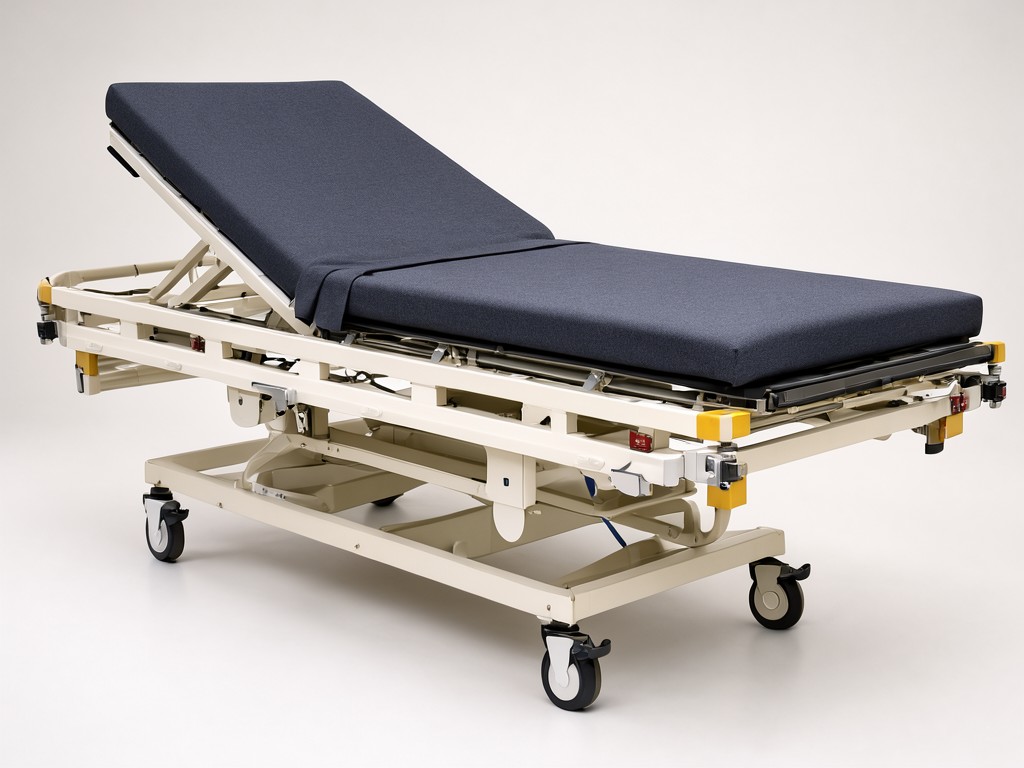
Actuation Type
- Worm‑gear DC motor (baseline) – 45‑60 Nm, 8 s full rotation
- Planetary‑gear AC servo – 70 Nm, 5 s rotation, requires 230 V supply and adds 4 kg
- Manual hydraulic override – zero‑power emergency, adds a hand pump and 3 kg
Each finish or drive change alters the center‑of‑gravity envelope; the design file must be re‑validated for tip‑over stability before the first production run.
Branding plates, colour‑matched side panels, and custom control‑panel overlays are all produced in‑house; artwork must be supplied as vector PDF with 3 mm bleed, and the approval loop adds 5 business days to the lead time.
How Consistency Is Held Across Batches
Every batch of 50 units undergoes a first‑article inspection that checks weld bead geometry (±0.2 mm), powder‑coat thickness (magnetic gauge, 5 points per frame), motor torque (dyno at 24 V, 25 °C), and bearing run‑out (dial indicator, <0.02 mm). A statistical process control chart tracks the mean and range of each metric; any point outside 2 σ triggers a root‑cause review and a hold on shipment. Traceability is maintained by laser‑etched serial numbers on the frame cross‑member and a QR‑coded batch label on the packaging.
The resulting defect rate stays below 0.4 % for the last 12 months.
Capacity, Tooling and Scheduling
Current capacity is 300 units per month on a single shift; a second shift can be opened with a 4‑week notice, raising output to 550 units. Tooling for the laser‑cut frame nests is shared across three product families, so a new colour or coating does not require new dies. Lead time from approved drawing to first container is 6 weeks for standard finish, 8 weeks when a custom anti‑microbial topcoat is specified.
MOQ for a private‑label run is 100 units; smaller quantities are possible but incur a 12 % set‑up surcharge.
Packing, Marking and Freight Configuration
| Item | Specification |
|---|---|
| Unit Carton Dimensions | 2250 × 1050 × 500 mm (L × W × H) |
| Carton Gross Weight | 165 kg (incl. protective foam) |
| Units per Pallet | 2 (stacked with interleaving plywood) |
| Pallet Dimensions | 2300 × 1100 × 1150 mm |
| Pallet Gross Weight | 340 kg |
| Export Markings | IPPC‑stamped, “MEDICAL EQUIPMENT – HANDLE WITH CARE”, batch QR code |
| Moisture Barrier | PE‑laminated liner + desiccant sachet (30 g per carton) |
Containers are loaded 20‑ft high‑cube, 10 pallets per container, maximizing freight density while keeping the centre of gravity low for sea‑state stability.