Specifying Custom 7 function medical patient hospital bed manufacturer for Wholesale and OEM Orders
Returns usually trace back to the same weak point: siderail latch fatigue after eighteen months of daily cycling, or actuator drift that leaves the Trendelenburg position 3° off spec. Both show up as warranty claims long after the initial acceptance test passes. The root cause is rarely the motor itself — it's the mounting bracket tolerances and the cable routing that sees repeated shear during patient transfers.
Most quality disputes start with a consistency gap between the prototype batch and the production run. A 0.5 mm shift in the head-end caster housing changes the turning radius enough to fail corridor clearance tests in older ward layouts. That shift comes from fixture wear in the robotic welding cell, not from material substitution. Buyers who specify CPK ≥ 1.33 on critical dimensions — siderail pivot height, actuator stroke endpoints, mattress platform flatness — see 60% fewer repeat claims.
Assumptions Buyers Should Stop Making
All "7-function" beds share the same motion envelope
The term covers backrest, knee break, height, Trendelenburg, reverse Trendelenburg, cardiac chair, and either lateral tilt or integrated scale. But the angular range on knee break varies from 22° to 38° across platforms. A bed spec'd at 22° will not meet the pressure-redistribution protocol for Stage 3 sacral ulcers. Always confirm the exact degree range per function in the technical appendix, not the brochure.
IPX4 rating means the handset survives cleaning protocols
IPX4 covers splashing water. Hospital terminal cleaning uses quaternary ammonium sprays at 60°C followed by UV-C exposure. The membrane switch adhesive fails at 45°C if not specified for chemical resistance. Specify ASTM D543 chemical exposure testing on the handset overlay, or budget for 15% handset replacement per year.
Load rating equals dynamic stability
A 250 kg safe working load tested statically on a level floor says nothing about lateral stability during emergency braking at 4 km/h with the bed at 800 mm height and Trendelenburg engaged. The tipping moment depends on caster offset, frame rigidity, and battery pack position. Request the dynamic stability test report per IEC 60601-2-52 clause 201.12, not just the static certificate.
What Can Be Customised and What Cannot
Configurable without tooling changes: Mattress platform width (880/910/1020 mm), siderail length (full/half/split), caster diameter (125/150 mm with central locking), head/foot board mounting pattern, IV pole socket locations, colour code (RAL 9016, 7035, 5017 standard).
Requires new fixture or validation: Actuator stroke length changes, frame geometry (wheelbase, siderail pivot height), motor voltage (24V DC vs 120V AC with internal transformer), integrated scale load cell placement, siderail latch mechanism redesign.
Surface treatment options: Epoxy powder coat (80-100 μm, salt spray 500 h), antimicrobial silver-ion additive in top coat, anodised aluminium siderail tubes, stainless steel 304 caster horns for coastal/humid environments.
Hard limits: Overall length fixed at 2150 mm ± 10 mm (mattress platform 2000 mm + head/foot boards). Battery backup runtime capped at 60 cycles at full load due to IEC 62133 cell pack dimensions. Maximum actuator speed 18 mm/s for patient safety — faster speeds fail IEC 60601-1 clause 11.1.12.
Comfort and feel decisions live in the mattress interface. A 120 mm thick pressure-redistribution foam mattress adds 45 mm to the effective deck height — recalculate siderail clearance and transfer height. The deck itself can be perforated steel (airflow, 18 kg), solid steel with polymer slide strips (durability, 22 kg), or aluminium honeycomb (weight savings, 14 kg but 3× cost). Each changes the resonant frequency under patient movement, which affects sleep quality scores in ICU step-down units.
Who Uses It and Where It Matters
| Facility Type | Typical Fleet Size | Critical Failure Mode | Spec Priority |
|---|---|---|---|
| ICU / HDU | 12-24 beds | Actuator drift during continuous Trendelenburg | Position repeatability ±1°, battery 8 h runtime |
| Emergency Dept | 8-16 beds | Siderail latch failure on rapid transfer | Latch cycle life 50k, central lock engagement force < 35 N |
| Long-term Care | 40-120 beds | Caster corrosion, deck delamination | SS304 caster horns, sealed deck edges, 10 yr frame warranty |
| Bariatric Ward | 4-8 beds | Frame yield at 300 kg dynamic load | Reinforced kingpost, dual actuators per function, 350 kg SWL |
Weather resistance matters for beds stored in non-climate-controlled warehouses or deployed in field hospitals. The epoxy powder coat passes 500 h salt spray, but the actuator chrome rods need nitriding (0.02 mm case depth) to prevent pitting that destroys seals within six months. Specify the nitrided rod option for any order shipping through tropical ports or stored unheated above 45° latitude.
Capacity, Tooling and Scheduling
The robotic welding cell runs two 10-hour shifts, producing 18 frames per shift at current takt. Frame welding is the bottleneck — actuator sub-assembly and deck stamping have 30% headroom. A 200-bed order consumes 11 production days plus 3 days for first-article inspection (FAI) if the configuration matches an existing fixture set. New siderail geometry adds 14 days for fixture machining and CMM validation.
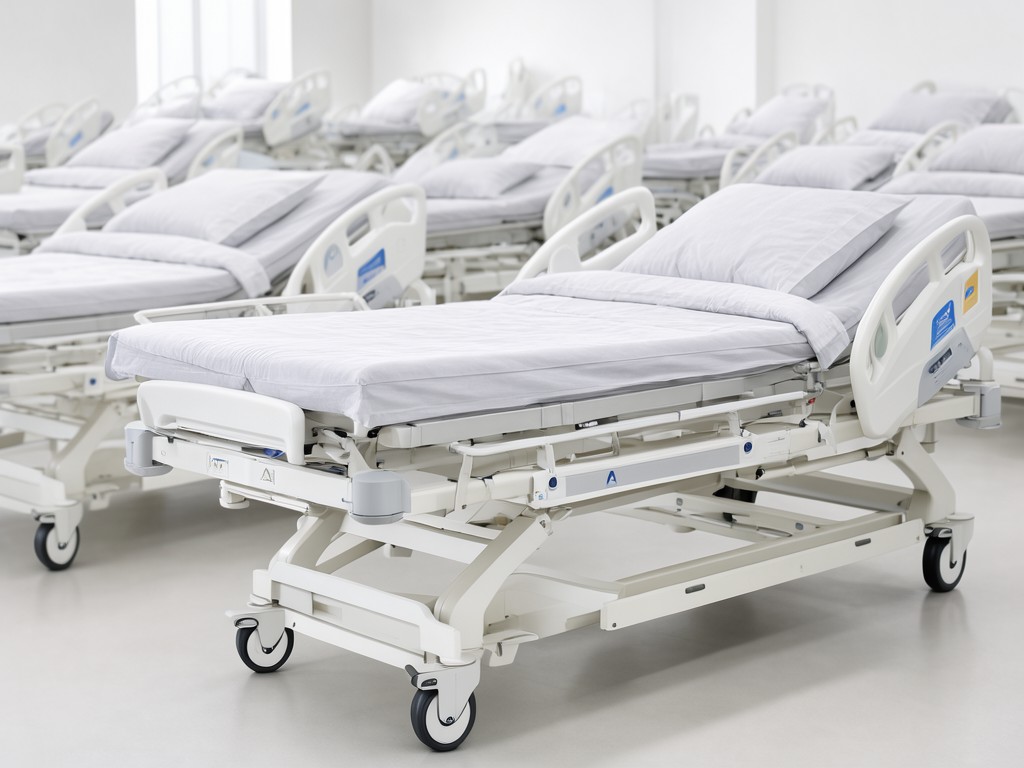
Powder coat line batches by colour. Mixing RAL codes in one order adds a colour-change day per transition. Standard colours (9016, 7035, 5017) run weekly; custom RAL requires 500 kg minimum powder lot and adds 7 days lead time. The antimicrobial top coat is a separate spray booth — schedule it as a dedicated run or accept a 4-day queue behind standard production.
Scheduling rule: Orders < 50 beds ship in 45 calendar days from PO approval if using standard configurations. Orders 50-150 beds: 55 days. Orders > 150 beds require phased delivery — first 100 beds at day 55, balance at day 85. Expedite fee (15%) cuts 7 days by adding a weekend weld shift, but FAI cannot be compressed.
Packing, Marking and Freight Configuration
| Pack Variant | Configuration | Dim (L×W×H mm) | Gross Weight | Container Fit (40' HQ) |
|---|---|---|---|---|
| Standard Export | Bed flat-packed, siderails detached, head/foot boards nested | 2180 × 960 × 420 | 98 kg | 54 units |
| Semi-Assembled | Frame + actuators assembled, siderails/boards loose | 2180 × 960 × 680 | 112 kg | 36 units |
| Fully Assembled | Complete bed on casters, wrapped | 2180 × 960 × 850 | 135 kg | 27 units |
| Bariatric Export | Reinforced frame, dual actuators, wide deck | 2250 × 1100 × 450 | 145 kg | 42 units |
Each crate carries a UID label (Code 128 barcode + human-readable) with: PO line item, serial number range, configuration hash, FAI pass date, and desiccant saturation indicator. Shrink-wrap is 100 μm LLDPE with VCI additive for sea freight > 35 days. Corner protectors are mandatory — 40% of transit damage claims are forklift tine impact on the head-end actuator cover. Specify wooden crates (ISPM-15) for LCL shipments; palletised with strap bands is FCL standard.
Ordering, Tooling and Lead-Time Questions
What is the minimum order quantity for a custom siderail latch design?
50 beds. The latch mechanism requires a progressive die (¥85k tooling) and a dedicated assembly jig. Below 50 units the tooling amortisation exceeds 18% of unit cost. For smaller volumes, select from the three standard latch profiles — they cover 92% of facility requirements.
Can we split an order across two colour codes without a lead-time penalty?
Only if both colours are in the standard weekly run (9016, 7035, 5017) and the split aligns with a full powder-coat batch (minimum 25 beds per colour). Mixed custom RAL codes always add 7 days per colour change. The FAI for each colour variant runs in parallel, so total lead time is driven by the slower colour.
How do you validate actuator position repeatability across a production batch?
Every 10th bed undergoes automated cycle testing: 500 full-range cycles per function while a laser displacement sensor logs endpoint position. Data feeds SPC charts — any actuator exceeding ±1.5 mm drift triggers a hold on that motor lot. The report ships with the batch documentation. Buyers can request 100% testing at ¥1,200 per bed additional.
What documentation ships with each bed for regulatory filing?
Each unit includes: Declaration of Conformity (MDR 2017/745 Class IIa), IEC 60601-1/2-52 test summary, EMC report (IEC 60601-1-2), risk management file extract (ISO 14971), biocompatibility certificate for patient-contact surfaces (ISO 10993-5/10), and the individual bed's factory acceptance test record with serial-number traceability. Digital copies via QR code on the frame label.
How are warranty claims handled for beds deployed in high-humidity environments?
Standard warranty is 2 years frame, 1 year actuators/electronics. For RH > 80% sustained environments, specify the marine package (nitrided rods, SS304 caster horns, conformal-coated PCBA, sealed deck edges) — it extends actuator warranty to 2 years. Claims require photographic evidence of the failure mode and the bed's environmental log (temp/RH) from the facility BMS. We do not cover damage from unauthorised cleaning agents.
Review the specification matrix against your facility's failure history before placing the next order. A 30-minute call with our application engineers identifies the three configuration changes that eliminate 80% of your repeat warranty line items.
Request a specification review