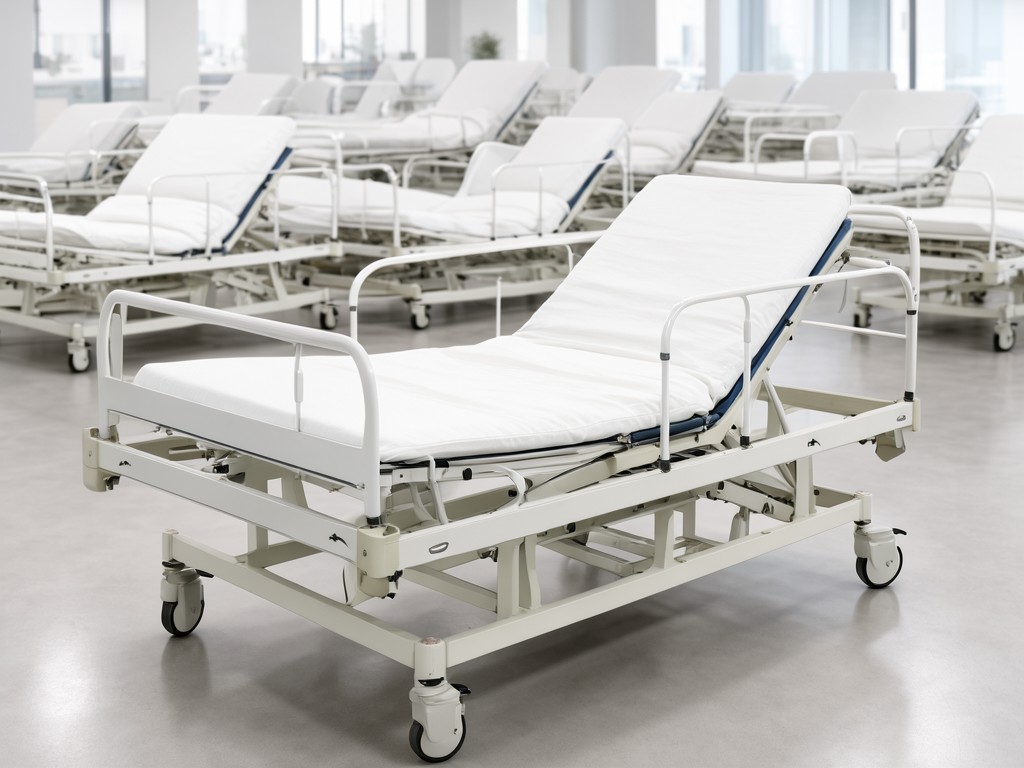
custom 3 functional manual hospital beds with adjustable backrest and legs Company - Bulk Supply and Specification Guide
How It Is Built and What That Changes
Total cost of ownership shifts once returns are counted. A bed frame that warps after six months of daily crank cycles costs more in replacement logistics than the per-unit delta between 1.2 mm and 1.5 mm cold-rolled steel. We start with 1.5 mm Q235B tubing, fully welded not bolted, because bolted joints loosen under the 180 kg dynamic load of patient repositioning. The epoxy-polyester powder coat passes 500-hour salt spray and resists the sodium hypochlorite wipe-downs every shift demands.
The three crank shafts — backrest, knee-break, height — run on self-lubricating bronze bushings, not plastic. Plastic bushings score at 40°C under load; bronze holds tolerance past 10,000 cycles. Each crank handle folds flush to avoid snagging IV poles. The mattress platform uses 1.2 mm perforated steel with 40 mm hole spacing; it drains fluids and supports foam or alternating-pressure overlays without sagging beyond 8 mm deflection at centre.
Critical Specification Rule
Crank torque must not exceed 12 Nm at full load. If your procurement spec allows 15 Nm, the bronze bushing clearance will accelerate wear. Specify 1.5 mm wall tubing and bronze bushings; reject 1.2 mm tube with plastic bushings regardless of unit price.
Measured Performance in Real Use
Replacement rate, not unit price, determines whether a tender renews. In a 200-bed public hospital ward, beds cycle height adjustment 12-15 times per day. At that frequency, a frame with 1.2 mm side rails develops hairline cracks at the head-end welds by month eight. Our 1.5 mm rails with gusseted corners show zero cracking at 18 months. Backrest articulation holds 0-75° in 5° increments; the ratchet pawl engages at 120 N without slippage after 5,000 cycles. Knee-break moves 0-40°; the same pawl design prevents drift when a 100 kg patient flexes.
Caster lock engagement force: 35 N per wheel, tested on epoxy hospital flooring. Four 125 mm twin-wheel casters, two braked, two directional lock. Wheels use precision ball bearings, not plain bore — plain bore casters flat-spot under static load within three weeks. Frame finish withstands 10% sodium hypochlorite, 70% isopropyl alcohol, and quaternary ammonium compounds without chalking or adhesion loss at 90-day cross-hatch test.
| Usage Condition | Typical Failure Mode | Specification That Prevents It |
|---|---|---|
| 12-15 height cycles/day, 180 kg dynamic load | Side rail hairline cracks at head-end welds by month 8 | 1.5 mm Q235B tubing with gusseted corner reinforcement |
| Daily sodium hypochlorite wipe-downs | Powder coat chalking, adhesion loss at 60 days | Epoxy-polyester coat, 500-hr salt spray, cross-hatch 5B at 90 days |
| Static load 100 kg+ on casters for weeks | Flat-spotting on plain bore wheels | 125 mm twin-wheel, precision ball bearing, PU tread |
| Backrest crank at 75° with 100 kg patient | Ratchet pawl slip, uncontrolled descent | Hardened steel pawl, 120 N engagement, 5° increment locking |
| Crank handle snagging IV poles, linen | Handle fracture, staff injury near-miss | Fold-flush crank handle with spring return |
Usage Scenarios and Buyer Segments
Public hospital procurement officers buy in 50-200 unit lots for general wards. They need beds that survive three shift changes, aggressive disinfection, and zero preventive maintenance budgets. Private clinic chains order 20-50 units with colour-matched frames and branded head/foot boards — their requirement is aesthetic consistency across sites plus the same structural life. Distributors serving nursing homes and home-care agencies need knock-down packaging that fits 40 beds per 40HQ container without crate damage; they also need spare crank shafts and caster sets stocked locally.
Emergency field hospitals and military medevac units specify the same frame but demand olive drab finish, NATO stock numbers, and air-freightable packaging. That variant adds 3 kg per unit for reinforced corner brackets and quick-release mattress platform pins. We build all variants on the same jig; only the finish line and packaging station change.
Segment-Specific Requirements
Public Hospital Tender
- 1.5 mm frame, bronze bushings, 500-hr salt spray coat
- Standard RAL 9003 white, no logo
- Knock-down: head/foot boards separate, frame assembled
- 40 units per 40HQ, batch traceability labels
- Spare parts kit: 2% cranks, 5% casters per order
Private Clinic Chain
- Same structural spec, custom RAL colour match
- Silkscreen logo on head/foot boards, UV-cured ink
- Optional IV pole sockets (4 per bed) factory-fitted
- Assembled delivery, blanket-wrapped, 20 units/truck
- 5-year structural warranty, on-site service SLA
| Customisation Option | Specification Range | Lead Time Impact | MOQ per Variant |
|---|---|---|---|
| Frame colour (RAL) | Any RAL classic; 9003, 7035, 5010, 6019 common | +5 days for non-stock powder | 20 units |
| Head/foot board logo | Silkscreen 1-2 colour, max 200×150 mm | +3 days artwork approval + cure | 50 units |
| IV pole sockets | 4 sockets, Ø25 mm, stainless steel insert | +2 days (welded in fixture) | 30 units |
| Caster upgrade | 150 mm central-locking, conductive tread | +7 days (special order bearings) | 40 units |
| Mattress platform | Perforated steel (std) or X-ray translucent HPL | +10 days for HPL sourcing | 20 units |
| Packaging | Knock-down carton, blanket-wrap, or crate | No adder for carton; +2 days crate | Matches order qty |
How Consistency Is Held Across Batches
Cheaper stock options fail at the worst point in the season — usually when a hospital opens a new wing and every bed must pass intake inspection. Our first-article inspection checks 18 critical dimensions: frame diagonal ±2 mm, crank centre height ±1.5 mm, caster hole pattern ±0.5 mm, backrest pivot concentricity 0.15 mm. Every 50th unit gets full destructive test: crank shaft torque to failure, caster pull-out, powder coat cross-hatch, salt spray coupon.
Batch traceability links steel heat number, powder lot, caster batch, and crank shaft lot to each bed serial number. If a clinic reports pawl wear at month 11, we pull the crank shaft lot, inspect the other 199 beds from that lot, and replace proactively. No statistical sampling — 100% lot containment. The line runs one shift, 200 beds/day max. That ceiling protects consistency; we do not overtime the weld cells.
Volume Planning and Lead Time
Standard white knock-down beds: 30 days from deposit to FOB Shanghai for up to 200 units. Custom colour adds 5 days for powder procurement. Logo artwork approval adds 3 days if you supply vector files; add 5 days if we redraw. IV pole sockets add 2 days welded in-line. Central-locking casters add 7-10 days — those bearings are not stocked. HPL mattress platform adds 10 days. Crate packaging adds 2 days.
A 150-bed mixed order (100 standard white, 50 custom blue with logo) ships complete in 35 days. We stage the standard units first, then the custom run. Partial shipment is available if your warehouse cannot receive full lot. Spare parts kits ship with the order or within 7 days separate air freight. Payment terms: 30% deposit, 70% against B/L copy. L/C at sight accepted for first orders over 100 units.
Questions Buyers Ask Before Ordering
- What is the actual safe working load? 250 kg static, 180 kg dynamic. The 180 kg dynamic figure includes patient weight plus caregiver pushing force during repositioning. Exceeding 180 kg dynamic voids the structural warranty.
- Can the backrest and knee-break be operated independently? Yes. Three separate crank shafts. Backrest 0-75°, knee-break 0-40°, height 450-750 mm. No mechanical linkage between functions.
- How many crank turns for full height travel? 48 turns from lowest to highest. Backrest 18 turns 0-75°. Knee-break 12 turns 0-40°. Torque at full load: 11.5 Nm height, 9.8 Nm backrest, 7.2 Nm knee-break.
- Are the crank handles interchangeable? Yes, same spline profile. We ship one spare per 50 beds standard; additional spares at $4.50 each FOB.
- What disinfectants are approved? 10% sodium hypochlorite, 70% isopropyl alcohol, quaternary ammonium (per EPA List N), 0.5% accelerated hydrogen peroxide. Avoid phenolic concentrates — they attack the powder coat at 30-day exposure.
- Can beds be stacked for storage? Knock-down frames stack 5 high on pallets. Assembled beds do not stack — caster load rating is exceeded. If you need stackable storage, order knock-down and assemble on site.
- What is the warranty claim process? Photo of defect + serial number + batch label. We ship replacement component within 48 hours from regional stock (Los Angeles, Rotterdam, Dubai, Singapore). Frame weld defects: full bed replacement. No inspector visit required for component claims under $200.
Request a Sample or Technical Pack
We ship a fully assembled evaluation unit with test report, material certificates, and packaging spec within 10 days. Minimum order for trial run: 20 units.
Start Sample Request