Specifying china multifunctional hospital bed with commode and toilet Company for Wholesale and OEM Orders
Where chlorine, sweat or UV exposure is routine in high-turnover wards, the frame coating and polymer components decide whether a bed survives a two-year procurement cycle or generates warranty claims by month eight. Epoxy-polyester powder coat at 80-100 µm dry film thickness resists sodium hypochlorite wipe-downs better than wet-paint alternatives, but only if the pretreatment phosphate layer passes a 24-hour salt-spray screen before topcoat application. We see repeat buyers specify this threshold in their purchase orders after the first batch shows blistering at weld seams.
The commode cutout and toilet interface introduce a second failure mode: repeated removal of the collection pan stresses the ABS surround at the same points where caregivers lean during transfers. A 3 mm wall section with 25% glass-fill holds screw bosses through 500+ cycles; unreinforced ABS cracks at 120 cycles under the same 120 kg vertical load. Buyers who skip the glass-fill option to save ¥18 per unit typically reorder within six months requesting the upgrade.
Material Options and Their Trade-offs
Specification rule: every frame tube must show ≥ 80 µm coating thickness on the internal diameter at the commode cutout — the spot most exposed to splash and least accessible to touch-up. We verify with a calibrated eddy-current gauge on 100% of first-article pieces and 10% per production lot thereafter.
| Component | Standard Grade | Upgrade Grade | Cost Delta (per bed) | Service Life Impact |
|---|---|---|---|---|
| Frame tube (Q235B vs. Q345B) | Q235B, 1.5 mm wall | Q345B, 1.2 mm wall | +¥42 | +18 months before yield at caster mounts |
| Commode surround | ABS, 3 mm, unfilled | ABS/GF25, 3 mm | +¥18 | 500 vs. 120 pan-change cycles |
| Mattress platform | Steel mesh, 30×30 mm grid | ABS ventilated panels | +¥65 | Eliminates mesh deformation; 30% faster terminal cleaning |
| Caster housing | Nylon 6, single ball race | PA66-GF30, double ball race | +¥28 | Swivel torque stays < 0.8 Nm after 20k km |
| Actuator spindle | Trapezoidal, 16×4 mm | Ball screw, 16×5 mm | +¥120 | Backlash < 0.15 mm for 10k cycles; critical for Trendelenburg repeatability |
How It Is Built and What That Changes
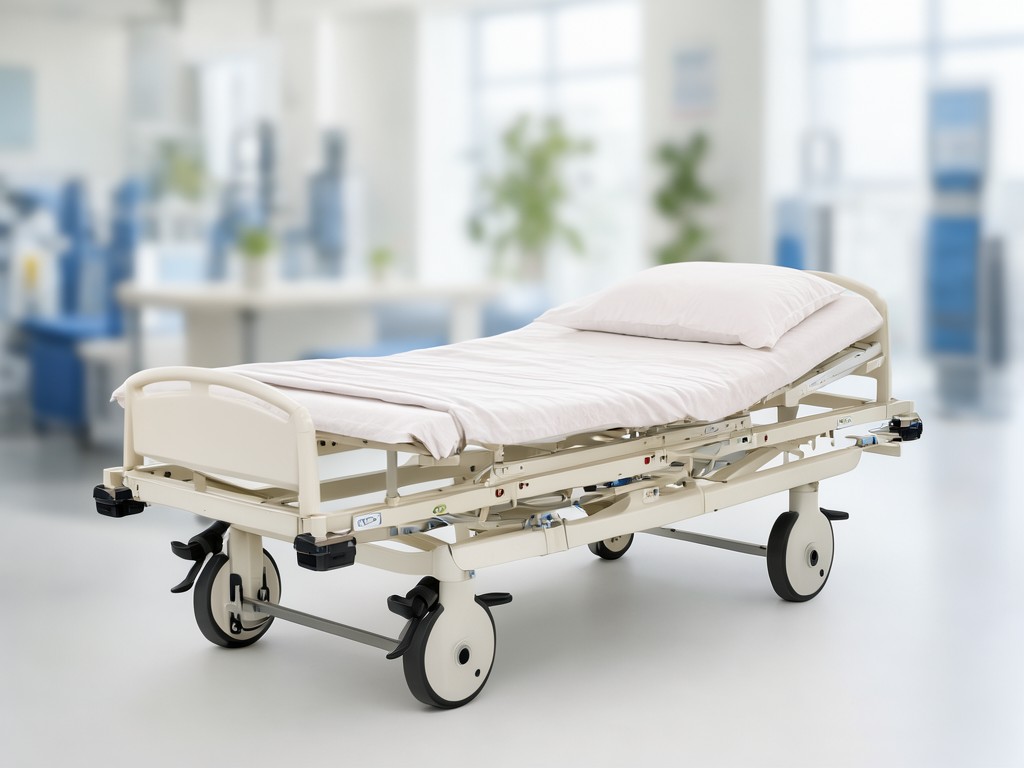
Construction options diverge as soon as weight matters. The four-section platform (back, seat, thigh, calf) can be welded as a single weldment or assembled from bolted sub-frames. Welded units ship 12% lighter and eliminate bolt-loosening complaints, but they require a 3.2 m fixture bed and a certified welder per shift — tooling cost ¥85k amortised over 2,000 units. Bolted sub-frames let a regional assembly plant finish beds from flat-pack kits, saving 35% on ocean freight for Southeast Asian distributors, yet they add 4.3 kg and a torque-audit step at final QC.
The commode cutout is CNC-routed in the seat section before coating. If the router bit dulls beyond 0.15 mm flank wear, the ABS surround develops a 0.3 mm lip that traps fluid and defeats the IPX4 spray test. We change bits every 120 panels and log the count in the router controller; the log ships with the batch paperwork so the buyer can audit without visiting the line.
Welded Weldment Route
- Single-piece frame, no fastener audit
- Leak path at commode cutout eliminated
- Requires 3.2 m jig, certified welder
- Best for domestic hospital tenders
Bolted Sub-frame Route
- Flat-pack, 2×40'HQ = 180 beds vs. 130
- Torque spec: 22 Nm ± 2 Nm on M8×1.25 flange bolts
- Adds 4.3 kg, 2 extra QC stations
- Preferred by export distributors
Customisation Options and Their Limits
Cost and durability pull in opposite directions once branding and accessory brackets enter the spec. A silk-screened logo on the headboard panel survives 200 autoclave cycles at 134 °C only if the ink is a two-part epoxy cured at 180 °C for 20 minutes — standard air-dry inks lift at cycle 40. The cure oven adds ¥7 per bed and a 45-minute bottleneck; we batch logos in runs of 50 to keep the adder below ¥12.
Side-rail mounting patterns follow either the DIN 13063 hole grid (50 mm pitch) or the legacy 47 mm pitch used by older Chinese hospital fleets. Mixing patterns on one order forces a second fixture set and a 15% scrap rate on the first 30 rails. We require the buyer to declare the pattern at PO confirmation; changes after first-article approval incur a ¥3,200 fixture rework charge and a 10-day schedule slip.
| Option | Range / Choice | MOQ Impact | Lead-time Adder |
|---|---|---|---|
| Frame colour (RAL) | RAL 9016, 7035, 5015, custom | 50 pcs per colour | +3 days for custom |
| Headboard logo | Epoxy screen, laser etch, none | 50 pcs per artwork | +2 days (epoxy cure) |
| Side-rail pattern | DIN 13063 (50 mm) or 47 mm legacy | 100 pcs per pattern | 0 days if declared at PO |
| IV pole sockets | 2, 4, or 6 positions (Ø 25.4 mm) | No MOQ change | +1 day for 6-position |
| Battery backup | 24 V 2.3 Ah NiMH or 24 V 5 Ah LiFePO₄ | 20 pcs for LiFePO₄ | +5 days (UN38.3 paperwork) |
Usage Scenarios and Buyer Segments
Public hospital tenders in Tier-1 cities demand the Q345B welded frame, ABS/GF25 commode surround, ball-screw actuators, and LiFePO₄ backup — configured to DIN 13063 rails. The spec sheet runs 14 pages; first-article inspection takes a full shift with a third-party lab witness. These buyers order 200-500 beds per award and reorder every 3-4 years. Warranty claims above 0.8% trigger a root-cause audit at our cost.
Private clinic chains and nursing-home operators in Tier-2/3 regions choose the bolted Q235B frame with steel mesh platform, trapezoidal actuators, and NiMH backup. They purchase 30-80 beds per PO, often split across two deliveries to match cash flow. Their failure mode is different: caster swivel torque drift after 18 months on epoxy floors. We supply a retrofit PA66-GF30 caster kit (¥28 per bed) that they can install in-house with a 14 mm socket.
Export distributors serving Southeast Asia and the Middle East order flat-pack kits in 40'HC containers. They specify the 47 mm rail pattern, RAL 7035 frame, and no battery (local sourcing avoids UN38.3 freight classification). Their QC checklist focuses on carton compression (ISTA 3A), desiccant sachet count, and a photographic record of the torque-seal on every M8 flange bolt. We pack 180 beds per container versus 130 for welded units — a freight saving that often covers the bolted-frame weight penalty.
What Gets Checked Before Shipment
Every bed leaving the line passes a 17-point functional test before it sees a carton. The sequence: (1) electrical safety per IEC 60601-1 — earth continuity < 0.1 Ω, leakage < 100 µA; (2) actuator stroke and speed at no load and 180 kg — backrest 0-70° in 28±3 s, knee-break 0-30° in 18±2 s; (3) commode pan insertion/removal force < 15 N with one hand; (4) central brake engagement force < 45 N at pedal; (5) side-rail latch pull-out > 200 N; (6) IPX4 spray on the commode cutout — no ingress at the actuator bellows; (7) 24-hour static load at 250 kg on the mattress platform — permanent set < 3 mm.
Coating adhesion gets a cross-hatch test (ISO 2409) on the frame interior at the commode cutout — rating 0 or 1 only. We pull one bed per 50 for destructive salt-spray (96 h, NSS, ISO 9227) and report blister density. If density exceeds 2 per 100 cm², the lot is held for 100% rework. The test report ships with the commercial invoice; buyers who skip the report review discover coating failures only after the beds reach the ward.
Keeping Repeat Orders Supplied
We hold safety stock of the five highest-wear components — PA66-GF30 casters, ABS/GF25 commode surrounds, ball-screw actuator spindles, NiMH battery packs, and epoxy-logo headboard panels — in a bonded warehouse 15 km from the assembly line. Replenishment lead time for these SKUs is 48 hours from kanban signal. For welded-frame beds, the frame itself is not stocked; the 3.2 m fixture runs a dedicated two-week window every quarter. Buyers who forecast quarterly requirements at PO placement lock that window and avoid the 6-week gap when the fixture is committed to another programme.
Tooling review meetings happen at the 18-month mark of any repeat contract. We present dimensional drift data from the last three first-article reports, coating thickness Cp/Cpk trends, and caster torque histograms. If Cp on frame tube diameter drops below 1.33, we schedule die maintenance before the next lot. This discipline keeps the 0.8% warranty threshold intact across four consecutive tenders for our largest public-hospital account.
Request a Tooling Review for Your Next Tender
Send us the tender spec sheet, target award volume, and delivery calendar. We return a fixture plan, first-article timeline, and a cost breakdown by material grade within three working days.
Start Tooling Review