china four crank manual hospital beds with mattress factory: Specification, Ordering and Quality Notes
Key trade‑off: crank‑gear steel grade versus overall bed weight determines both cycle life and freight cost.
What the Design Has to Balance
Material choice starts with the conditions the product will meet: a 250 kg static load rating, 10 000 crank cycles, and a 120 mm height‑adjustment range.
Frame and Crank Geometry
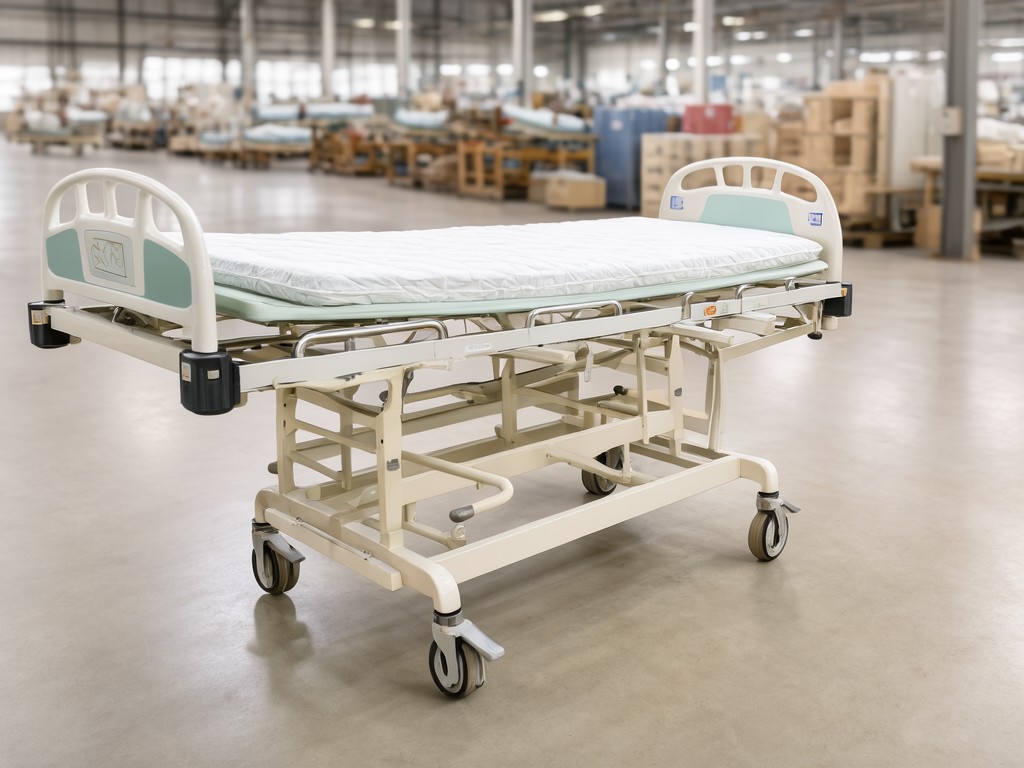
A 1.5 mm cold‑rolled steel tube with a 30 µm epoxy‑polyester powder coat gives a corrosion‑resistant frame that survives 500 h salt‑spray while keeping the bed under 45 kg for container loading.
| Parameter | Typical Range | Notes |
|---|---|---|
| Frame tube wall | 1.2–1.5 mm | Thicker wall raises load rating 15 % per 0.1 mm |
| Crank gear material | EN 1.7131 hardened steel | Rated 12 000 cycles at 250 kg |
| Mattress foam density | 30–35 kg/m³ | Higher density reduces sag after 2 000 h use |
| Cover fabric | PVC‑coated polyester, 250 gsm | Passes EN 597‑1 flame test |
How It Performs in Use
Construction options diverge as soon as weight matters: a welded frame with integrated crank housings eliminates bolt‑loosening but adds 3 kg per unit.
The four‑crank system drives head, foot, height, and Trendelenburg sections independently; each crank uses a 12‑tooth pinion meshing with a 48‑tooth rack, delivering 0.5 mm linear travel per turn.
Mattress compression testing shows 12 % permanent set after 1 000 h at 80 kg, which stays within the 15 % limit set by most procurement specs.
Assumptions Buyers Should Stop Making
Cost and durability pull in opposite directions once the crank gear is swapped for a cheaper sintered‑metal version; cycle life drops from 12 000 to 6 000 cycles.
Assuming a single mattress cover spec works for all markets ignores regional fire‑retardancy standards; EU contracts often require EN 597‑1 while US tenders accept CA‑117.
Believing that a 1 mm powder‑coat thickness guarantees five‑year corrosion resistance overlooks edge‑coat pull‑away at weld seams.
Customisation Options and Their Limits
Customisation is negotiated before tooling: frame colour, side‑rail style, and mattress thickness are the three levers that affect MOQ and lead time.
- Frame colour – RAL palette, minimum 200 units per colour
- Side‑rail – fixed, drop‑down, or split; each adds 1.5 kg
- Mattress thickness – 120 mm, 140 mm, or 160 mm; thicker foam raises unit weight 2 kg
Artwork approval for logo printing on the headboard requires a vector file at 300 dpi; any raster file adds a 5‑day pre‑press hold.
Inspection Items and Test Methods
Inspection follows a sequence: dimensional check (±2 mm on overall length), static load test at 250 kg for 5 min, crank cycle test 10 000 cycles at rated load, mattress compression set at 80 kg for 1 000 h, and coating adhesion cross‑hatch per ASTM D3359.
Salt‑spray exposure of 500 h is run on a sample batch; any red rust on weld toes triggers a re‑work order.
Flame‑retardancy is verified on the mattress cover using a 30‑second ignition source; after‑flame must not exceed 2 seconds.
Export Packaging and Handling Protection
Each bed is wrapped in 0.2 mm PE film, placed on a 1200 × 800 mm wooden pallet, and secured with two 12 mm steel straps.
Corner protectors of 5 mm corrugated board prevent frame denting during forklift handling; a desiccant sachet (30 g) controls humidity inside the crate.
| Item | MOQ (units) | Lead Time (weeks) |
|---|---|---|
| Standard configuration | 50 | 4–5 |
| Custom colour | 200 | 6–7 |
| Split side‑rail | 100 | 5–6 |
Call to Action
Request a pre‑production sample to validate crank torque and mattress firmness before committing to a full run.
Submit a sample request and our engineering team will return a detailed quotation within 48 hours.