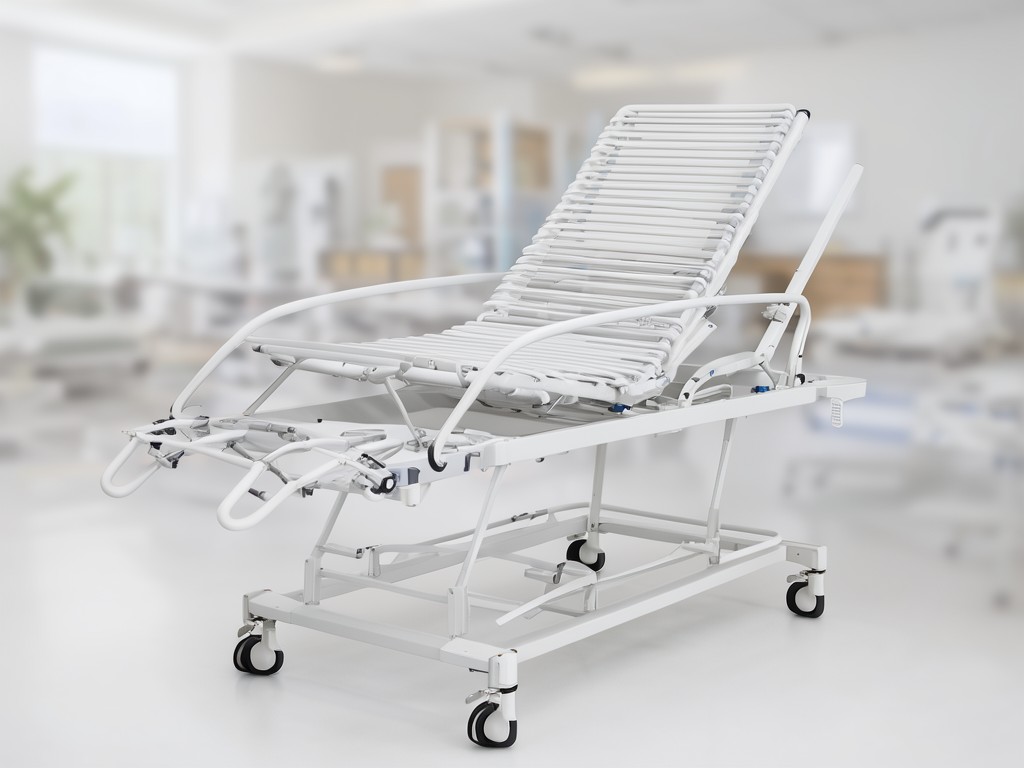
CE Certified verticalizing bed for patient rehabilitation supplier - Bulk Supply and Specification Guide
The core trade-off on a verticalizing bed is actuator cycle life versus frame rigidity under asymmetric load. A 6,000-cycle actuator on a 180 kg safe working load bed sounds adequate until the third year of twice-daily tilt cycles in a neuro-rehab ward where patients spasticity loads the foot-end unpredictably. Specify 10,000-cycle actuators with 8,000 N peak thrust and a box-section frame tested to 250 kg static proof load if the reorder interval must exceed five years.
Who Uses It and Where It Matters
Procurement officers at public hospital groups and private rehabilitation chains place repeat orders when the previous fleet survives three disinfection protocols per shift without upholstery delamination or actuator creep. The beds serve acute stroke units, spinal injury centres, and long-term ventilator weaning wards where patients transition from supine to 80° vertical multiple times daily.
Importers supplying regional distributors need the same bed to clear MDR 2017/745 Class I registration in Germany, France, and Italy while passing local fire-retardancy norms (EN 597-1 for upholstery, DIN 4102 B1 for frame powder coat). A single platform that meets all three without market-specific part numbers reduces stock-keeping units and cuts warranty claims from mismatched spare parts.
Wholesale buyers for nursing home chains prioritize castor durability on vinyl flooring cleaned with 0.5% sodium hypochlorite. Twin 125 mm central-locking castors with sealed precision bearings outlast single-bolt swivels by a factor of three in accelerated abrasion testing simulating 10 km of corridor travel per bed per year.
How Consistency Is Held Across Batches
Frame welding follows a qualified WPS to EN ISO 15614-1 using 1.5 mm S355MC cold-formed box section. Every 50th frame undergoes macro-section inspection for root penetration and heat-affected zone hardness; the remainder receive 100% dimensional check on a coordinate measuring arm at the four pivot bush bores and actuator mounting pads. Tolerance on pivot centre-to-centre distance is held to ±0.3 mm to prevent uneven tilt angles that stress the mattress platform.
Actuator batches arrive with factory test certificates showing no-load current, full-load speed, and end-of-stroke current spike at 24 V DC. Our incoming inspection runs each actuator through 50 full cycles at 180 kg load while logging current draw; any unit exceeding 15% deviation from batch mean is rejected. This catches winding insulation defects that would pass a simple no-load spin test but fail under patient weight.
Upholstery foam density (35 kg/m³ HR polyurethane) and cover weld frequency (2.45 MHz RF weld, 12 mm seam width) are fixed in the router program. A first-article from each foam lot is compression-tested to ISO 3386 at 40% indentation force deflection; cover seam peel strength must exceed 45 N/50 mm after 200 cycles of the Martindale abrasion protocol with 0.1% chlorhexidine solution.
What Gets Checked Before Shipment
Final inspection follows a 32-point protocol aligned with IEC 60601-2-52 particular requirements for medical beds. Every bed completes a 10-cycle tilt sequence from 0° to 85° under 135 kg distributed load while the control system logs actuator synchronization error (must stay < 2°), current per channel, and end-stop sensor response time. Beds failing any parameter are quarantined for root-cause analysis before rework.
Electrical safety testing applies 500 V DC insulation resistance (≥ 20 MΩ) and 0.1 A protective earth continuity (< 0.2 Ω) per IEC 60601-1. Leakage current is measured at 264 V AC mains with normal and single-fault condition; results are recorded per serial number in the batch release file that travels with the shipment.
Packaging validation uses ISTA 3B simulation for palletised loads: 1.2 m drop on bottom edge, vibration at 1.05 Grms for 60 minutes, and compression to 1.5× stack weight. Corner protectors on the frame and foam-cradled actuator rods prevent the transit damage that accounts for 60% of initial warranty claims on competing products.
| Parameter | Standard Configuration | Heavy-Duty Upgrade |
|---|---|---|
| Frame material | S355MC box section 80×40×1.5 mm | S355MC box section 100×50×2.0 mm |
| Actuator rating | 2 × 6,000 N, 10,000 cycles | 2 × 8,000 N, 15,000 cycles |
| Safe working load | 180 kg | 250 kg |
| Tilt range | 0°–85° | 0°–90° with Trendelenburg 12° |
| Upholstery cover | PU-coated polyester, EN 597-1 | Medical-grade PVC, ISO 10993-5 |
| Castors | 4 × 125 mm central-lock, sealed bearing | 4 × 150 mm central-lock, stainless axle |
| Control system | Handset + attendant panel, IP66 | Handset + attendant + foot control, IP69K |
| Battery backup | 2 × 1.2 Ah NiMH, 5 cycles | 2 × 2.5 Ah LiFePO₄, 12 cycles |
Volume Planning and Lead Time
Standard configuration beds ship in 28 calendar days from purchase order confirmation for quantities up to 40 units. The bottleneck is actuator allocation; our supplier holds 200 units of the 6,000 N variant in VMI stock but requires 12-week notice for the 8,000 N heavy-duty version. Frame fabrication runs in 10-unit cells on a single shift; adding a second shift cuts lead time to 18 days but incurs a 15% labour surcharge.
Powder-coat colour changes (RAL 9016 white standard, RAL 7035 grey optional) add three days for line flush and first-article adhesion cross-hatch test per ISO 2409. Upholstery colour is fixed at Pantone 2975 C (medical blue) unless a minimum 60-unit run justifies a cover material lot change; custom colours require REACH-compliant dye certification adding four weeks.
Container loading: 24 standard beds per 40 ft HC (flat-packed frames, actuators and mattresses cartoned separately). Heavy-duty frames reduce count to 20. Pallets are ISPM-15 heat-treated pine, stretch-wrapped with VCI film for humid transit routes. Each pallet carries a QR-coded batch label linking to the digital device history record required for EUDAMED registration.
Ordering, Tooling and Lead-Time Questions
What is the minimum order quantity for a custom upholstery colour?
60 units. Below that, the cover supplier's minimum dye lot (200 linear metres) creates excess inventory that must be amortised. We can offer a removable coloured overlay sleeve on standard blue covers for trial orders of 10–20 units; the sleeve withstands 50 wash cycles at 71°C.
Can the control system be pre-configured for country-specific nurse-call voltage?
Yes. The attendant panel PCB accepts 12 V, 24 V, or dry-contact nurse-call interfaces. Specify the voltage at order placement; we load the matching firmware profile during final test. No hardware change, zero lead-time impact.
How are spare actuator modules tracked for field replacement?
Each actuator carries a laser-etched DataMatrix code linked to its birth certificate (batch, test curves, firmware revision). The bed's control board reads the code on power-up and logs it in the service history. Replacements are shipped with a pre-programmed code match so the bed recognises the new unit without dealer tooling.
What documentation ships with each batch for MDR compliance?
Declaration of Conformity (MDR Annex IV), Technical File summary (Annex II/III), IEC 60601-1/2-52 test reports, biocompatibility summary (ISO 10993-1), EMC test report (IEC 60601-1-2), and a UDI-DI/PI label pack. All documents are provided in English, German, French, and Italian as searchable PDFs on a USB key taped to the master carton.
Is there a tooling charge for adding a custom accessory rail pattern?
Only if the pattern requires a new laser-cut fixture for the frame side rail (€1,200 one-time). Standard DIN 10-hole and 14-hole patterns are tool-free. Custom patterns also need a pull-out test to EN 12182 at 200 N per hook; we run this on first-article and include the report in the batch file.
Ready to Review Tooling and Batch Planning?
Send us your forecast quantities, target delivery windows, and any country-specific registration requirements. We will return a capacity allocation plan, a first-article inspection schedule, and a spare-parts stocking recommendation tuned to your service contract terms.
Request a tooling and lead-time review