ce certified rehabilitation standing beds for hospital Company: What Buyers Should Check Before Ordering
The build method decides the load path, actuator alignment, and ultimately the service interval a rehabilitation standing bed can sustain in a high-throughput ward. A fully welded chassis eliminates joint creep that otherwise adds 0.15 mm per cycle to the height rail tolerance.
Process choice shows up later as dimensional drift in the height-adjustment rails or as audible motor harmonics that exceed the 45 dB threshold required for patient comfort. Consistency is set at the forming stage, where laser-cut profiles hold ±0.3 mm flatness before any secondary machining.
| Configuration | MOQ (units) | Lead Time (weeks) | Sample Approval |
|---|---|---|---|
| Standard Electric (CE) | 10 | 6–8 | Yes |
| Standard Manual (CE) | 15 | 4–6 | Yes |
| Custom Actuator Package | 20 | 8–10 | Required |
Materials and Construction Trade-offs
Frame material and surface treatment drive both corrosion resistance and the weight budget that determines freight cost. Cold-rolled steel with an 80 µm epoxy powder coat survives 5,000 cycles of chlorine-based disinfectant without blistering, while a 120 µm coat adds 2 kg per unit.
- Cold-rolled steel frame, 80 µm epoxy powder coat – resists chloride cleaning agents for 5,000 cycles.
- Aluminium alloy side rails, anodised 15 µm – reduces overall mass by 12 % but lowers impact rating to 150 kg.
- Medical-grade vinyl mattress cover, antimicrobial additive – passes ISO 22196 for bacterial reduction; replacement cycle 18 months.
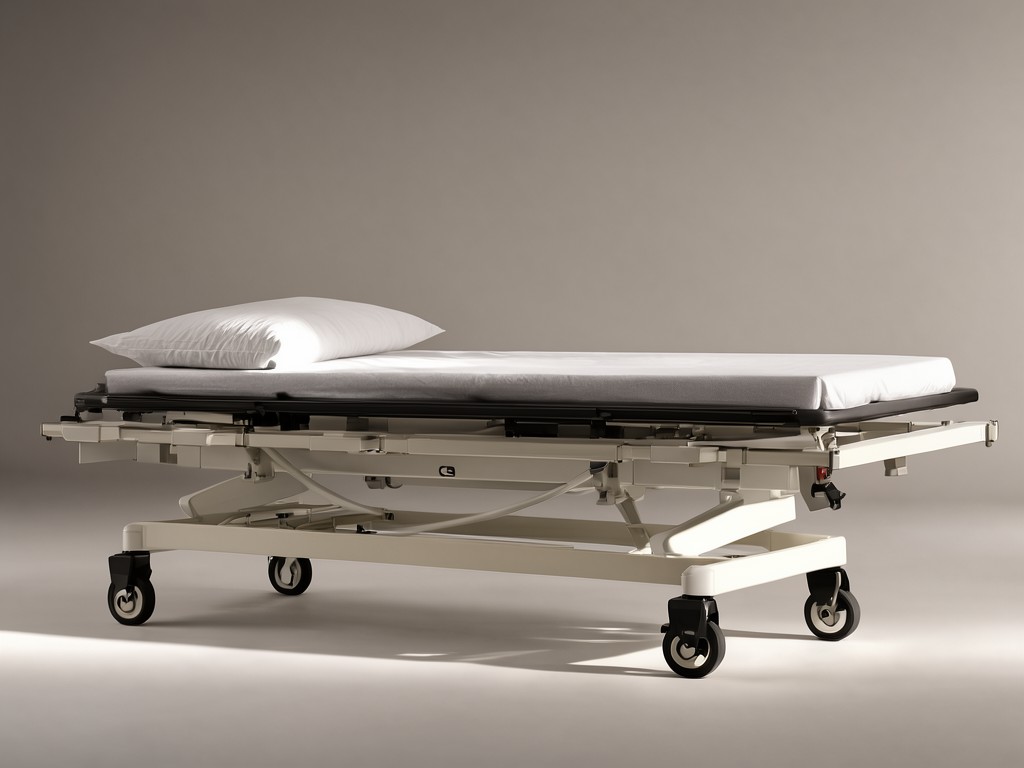
Construction Method and Its Effect on Consistency
Welded chassis construction locks the actuator mounting points into a single datum, keeping height repeatability within ±0.4 mm over 10,000 cycles. Bolted sub-assemblies introduce a stack-up of 0.15 mm per fastener, which accumulates to 0.6 mm deviation after full articulation. The chosen method also dictates the torque specification for the motor mount – 12 Nm for welded, 9 Nm for bolted – and influences the preventive maintenance schedule.
Specification Range and Customisation Limits
Height adjustment typically spans 400 mm to 800 mm, tilt angle 0° to 30°, and actuator speed 10 mm/s to 15 mm/s depending on the motor winding selected. Customisation beyond these bounds requires a new tooling validation because the load cell calibration shifts non-linearly past 800 mm.
Critical spec: maximum patient weight 180 kg; exceeding this voids the CE declaration and voids the actuator warranty.
Comparing Two Standard Configurations
Standard Configurations Compared
Two baseline configurations cover the majority of ward requirements.
Standard Electric (CE) – dual 24 V DC actuators, 150 kg load rating, 12 mm/s max speed, 48 dB at full load.
Weight: 68 kg; crate dimensions 2100×950×400 mm; includes handheld pendant with lockout.
Standard Manual (CE) – gas-spring assist, 130 kg load rating, manual crank, 0 dB operation.
Weight: 55 kg; crate dimensions 2050×900×380 mm; no electrical certification required beyond CE.
What Gets Checked Before Shipment
Every unit undergoes a 100 % load test at 1.25× rated capacity, a 5,000-cycle articulation run, and an electrical safety check per IEC 60601-1.
Dimensional inspection verifies height rail straightness within 0.3 mm/m and actuator stroke within ±2 mm.
Packaging is drop-tested from 750 mm to confirm freight integrity for sea containers.
Ready to lock in specifications and schedule a tooling review?
Request a tooling review