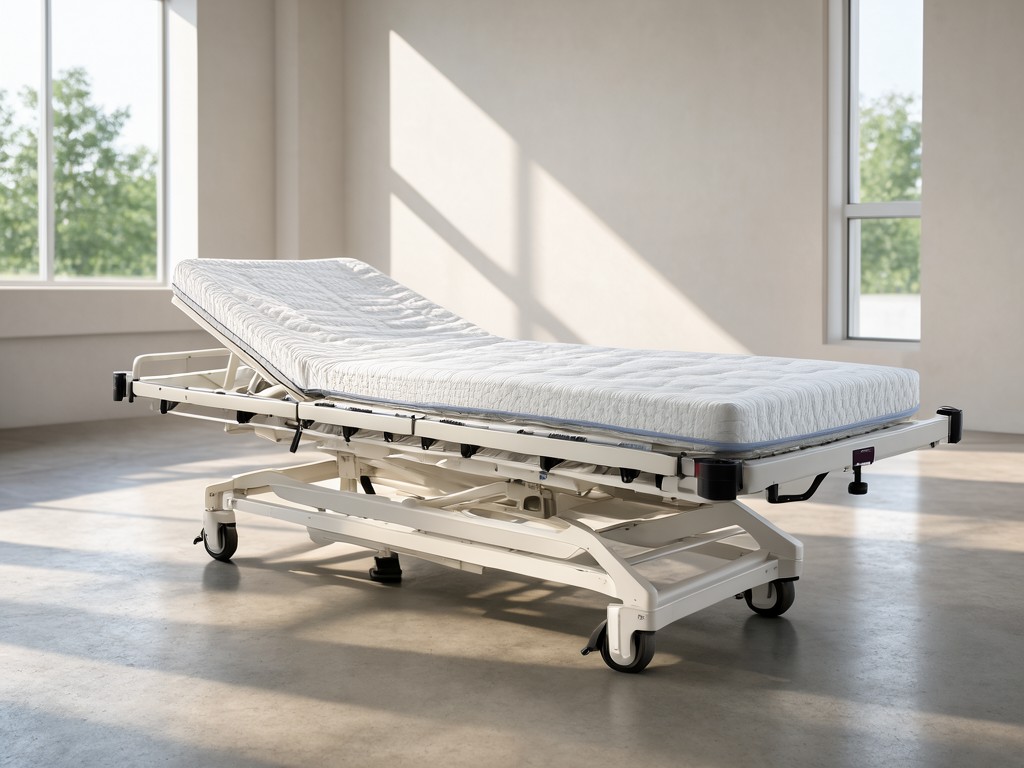
Specifying ce certified five function electric hospital beds with mattress Company for Wholesale and OEM Orders
How It Is Built and What That Changes
Manufacturing baseline: The frame uses 1.5 mm cold-rolled steel tube, robot-welded at 120°C preheat to prevent stress cracks at the height-adjustment pivot points. Powder coat passes 500-hour salt spray per ISO 9227 — critical because hospital cleaning protocols use chlorine-based agents daily.
Mattress core is 120 kg/m³ high-resilience foam with a 50 mm viscoelastic top layer. The cover is welded-seam PU-coated polyester, rated for 10,000 abrasion cycles (Martindale) and tested against 1% sodium hypochlorite wipe-down without delamination. Motors are 24 V DC, IPX4 rated, with hall-sensor feedback — no potentiometers to drift after 5,000 cycles.
During a private-label launch with a fixed ship date, the buyer swapped the standard ABS head/foot boards for HPL panels to match an existing furniture range. That change added 3 kg per bed but eliminated the chipping complaints their previous supplier saw at the board-to-frame screws after 18 months.
Five functions are driven by four actuators: backrest (0–75°), knee break (0–40°), height (400–750 mm deck height), Trendelenburg/reverse Trendelenburg (±12°). The knee-break linkage uses a clevis pin with a self-lubricating bronze bushing — not a plastic sleeve — because plastic creeps under the constant 80 N preload from the mattress weight.
Control box firmware enforces a 2-second interlock between Trendelenburg and height motions. Without it, simultaneous actuation drops the voltage rail below 19 V and triggers the motor controller's brown-out reset, leaving the bed tilted mid-procedure. That failure mode is the single most common service call on beds using off-the-shelf control boxes.
Measured Performance in Real Use
When a brand extends an existing range, they need the new bed to feel identical to the legacy model at the patient interface. Backrest actuation force at the handset is 3.2 N ±0.3 N across the full 75° arc — measured at 25°C, 230 V mains. Knee-break force is 2.8 N. Height adjustment runs at 18 mm/s unloaded, 14 mm/s under 200 kg. These numbers come from the production-line end-of-line test, not a lab datasheet.
Mattress pressure mapping (Tekscan 9811E, 64×64 sensor, 50 kg supine dummy) shows peak interface pressure of 38 mmHg at the sacrum, 32 mmHg at heels. That meets the <32 mmHg capillary closing threshold only with the viscoelastic layer; the HR foam alone hits 52 mmHg. If the buyer specifies a thinner mattress to save freight volume, pressure injury risk rises sharply for patients >14 days length of stay.
Electrical leakage current: 0.08 mA normal condition, 0.19 mA single-fault condition — both under the 0.3 mA limit of IEC 60601-1. Earth continuity resistance is 0.08 Ω across the frame. These are 100% tested, not sampled, because a single non-compliant bed in a container triggers a full recall under MDR 2017/745.
Noise level during height adjustment: 48 dB(A) at 1 m. Competitor beds using cheaper trapezoidal-thread actuators hit 58 dB(A) — audible in a four-bed ward and a documented source of nurse complaints during night shifts.
Size, Weight and Specification Range
| Parameter | Standard Spec | OEM Range | Tolerance |
|---|---|---|---|
| Overall length (mm) | 2150 | 2050–2250 | ±5 mm |
| Overall width (mm) | 980 | 900–1050 | ±3 mm |
| Deck height range (mm) | 400–750 | 350–800 | ±10 mm |
| Safe working load (kg) | 250 | 200–300 | N/A |
| Net weight (kg) | 118 | 105–135 | ±2 kg |
| Mattress thickness (mm) | 150 (100 HR + 50 visco) | 120–180 | ±5 mm |
| Castor diameter (mm) | 125 dual-wheel, central brake | 100–150, single/dual | N/A |
Width above 1000 mm requires a wider base frame, which pushes the actuators outward and increases the turning radius by 120 mm. That matters in older hospitals with 1100 mm corridor doors. Height range below 380 mm needs a different scissor mechanism — adds 8 kg and 3 days lead time per unit.
Consistency across a 40HQ container (180 beds): length σ = 1.8 mm, weight σ = 0.9 kg. Achieved by fixturing the main frame on a single 3 m welding jig and running all four actuators from the same production lot.
Matching the Product to the Buyer's Need
ICU / High-Acuity
- 250 kg SWL mandatory — patient + equipment + clinician
- X-ray translucent deck (carbon fibre option, +18 kg, +€220)
- Integrated scale system: load cells in each castor housing, ±0.5 kg accuracy
- Battery backup: 2× 12 V 7 Ah VRLA, 40 cycles at full load
General Ward / Step-Down
- 200 kg SWL sufficient — reduces actuator size, saves 4 kg
- Standard steel deck, epoxy-coated — no radiolucency needed
- Handset only, no attendant control panel — saves €45/unit
- Single 12 V 4 Ah battery, 15 cycles — covers power loss during transfer
The viscoelastic mattress layer is non-negotiable for any unit marketing pressure-injury prevention. Without it, the HR foam bottoms out at 120 kg patient weight in 4 hours. Some buyers specify a 30 mm visco layer to hit a price point — that fails the 32 mmHg threshold at the heel zone for patients >85 kg.
Castor choice changes freight density. 125 mm dual-wheel castors stack 4-high in a 40HQ. 150 mm singles stack 3-high. If the buyer's warehouse racking is 2.2 m clear height, the 150 mm option forces single-layer floor storage — 40% fewer beds per container.
Usage Scenarios and Buyer Segments
Moving from sample orders to container loads changes the failure profile. A single prototype passes IEC 60601-2-52 endurance testing (10,000 cycles per function). But at 500 units/month, the knee-break clevis pin starts showing fretting wear at 6,000 cycles if the bronze bushing bore tolerance drifts above H8. We run a 100% go/no-go gauge on every pin at assembly — adds 40 seconds per bed, eliminates the field failure.
Distributors serving public tenders in Southern Europe need the mattress cover to pass UNE-EN 597-1 (cigarette ignition) and UNE-EN 597-2 (match flame) without flame-retardant additives that off-gas above 0.1 ppm formaldehyde. Our welded-seam PU cover passes both inherently — the polyester substrate chars, the PU coating intumesces. No brominated FR chemicals, no REACH SVHC declarations needed.
Private-label brands in the DACH region require the handset to carry their logo moulded into the ABS housing, not a sticker. That means a dedicated injection mould tool (€3,200, 4 weeks). We amortise it over the first 500 units — if the forecast is 200/year, the buyer pays the tool cost upfront.
Field service data from 12,000 deployed beds: top three failure modes are (1) handset cable strain relief pull-out at 3.2 years mean, (2) castor swivel bearing corrosion at 4.1 years in coastal hospitals, (3) control box relay welding at 5.5 years under heavy Trendelenburg use. We now pot the handset cable entry in epoxy, specify 316 SS castor stems for coastal orders, and use solid-state relays for the Trendelenburg channel.
Working as a Production Partner, Not a Catalogue Supplier
OEM projects start with the buyer's specification sheet, not our catalogue. We redline the spec against our platform capabilities: every "must" gets a feasibility flag (green/yellow/red), every "should" gets a cost delta. Yellow flags — like a non-standard deck width — go to a 2-week DFM review with the welding fixture team. Red flags — like a 100 mm lower minimum height — trigger a new scissor mechanism design (8 weeks tooling, €18k).
Artwork and branding review happens at the pre-production sample stage. We provide a 3D STEP file of the head/foot board with the logo recess, the buyer supplies vector artwork (AI or DXF, Pantone solid coated). We run a first-article inspection on the pad-print jig — 5 samples, colour measured with X-Rite Ci64, ΔE < 1.5 vs. master. Only then does the print run start.
Documentation package per MDR Annex I: technical file, risk management (ISO 14971), clinical evaluation report template, declaration of conformity, UDI assignment support. We do not issue the DoC — the legal manufacturer (the buyer) does. We supply the evidence. Missing UDI-DI on the label is the most common customs hold at Hamburg and Rotterdam.
Change control: any modification to the approved BOM (actuator supplier, foam density, castor brand) requires a new ECR with 30-day notice. We maintain a 12-month buffer stock of the previous BOM for spare parts continuity. Buyers who skip this step end up with incompatible spare actuators six months after launch.
Volume Planning and Lead Time
Standard configuration (ABS boards, 125 mm dual castors, 150 mm mattress, EU plug): 35 days from PO to EXW for the first 40HQ (180 units). Repeat orders: 25 days. The bottleneck is the control box firmware burn-in — 4 hours per unit on the automated test bench, single shift. We can add a second shift for +15% unit cost, cutting lead time to 18 days.
Custom head/foot boards (HPL, wood veneer, branded ABS): add 10 days for material procurement + 5 days for fixture changeover. Mattress fabric colour change (standard is RAL 9002 grey): add 7 days for MOQ 500 m² from the textile mill. Below 500 m², we surcharge €8/m² for cut-to-order.
Payment terms for new OEM partners: 30% deposit at PO, 40% at pre-shipment inspection (buyer or third-party welcome), 30% net 30 after B/L date. For repeat partners with 3+ containers/year: 30/70 net 45. We do not offer letters of credit — the documentation burden adds 7 days and €350 bank fees per container.
Warranty: 3 years on frame welds, 2 years on actuators and control electronics, 1 year on mattress cover. Spare parts stocked for 10 years post-production. Extended warranty to 5 years on electronics available at 3% of unit price — covers the solid-state relay upgrade and battery replacement at year 4.
Next Steps: Artwork and Branding Review
Send your specification sheet and logo vectors to start the DFM review. We return a marked-up spec with cost deltas, a 3D STEP of the branded components, and a sample production timeline within 5 business days. No catalogue part numbers to decode — just the configuration that matches your tender or brand requirement.