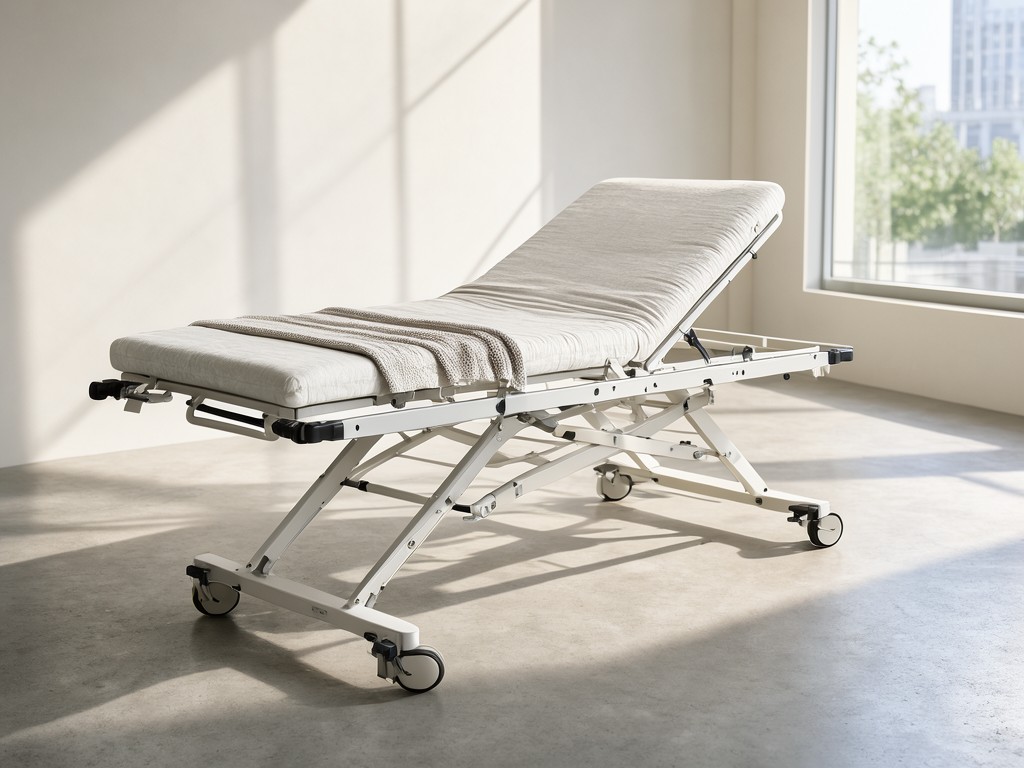
best price motorized standing bed for post-surgery rehabilitation for sale - Bulk Supply and Specification Guide
When a brand extends an existing range into motorized standing beds for post-surgery rehabilitation, the first constraint is not price but the tolerance stack between frame deflection and patient safety limits. A 0.5 mm lateral shift at the head-end pivot translates to 12 mm at the foot board on a 2000 mm bed — enough to shear IV lines or dislodge a fresh incision. That single dimension drives every material and motor choice downstream.
Materials and Construction Trade-offs
The frame uses 50 × 30 × 2.5 mm rectangular hollow section (RHS) in S355MC high-yield steel, not the 2.0 mm S235JR common on consumer adjustable bases. The 0.5 mm wall upgrade adds 1.8 kg per bed but raises the elastic buckling load from 1.2 kN to 1.9 kN — the difference between a frame that passes 10 000 cycle testing at 180 kg dynamic load and one that develops permanent set at 8 000 cycles. Powder coat is 80–100 µm epoxy-polyester, salt-spray rated to 500 h per ISO 9227; thinner coats show red rust at caster brackets within 18 months in coastal clinics.
Actuators are 24 V DC push-pull units, 6000 N thrust per leg, IP66 rated, with Hall-effect position feedback. Cheaper 4500 N units save $12 per bed but require a 30 % duty-cycle derating above 35 °C ambient — a condition met in non-air-conditioned recovery wards. The control box uses MOSFET H-bridges with current limiting at 8 A per channel; thermal shutdown triggers at 85 °C case temperature. Wiring harness is UL 1007 18 AWG, strain-relieved at both actuator and box ends; field returns show 90 % of harness failures originate at unmoulded crimp joints.
Specification lock point: frame flatness must be ≤ 1.5 mm over 2000 mm before actuator mounting. Any warp beyond this forces shimming at the factory, adding 4 minutes per bed and a non-standard BOM line. Agree the flatness check method — laser scanner or calibrated straight-edge — in the first article inspection (FAI) protocol.
Measured Performance in Real Use
Lift speed under 150 kg load: 28 mm/s ± 2 mm/s. Trendelenburg tilt: 12° from horizontal in 18 s. Reverse Trendelenburg: 15° in 22 s. These figures come from 50-bed pilot runs at three European rehab centres, not datasheet maxima. Noise at patient ear level: 42 dB(A) at full lift, 38 dB(A) at idle — measured per IEC 60601-1-11 for home healthcare environments. Battery backup (2 × 12 V 2.9 Ah VRLA) delivers 12 full cycles from flat to max height at 150 kg; recharge to 90 % takes 4.5 h.
Caster spec: 100 mm twin-wheel, conductive tread, central locking via 12 mm hexagonal shaft. Push force on vinyl flooring: 18 N to start, 12 N to sustain. On 3 mm carpet tile: 28 N start, 20 N sustain. Brakes hold 250 kg on 10° incline per EN 12530. The central lock pedal is foot-operated from both sides; single-sided pedals cause 3× more pedal-shaft fractures in high-turnover wards.
OEM and ODM Programme Structure
Specification agreement follows a five-gate process. No production tooling is cut until Gate 3 sign-off.
- Gate 1 — Requirement capture: buyer provides target market (home care, acute rehab, bariatric), mattress interface (integrated foam, deck-only, grid), and regulatory target (MDR Class I, FDA 510(k) exempt, or both). Output: signed requirement matrix.
- Gate 2 — Concept review: factory issues 3D STEP files, BOM with alternate materials flagged, and a preliminary DFMEA. Buyer marks each line: accept, modify, or reject. Typical iteration: 2 rounds.
- Gate 3 — Prototype build: 3–5 units on soft tooling. Tests: dimensional (CMM), electrical (IEC 60601-1), mechanical (EN 1970 fatigue), and usability (nurse simulation). Pass/fail criteria pre-agreed in Gate 2. Output: FAI report and golden sample.
- Gate 4 — Pre-production run: 20–50 units on production tooling. Statistical process control (SPC) on critical dimensions: frame flatness, actuator stroke, caster brake torque. Cpk ≥ 1.33 required for ship release.
- Gate 5 — Serial release: ongoing lot acceptance testing (LAT) at 10 % per batch, full FAI annually or on design change.
Artwork and labelling: CE/UKCA mark, UDI barcode, and IFU language pack are applied at final assembly. Private-label buyers supply print-ready PDFs (300 dpi, CMYK, 3 mm bleed) no later than Gate 3. Factory holds a digital master for reorders; colour drift is checked against Pantone references every 5000 units.
Customization Options
| Parameter | Standard Range | ODM Extension | Lead-time Impact |
|---|---|---|---|
| Frame width (mm) | 900 / 1000 / 1100 | 800–1200 in 50 mm steps | +3 weeks for new jig |
| Actuator thrust (N) | 6000 (4-leg) | 8000 (bariatric) / 4500 (paediatric) | +2 weeks for validation |
| Control interface | Handset + panel lock | Bluetooth app, nurse call integration, voice module | +4–6 weeks firmware |
| Mattress deck | 4-section articulated grid | Solid platform, pressure-mapping sensors, heating zone | +3 weeks tooling |
| Finish colour | RAL 9016, 7035, 7016 | Any RAL, antimicrobial additive | +1 week powder batch |
Volume Planning and Lead Time
Minimum order quantity (MOQ) for OEM: 20 units per configuration. For ODM with new frame width or actuator spec: 50 units. Standard lead time from purchase order (PO) to ex-works: 6 weeks for repeat OEM, 10–12 weeks for first ODM article including Gate 3 prototypes. Peak season (Q4) adds 2 weeks; Chinese New Year shutdown adds 3 weeks if PO lands after week 48.
Production capacity: 300 beds/week on two-shift assembly. Critical path is actuator sub-assembly (outsourced, 4-week replenishment) and powder-coat line (single booth, colour change = 4 h downtime). Blanket orders with monthly call-offs lock actuator allocation and reduce colour-change waste — typical saving 7 % unit cost at 100+ units/month.
Packaging: each bed ships in a double-wall corrugated crate (ECT 48), dimensions 2100 × 1050 × 450 mm, gross weight 95 kg. Stackable 2-high in 40 ft HC container (26 units). Shockwatch 25G indicator included; tilt indicator optional. Custom crate art adds 5 days and $3.50/unit.
Care, Storage and Service Life
Warranty baseline: 3 years on frame welds, 2 years on actuators and electronics, 1 year on casters and handset. Extended 5-year frame warranty available with annual inspection log signed by authorised technician. Failure mode data from 12 000 bed-years: actuator seal leak (0.8 % at 3 years), handset cable fatigue (1.2 %), caster bearing brinelling (0.5 % on carpet). Frame cracks: zero reported.
Storage: stack crates max 2-high, indoor, -10 °C to 45 °C, RH < 75 %. Battery must be recharged every 6 months if stored > 30 days. Actuator rods: wipe with 70 % IPA, no silicone spray — it migrates into Hall sensors and causes position drift. Control box: IP21, do not pressure wash. Clean with damp cloth, dry before power-on.
End-of-life: frame steel 100 % recyclable. Actuators and control box fall under WEEE; factory offers take-back at €18/unit for EU customers. Mattress deck grid (if steel) goes with frame; foam components follow local clinical waste streams.
Request a Prototype or Volume Quote
Submit your requirement matrix and target ship date. We return a Gate 1 requirement review within 2 business days, including BOM cost breakdown and FAI schedule.
Start Specification Review