Specifying Wholesale three crank manual medical beds with casters Supplier for Wholesale and OEM Orders
Fatigue appears at the stress concentration where the crank shaft meets the worm gear housing, not at the rated load printed on the carton. A bed that passes a static 250 kg test can still generate warranty claims within six months if the gear teeth are cut from sintered powder metal instead of hobbed from 45 # steel, because the contact patch collapses under repeated 90-degree backrest cycles. Buyers who specify only the headline safe working load miss the variable that actually drives return rates: crank torque retention after 5,000 cycles.
The limiting factor is rarely the headline specification but the interaction between caster stem retention and frame weld geometry when the bed is moved across expansion joints at 4 km/h. A 125 mm dual-wheel caster with a precision ball bearing raceway and a 32 mm stem diameter transmits shock loads directly into the corner gusset; if that gusset is a 3 mm fillet weld rather than a 6 mm full-penetration joint, the frame develops hairline cracks at the head-end corner within 18 months of ward service. This is the failure mode that empties inventory buffers and triggers re-order disputes.
Where This Product Beats Standard Alternatives
Standard two-crank beds force the caregiver to choose between backrest elevation and knee-break adjustment, leaving the patient flat during the transition. The three-crank layout decouples these motions: crank one drives the backrest through 0-75°, crank two articulates the knee section 0-40°, and crank three adjusts deck height 450-750 mm without shifting the patient's centre of gravity. The torque required at the handle remains below 8 Nm across the full range because each gearbox uses a 24:1 worm ratio with a 14 mm output shaft supported by two 6202-ZZ bearings, eliminating the binding that plagues single-shaft designs.
Casters are not an afterthought. Each bed ships with four 125 mm TPR-tread wheels, two directional-locking and two total-locking, mounted on cold-forged stems that are interference-fit into 35 mm OD × 3 mm wall tubular sockets. The stem-to-socket joint sees a 1.2 kN pull-out test before powder coating, and the brake cam is machined from brass rather than stamped steel, so the parking force does not degrade after 10,000 engagements. Competing beds at this price point typically use 100 mm nylon wheels with plastic brake levers that crack at -10 °C.
Size, Weight and Specification Range
| Parameter | Standard Range | OEM Customisation Window | Tolerance |
|---|---|---|---|
| Overall length (mm) | 2150 | 2100-2250 in 25 mm steps | ±5 mm |
| Overall width (mm) | 980 | 920-1050 (side rail dependent) | ±3 mm |
| Deck height range (mm) | 450-750 | 400-800 (requires longer lead screw) | ±10 mm |
| Backrest angle (°) | 0-75 | 0-80 (gas spring assist optional) | ±2° |
| Knee-break angle (°) | 0-40 | 0-45 | ±2° |
| Safe working load (kg) | 250 | 200-300 (frame gauge change) | ±5% |
| Net weight (kg) | 68 | 62-78 | ±2 kg |
| Caster diameter (mm) | 125 | 100, 125, 150 | ±1 mm |
Comparing Two Standard Configurations
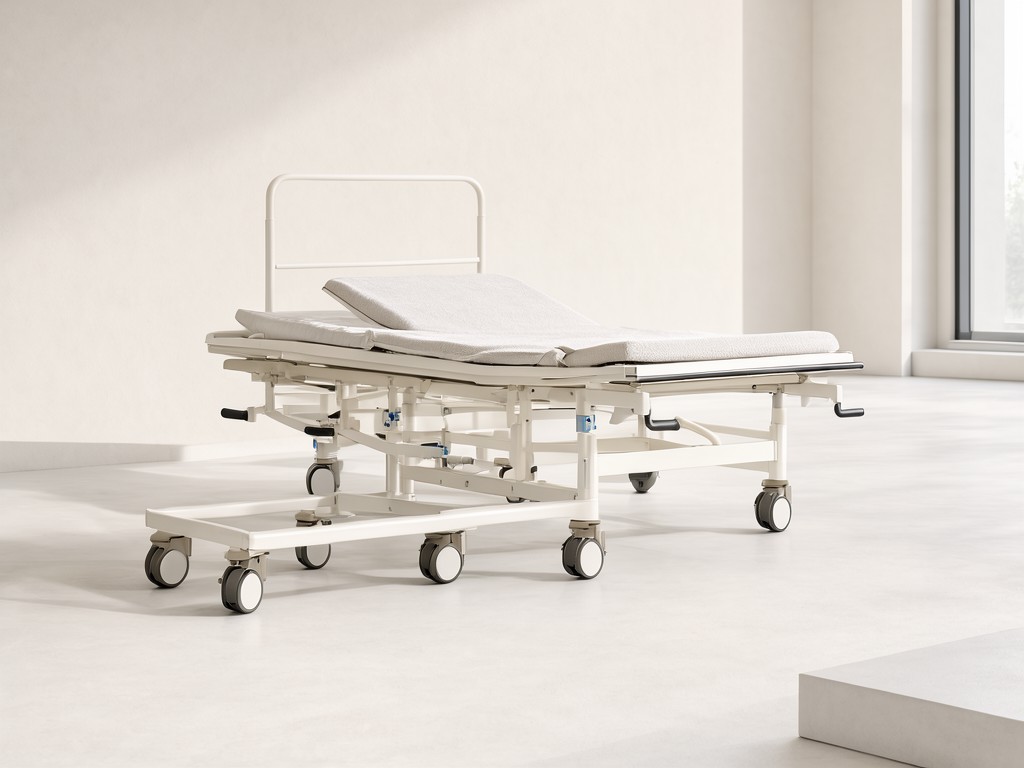
Config A: Ward Standard
Frame: 40 × 40 × 2 mm rectangular tube, epoxy-polyester powder coat 80 μm minimum. Head/foot boards: 12 mm HDPE, blow-moulded, recessed mounting brackets. Crank handles: fold-away polypropylene, 160 mm radius. IV pole sockets: four corners, 25 mm ID. Mattress retainer: welded wire grid, 50 × 50 mm mesh.
Best for: General ward, 4-6 bed bays, 8-10 year replacement cycle. Unit cost at 50+ MOQ: $142 EXW. Container load: 96 units / 40'HQ.
Config B: ICU / High-Acuity
Frame: 50 × 50 × 2.5 mm rectangular tube, zinc-rich primer + epoxy topcoat 120 μm. Head/foot boards: 15 mm ABS with integrated CPR release lever. Crank handles: stainless steel 304, fixed, 180 mm radius. IV pole sockets: six positions, 32 mm ID. Mattress retainer: perforated steel deck, 8 mm holes on 25 mm pitch. X-ray cassette tunnel: 350 × 25 mm under backrest.
Best for: ICU, step-down, bariatric-capable wards. Unit cost at 50+ MOQ: $218 EXW. Container load: 84 units / 40'HQ.
Weight and stiffness trade off against each other in the frame tube selection. The 2.5 mm wall in Config B adds 9 kg but reduces deck deflection under a 250 kg centred load from 18 mm to 11 mm, which matters when an overhead lift frame mounts to the bed ends. The zinc-rich primer on Config B survives 500 hours neutral salt spray (ISO 9227) without red rust; Config A shows creep at the scribe line after 240 hours. For coastal hospitals or high-humidity wards, the primer upgrade pays back in two repaint cycles.
How Consistency Is Held Across Batches
Every production lot undergoes a first-article inspection against a master gauge set that checks 27 critical dimensions: crank centre-to-centre distance, caster stem perpendicularity, deck flatness, and side rail latch engagement depth. The gauge set itself is calibrated quarterly against a CMM with ±0.02 mm uncertainty. If the first article shows crank centre distance drift beyond ±0.5 mm, the fixture is re-shimmed before the run continues — no "sort and ship" on dimensional deviations.
Crank gearboxes are 100% torque-tested at 12 Nm input for 50 cycles; any unit exceeding 0.8 Nm breakaway torque on the third cycle is rejected. This catches heat-treat variance in the worm wheel before it reaches the customer. Caster brakes are cycled 200 times on a pneumatic rig; the holding force must stay within 15% of the initial reading. Powder coat adhesion is verified by cross-hatch (ISO 2409) on every 50th frame, and film thickness is mapped at 12 points per bed with a magnetic gauge — minimum 80 μm, maximum 140 μm to avoid orange peel on the head boards.
Traceability and Batch Documentation
Each bed carries a laser-etched data matrix on the foot-end frame tube encoding: production date, fixture ID, gearbox serial numbers, caster lot codes, and powder batch number. The accompanying quality pack includes the first-article report, torque test log, salt spray certificate for the primer batch (when Config B is ordered), and a dimensional checklist signed by the line QC. This pack ships in a sealed sleeve inside the carton — not emailed separately — so the receiving warehouse can audit without chasing files.
Volume Planning and Lead Time
| Order Band | Lead Time (Calendar Days) | Tooling Amortisation | Packing Option |
|---|---|---|---|
| 10-49 units (spot buy) | 18-22 | N/A — standard fixtures | Single carton, knock-down |
| 50-199 units (stock replenishment) | 25-30 | N/A — standard fixtures | Single carton, knock-down |
| 200-499 units (annual blanket) | 35-40 | $1,200 dedicated fixture set, amortised at $6/unit | Bulk crate, 4 units/pallet |
| 500+ units (OEM programme) | 45-55 (first delivery), then 30-day rolling | $3,800 custom fixture + gauge set, amortised at $4/unit over 1,000 | Custom palletisation, label spec per PO |
The step-change at 200 units reflects the switch from shared-line scheduling to a dedicated cell with its own welding jig and gearbox assembly station. Below that threshold, changeover time eats 35% of available capacity. Above it, the cell runs a 22-day takt producing 18 beds per shift, and the fixture cost drops below the freight variance between LCL and FCL. For private-label programmes, the custom fixture set includes your branded head-board mould tool — budget an additional 15 days for T1 sampling and colour approval before the production clock starts.
Keeping Repeat Orders Supplied
We hold safety stock of the top 12 long-lead components — worm wheels, 6202-ZZ bearings, caster stems, and powder coat batches — sized to cover 60 days of the rolling 12-month forecast you provide. When your blanket order drops a release, the cell pulls from this buffer; replenishment orders to our sub-suppliers trigger at the 30-day cover level. This decouples your 30-day release cycle from our 45-day raw material lead time.
Colour consistency across production years is managed by locking the polyester resin batch and pigment masterbatch lot for the duration of your programme. We retain a 5 kg reference panel from each powder lot; if a re-order arrives 18 months later, the new coat is sprayed on a test coupon and measured with a spectrophotometer (D65/10°) — ΔE must stay ≤ 1.2 versus the reference. No visual match approval; the data travels with the quality pack.
Spare parts kits are configured per 100 beds deployed: 4 gearbox assemblies, 8 caster sets, 12 crank handles, 20 side rail latches, and 500 g touch-up powder in the programme colour. Kits ship in the same carton footprint as the beds, so they slot into your existing warehouse locations. Replenishment of the kit itself is automatic — when you scan the last gearbox, the ERP triggers a restock PO to us with zero manual intervention.
Next Step: Tooling Review
If your forecast sits above 200 units annually, the dedicated fixture set pays for itself in the first container. Send your current spec sheet, target price, and annual volume breakdown to /contactus and we will return a fixture design review, a first-article timeline, and a landed cost model for your port within three business days.