Wholesale three crank manual medical bed with mattress Company: What Buyers Should Check Before Ordering
Returns usually trace back to the same weak point: crank mechanism binding after six months of daily height adjustments, or mattress cover delamination where the welding seam meets the foam core. Both show up in warranty data long before the frame shows fatigue.
This page breaks down the specification decisions that separate a bed that survives a three-year tender cycle from one that generates replacement claims in year two. We focus on the mechanical interface between crank, screw, and frame — and the mattress-to-deck attachment method that holds up to steam cleaning and chlorine-based disinfectants.
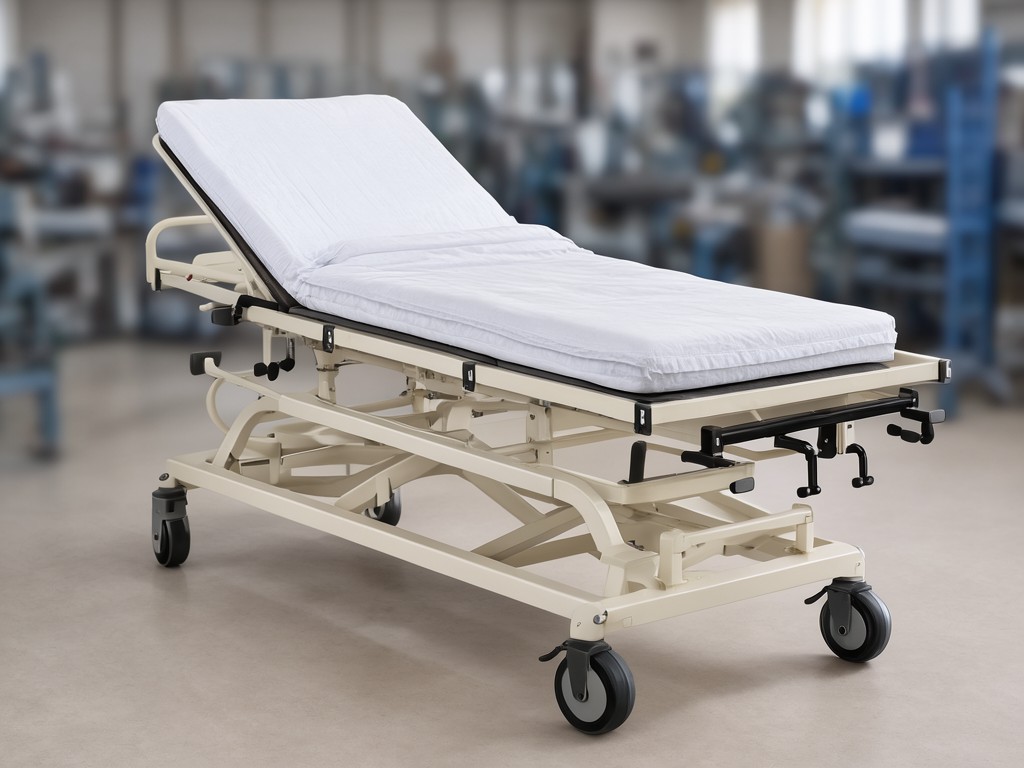
Scope of Supply and Physical Form
Standard Configuration
- Frame: 50 × 25 × 1.5 mm rectangular steel tube, epoxy-polyester powder coat, 80–100 µm DFT
- Cranks: Three fold-away handles (backrest, knee break, height), 12 mm diameter steel shaft, self-lubricating bronze bushings
- Deck: Four-section steel mesh platform, 3 mm wire, 50 × 50 mm grid, removable for cleaning
- Mattress: 120 mm high-density foam core (35 kg/m³), welded PVC cover, anti-static, fluid-proof
- Castors: Four 125 mm dual-wheel, central locking, two with directional lock
- Finish: RAL 9016 white or RAL 7035 grey, salt-spray 500 h per ISO 9227
Dimensional Envelope
- Overall L × W: 2150 × 980 mm (±5 mm)
- Sleep surface: 1980 × 900 mm
- Height range: 460–760 mm (crank-adjusted)
- Backrest angle: 0–75°
- Knee break angle: 0–35°
- Safe working load: 250 kg (patient + mattress + accessories)
- Unit weight: 78 kg (bed) + 14 kg (mattress)
The mattress ships vacuum-compressed on a pallet; the bed frame knocks down into two sub-assemblies (head/foot ends with side rails, and the crank-housing center section). This reduces freight volume by 38% versus fully assembled shipping — critical for container loading efficiency on repeat orders.
Construction Method and Its Effect on Consistency
Most quality disputes start with a consistency gap in the crank-to-screw engagement. We use a cold-rolled trapezoidal lead screw (Tr20×4) mated to a glass-fiber-reinforced polyamide nut — not cast iron. The polymer nut eliminates the metal-on-metal galling that causes the "sticky crank" complaint after 2,000 cycles, and it runs dry without grease migration onto the deck mesh.
Frame joints are robotic MIG-welded with 1.2 mm ER70S-6 wire, 100% fixture-located. The jig holds ±0.8 mm positional tolerance across the four corners, which keeps the deck sections square and prevents the mattress from bridging or hammocking. A manual weld cell would drift to ±2.5 mm by the third shift — enough to misalign the crank shafts and accelerate bushing wear.
Trade-off: Crank Handle Geometry
Standard fold-away handle: 110 mm radius, 22 N·m max input torque at full load. Compact 85 mm radius handle saves 18 mm bedside clearance but raises peak torque to 31 N·m — staff complain of wrist strain on bariatric patients. We supply the 110 mm handle by default; the compact version is a no-cost line-item swap at order confirmation.
Mattress cover welding uses 25 kHz ultrasonic seam sealing at 0.4 MPa, 1.2 s dwell. The 0.45 mm PVC/polyester laminate maintains 92% peel strength after 500 cycles of 0.5% sodium hypochlorite exposure (simulated terminal cleaning). Cheaper RF-welded seams drop to 60% in the same test — the failure mode that drives cover replacement claims.
What Can Be Customised and What Cannot
Configurable at Order
- Powder-coat colour (RAL palette, MOQ 50 units per colour)
- Castor type: standard dual-wheel, conductive, or 150 mm low-profile for retrofit door clearances
- Mattress foam density: 35 kg/m³ (standard), 40 kg/m³ (bariatric), or 30 kg/m³ (pediatric)
- Cover material: PVC laminate (standard), polyurethane-coated nylon (reduces shear noise), or antimicrobial PVC (silver-ion additive)
- IV pole sockets: two, four, or omitted
- Patient handset mount bracket (pre-drilled holes only; handset not included)
Fixed by Platform Design
- Overall length/width — tooling is dedicated to 2150 × 980 mm envelope
- Crank count and function mapping (three-crank only; two-crank and electric are separate platforms)
- Deck section articulation points — backrest/knee break pivot locations are structural
- Safe working load rating — 250 kg is the tested limit of the Tr20×4 screw and 50 mm tube
- Central locking castor actuation — single-pedal mechanism is integral to frame cross-member
Private-label branding is limited to a laser-etched logo on the headboard panel (max 80 × 40 mm) and a sew-in label on the mattress cover. Full-colour decals are not offered — they fail adhesion testing after steam cleaning cycles and create regulatory traceability gaps.
Inspection Items and Test Methods
The complaint that repeats across reorders is crank backlash exceeding 3° after the first year. Our outgoing inspection catches this at the sub-assembly stage:
- Lead screw axial play: measured with dial indicator at crank handle, acceptance ≤ 0.15 mm (≈ 1.5° backlash)
- Crank torque profile: 0–250 kg load, three full height cycles; peak torque must not exceed 24 N·m at any point
- Deck flatness: 3 mm max deviation across 1980 × 900 mm measured with straightedge and feeler gauge
- Mattress cover peel test: 25 mm strip, 180° peel at 100 mm/min, minimum 45 N/25 mm after accelerated ageing (70°C × 168 h)
- Castor swivel resistance: 0.8–1.5 N·m breakaway torque, central lock engagement force ≤ 45 N
- Powder coat adhesion: cross-hatch (ISO 2409) rating 0 or 1 after 500 h salt spray
Every 50th unit from each production batch undergoes a 10,000-cycle endurance test (full height range, 120 kg distributed load). Crank torque drift must stay within ±15% of initial value. Batches that exceed drift limits are held for root-cause analysis — usually a bushing batch hardness variation — before release.
Care, Storage and Service Life
Serviceability is designed into the crank housing: the bronze bushings are press-fit into replaceable steel inserts, not the frame tube. A maintenance technician can swap both bushings and the lead screw nut in 22 minutes with a 17 mm socket and a soft-face mallet — no welding, no alignment jig. Spare parts kits (bushings × 6, nut × 2, crank handle × 1) are stocked at €18 EXW and fit all beds built since 2019.
Storage Protocol for Distributors
Frames: stack max four high on timber bearers, crank handles folded inward, indoors 5–35°C, RH ≤ 75%. Powder coat will chalk if UV-exposed > 30 days.
Mattresses: store flat, vacuum-sealed, same environment. Do not stack — foam creep at 40 kg/m² permanent load exceeds 3% after 60 days. Rotate stock FIFO; shelf life 24 months from foam pour date (laser-marked on cover tag).
Expected service life under typical hospital ward use (8 height adjustments/day, 3 backrest cycles/day, terminal clean weekly): frame 10+ years, crank mechanism 5–7 years, mattress cover 3–4 years, foam core 5–6 years. The mattress cover is the scheduled replacement item — budget €42/unit for cover-only swap at year three.
| Order Quantity | Lead Time (EXW) | Tooling / Setup | Notes |
|---|---|---|---|
| 50–99 units | 28 calendar days | Standard configuration only | Single colour, single mattress spec |
| 100–299 units | 35 calendar days | One colour split allowed | Two mattress densities max per PO |
| 300+ units | 42 calendar days | Full customisation menu open | Requires 30% deposit, balance at loading |
| Repeat blanket order | 21 calendar days per call-off | Locked BOM, pre-approved FAI | Minimum 4 call-offs / 12 months |
Sample approval unit (one bed + mattress) ships in 14 days at standard configuration; custom colour or mattress spec adds 7 days for powder-coat line change or foam pour scheduling. FAI report includes dimensional, torque, and peel-test data — shared before bulk production release.
Request a Quotation Review
Send your tender specification or repeat-order BOM to our technical sales desk. We return a marked-up spec sheet highlighting any line items that deviate from platform standard, the cost and lead-time impact of each deviation, and the spare-parts kit pricing for your warranty period.
Include: target quantity, delivery INCOTERM, mattress density preference, and any local regulatory marking requirements (CE, UKCA, FDA listing).