wholesale one crank manual nursing beds with mattress manufacturer: Specification, Ordering and Quality Notes
Construction Method and Its Effect on Consistency
The frame is welded from 30 × 30 × 1.5 mm rectangular steel tube, bent on a CNC mandrel bender to hold ±0.5 mm radius repeatability across a 40-foot container run. Two-piece head and foot boards are stamped from 1.2 mm cold-rolled sheet, then powder-coated in a single 80 μm pass — no primer coat, which eliminates an adhesion interface that fails under terminal cleaning protocols.
Crank mechanism uses a 16 mm diameter trapezoidal lead screw (Tr16×4) with a bronze nut pressed into a reinforced nylon housing. The single crank drives both back-rest and knee-break sections through a torque tube; backlash is shimmed to 0.15–0.25 mm at assembly. This tolerance window is the practical limit for manual operation — tighter and the crank binds after three months of daily chlorine wipe-downs; looser and the patient feels "play" during position changes.
Critical Tolerance Rule
Lead-screw backlash >0.3 mm after 500 cycles triggers rework. Bronze nut wears 0.02 mm per 1,000 cycles under 120 kg load; schedule replacement at 18-month intervals in high-acuity wards.
Powder-Coat Durability
Single-pass 80 μm epoxy-polyester withstands 1,000 hours salt spray (ASTM B117) and 5,000 cycles of 0.5% sodium hypochlorite wipe-test. No primer means 15% faster line speed but zero rework window for coating defects.
Mattress platform uses 1.0 mm perforated steel deck, spot-welded on 50 mm pitch. Perforation pattern (8 mm holes, 12 mm centres) balances airflow against structural deflection — max 6 mm centre sag under 135 kg static load. Deck is powder-coated same spec as frame; no galvanizing underneath because chloride ingress at weld toes accelerates white rust in humid storage.
Customisation Options and Their Limits
Buyers typically specify three variables: deck perforation density, crank handle geometry, and mattress core density. Each choice moves cost and lead time differently.
| Option | Standard Spec | Custom Range | Cost Delta | Lead-Time Impact |
|---|---|---|---|---|
| Deck perforation | 8 mm holes, 12 mm centres | 6–10 mm holes, 10–15 mm centres | +3–7% per variant | +5 days for new punch die |
| Crank handle | Fold-away polymer grip, 120 mm radius | Fixed aluminium, 100–150 mm radius; antimicrobial coating | +$1.20–2.80/unit | +3 days if non-stock grip |
| Mattress core | 25 kg/m³ CMHR foam, 120 mm thick | 28–35 kg/m³ CMHR or 40 kg/m³ visco topper (30 mm) | +8–22% per density step | +7–14 days for foam cure |
Side rails are not customizable — they are a fixed 300 mm high, four-bar linkage design that passes IEC 60601-2-52 entrapment tests. Adding height or split-drop configurations requires new tooling (12-week lead) and re-certification; not viable for runs under 500 units.
Colour matching: RAL 9016 (traffic white) and RAL 7035 (light grey) are stock. Custom RAL adds €0.45/unit and requires 30 kg minimum powder batch — roughly 120 beds. Metallic or textured finishes fail the chlorine wipe-test at 6 months; we decline those requests.
Usage Scenarios and Buyer Segments
Primary volume comes from three channels: public hospital tenders (500–2,000 beds per award), private nursing home chains (50–200 beds per refurbishment cycle), and export distributors consolidating containers for regional health ministries. Each channel stresses different failure modes.
Public Hospital Tender
Cycle life: 15 position changes/day, 365 days/year. Crank mechanism sees 5,475 cycles/year — bronze nut replacement at 18 months aligns with preventive maintenance schedules.
Cleaning: terminal sodium hypochlorite 0.5% twice daily. Powder coat must pass 5,000 wipe cycles without gloss loss >15%.
Private Nursing Home Chain
Cycle life: 8 changes/day, but higher resident weight percentile (90th = 115 kg). Deck deflection and foam bottom-out become warranty drivers.
Aesthetic retention: visible frames in resident rooms. Colour fade ΔE <2 after 3 years UV exposure through windows.
Export Distributor / Ministry
Freight density: 40-bed container target. Knock-down packaging must survive 14-week sea transit, 40°C/90% RH hold conditions.
Documentation: bilingual labels, CE/UKCA declaration, certificate of origin per shipment. Batch traceability to heat number.
Quality Control and Batch Consistency
Every 50th frame pulls for dimensional audit: overall length ±3 mm, deck flatness ≤6 mm, crank centre height ±2 mm. Weld coupons from each shift (two per 8-hour run) undergo macro-etch and hardness traverse — target 180–220 HV at fusion line. Coating thickness mapped at 9 points per frame; any reading <60 μm or >100 μm holds the batch for 100% re-check.
Mattress foam density verified by 300 mm cube cut from each slab batch (one slab = 12 mattresses). ILD @ 25% compression must fall within ±1.5 N of spec. Cover fabric tensile strength tested per ISO 13934-1; seam slippage ≤3 mm at 180 N. Failed slab quarantines 144 mattresses — buyer sees this as a hold point, not a reject rate.
Batch Release Gate
No shipment leaves without: (1) dimensional audit sheet signed by QC lead, (2) coating thickness map PDF, (3) foam density certificate with slab ID, (4) crank torque test log (break-away ≤8 Nm, running ≤5 Nm). Missing any document = container held at dock.
Inspection Items and Test Methods
| Inspection Item | Method / Standard | Acceptance Criteria | Frequency |
|---|---|---|---|
| Frame weld integrity | Visual per ISO 5817 Level C + macro-etch coupon | No cracks, undercut <0.5 mm, reinforcement 1–3 mm | 2 coupons/shift |
| Crank torque | Digital torque wrench, 0–20 Nm range | Break-away ≤8 Nm, running ≤5 Nm @ 120 kg load | 100% at final assembly |
| Coating adhesion | Cross-cut tape test ISO 2409 | Classification 0 or 1 (no flaking) | 5 frames/lot |
| Mattress foam density | ISO 845 (300 mm cube) | Spec ±10% (e.g., 25 kg/m³ ±2.5) | 1 cube/slab (12 mattresses) |
| Cover fabric abrasion | Martindale ISO 12947-2, 12 kPa | ≥50,000 cycles to thread break | Per fabric roll |
| Entrapment gaps | IEC 60601-2-52 test cones & cylinders | No head/neck/chest entrapment per zones 1–7 | First article + 1/lot |
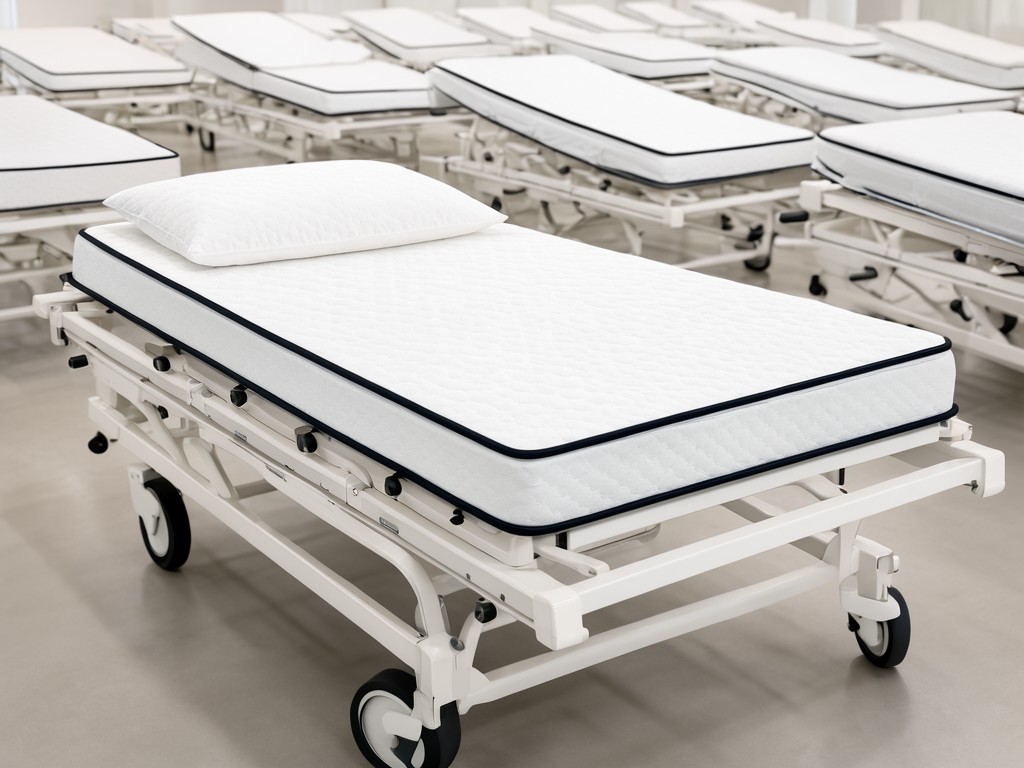
Accelerated life test: one bed per 500-unit batch runs 10,000 crank cycles (back-rest 0–70°, knee-break 0–22°) under 100 kg simulated load. Post-test backlash check, coating inspection, and foam ILD retention ≥90% of baseline. Failure rate target <0.5%; actual runs 0.2–0.3% over last 18 months.
Capacity, Tooling and Scheduling
Two production lines, each rated 40 beds/day single shift (welding, coating, assembly, pack-out). Coating line is the bottleneck — 8-hour cure cycle limits throughput to 320 frames/day max. Adding a second cure oven (€180k capex) would lift to 600/day but requires 16-week lead and re-validation of coating spec.
Tooling Ownership
Stamping dies for head/foot boards and side-rail linkages are customer-owned after 5,000-unit cumulative order. Before that threshold, we amortize die cost (€12k–18k per set) into unit price. Crank mechanism fixtures are house-owned — standard across all one-crank variants.
Changeover Penalty
Switching between RAL 9016 and RAL 7035 costs 4 hours line downtime (purge, bake-out, first-article approval). Custom RAL adds 8 hours. Schedule colour blocks in multiples of 200 beds to absorb changeover.
| Order Band | Standard Lead Time (EXW) | Expedite Option | MOQ per Release |
|---|---|---|---|
| 50–199 beds | 6–7 weeks | +25% price, 4 weeks (if coating slot open) | 50 beds |
| 200–499 beds | 5–6 weeks | +15% price, 3.5 weeks | 100 beds |
| 500–999 beds | 4–5 weeks | +10% price, 3 weeks | 200 beds |
| 1,000+ beds | 3–4 weeks (dedicated line week) | Standard price, 2.5 weeks | 500 beds |
Sample orders (1–5 beds) ship from safety stock in 10 business days if configuration matches stock RAL and standard foam. Non-stock configurations require 3-week minimum for foam cure and coating batch — no exceptions.
Packing, Marking and Freight Configuration
Each bed knocks down to three components: frame assembly (head/foot/side rails welded), deck-with-crank sub-assembly, and mattress rolled in PE sleeve. Frame ships on end in custom steel stillage (4 frames per stillage, stackable 2-high). Deck sub-assembly packs flat in triple-wall corrugated (400 × 900 × 1200 mm). Mattress rolls vacuum-compressed to 350 mm diameter × 900 mm.
40-foot high-cube container fits 160 complete beds: 40 stillages (80 frames) + 40 deck cartons + 40 mattress rolls. Gross weight 14,200 kg — well under 26,000 kg payload. No dunnage needed; stillages lock via corner posts. Each stillage and carton carries laser-etched QR label: PO line, batch ID, heat number, coating lot, foam slab ID. Scannable at receiving dock for traceability.
Freight Protection Rule
Mattress vacuum seal must hold ≥90% compression for 14 weeks. Test: 5 rolls per container held at 40°C/90% RH for 30 days; re-expansion height ≥95% of nominal. Failed seal = full container rework. We supply desiccant sachets (50 g silica gel per roll) as standard.
Care, Storage and Service Life
Frame design life: 10 years / 50,000 crank cycles under specified cleaning regime. Bronze nut is the scheduled wear item — replace at 18 months (high acuity) or 36 months (standard care). Replacement nut kit (bronze nut + shim set + lithium grease sachet) costs €4.20 ex-works; 10-minute swap by maintenance tech.
Mattress cover: welded PU-coated polyester, waterproof, vapour-permeable (MVTR 1,200 g/m²/24h). Clean with 0.5% sodium hypochlorite or 70% ethanol — no phenolic disinfectants (they plasticize the PU). Cover replacement cycle: 3–4 years in hospital use, 5–6 years in nursing home. Foam core does not require flipping; ILD drift <5% over 5 years at 25 kg/m³ density.
Storage Conditions
- Temperature: -10°C to +40°C (frame), +5°C to +35°C (mattress foam)
- Humidity: ≤75% RH non-condensing; foam absorbs moisture >80% RH
- Stack limit: 2 stillages high, 3 deck cartons high, mattress rolls flat (no stacking)
- Max storage: 12 months before crank lubrication refresh required
Warranty Baseline
- Frame welds: 5 years against structural failure
- Coating: 3 years against flaking/corrosion (excludes impact damage)
- Crank mechanism: 2 years or 10,000 cycles, whichever first
- Mattress foam: 3 years against >15% ILD loss or visible sag >15 mm
- Cover fabric: 2 years against delamination or seam failure
Key Parameter Quick Reference
Overall Dimensions
2120 × 960 × 500 mm
Safe Working Load
180 kg
Back-Rest Angle
0–70°
Knee-Break Angle
0–22°
Crank Torque (Run)
≤5 Nm @ 120 kg
Mattress Density
25 kg/m³ CMHR
Sample Request and Next Steps
Qualifying a second source starts with a 3-bed evaluation pack: one standard configuration (RAL 9016, 25 kg/m³ foam, fold-away polymer crank), one with your highest-volume custom spec, and one accelerated-life test unit (pre-cycled 2,000 cycles). We ship evaluation packs within 10 business days from stock components; custom-spec unit adds the lead time from the scheduling table above.
Evaluation pack includes full documentation bundle: dimensional audit sheet, coating map, foam certificate, crank torque log, and IEC 60601-2-52 entrapment test report. Your QA team can run incoming inspection against the same criteria we use for batch release.
Request your evaluation pack or discuss configuration lock for an upcoming tender.
Request Evaluation Pack