Specifying Wholesale double crank manual hospital beds with casters and mattress Company for Wholesale and OEM Orders
Scope of Supply and Physical Form
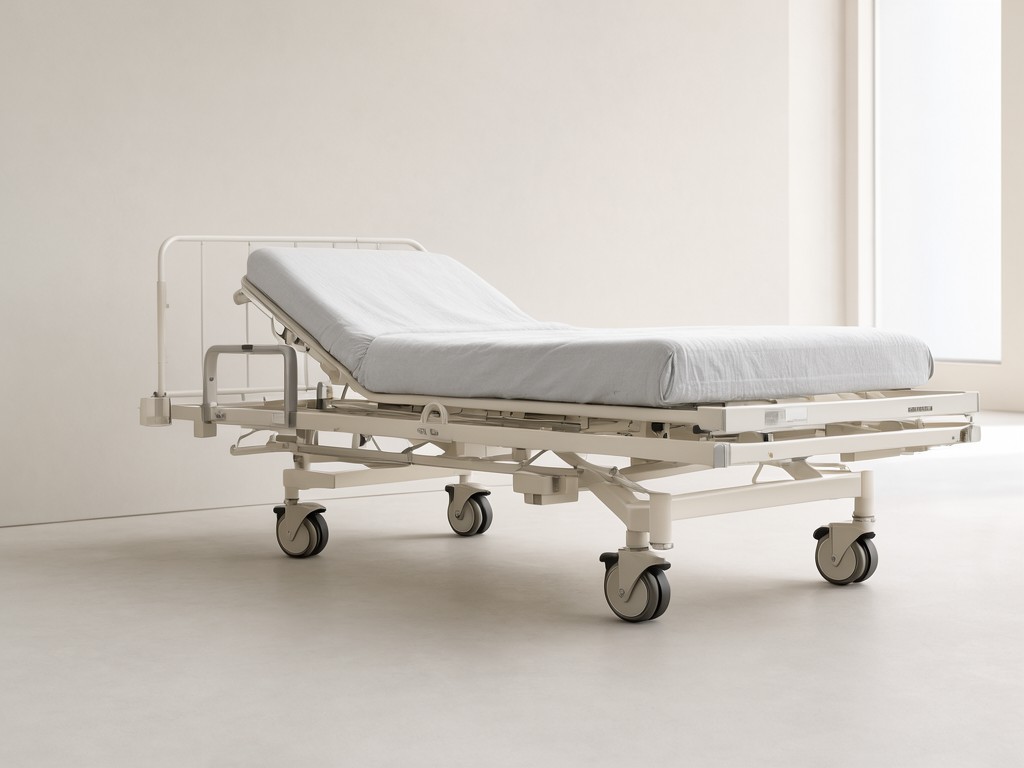
Cheaper stock options fail at the worst point in the season — when a ward is full and a crank mechanism seizes or a caster collapses under a 250 kg patient. The bed frame ships as a knock-down kit: head/foot boards, two-piece siderails, a four-section steel deck, and a separate mattress core. All steel components are 1.2 mm cold-rolled sheet, formed on a 300-tonne progressive die line, then epoxy powder-coated at 180 µm minimum dry film thickness. That coating resists the chloride-heavy cleaning agents used in infection control; salt-spray testing shows no red rust at 500 hours.
The double crank system uses a 12 mm diameter threaded rod with trapezoidal profile, mated to a bronze nut housed in a stamped steel bracket. Each full turn raises or lowers the backrest or knee section by 4 mm. The cranks fold flat against the frame when not in use, eliminating a common snag point for linens. Casters are 125 mm diameter, twin-wheel polypropylene with precision ball bearings and a central locking pedal that engages both wheels and the swivel simultaneously — rated for 150 kg per caster dynamic load.
Mattress ships vacuum-compressed in a polyethylene sleeve. The core is 120 mm high-density polyurethane foam (35 kg/m³) topped with a 20 mm viscoelastic layer (50 kg/m³). Cover is two-way stretch polyester with polyurethane coating, waterproof to 1.5 bar, flame-retardant to EN 597-1. Allow 24 hours for full loft recovery after unpacking.
How It Performs in Use
The crank mechanism is cycle-tested to 20,000 full strokes (equivalent to 10 years at 5 adjustments per day) with a 200 kg distributed load. Torque to turn the crank under maximum load stays below 8 Nm — within the capacity of a 95th-percentile female caregiver. Backrest angle range: 0–75°; knee break: 0–35°. Both sections move independently; there is no simultaneous articulation.
Caster swivel force is 1.2 Nm on epoxy flooring, rising to 2.5 Nm on carpet. The central lock holds on a 10° incline with 250 kg total load. Frame deflection at the centre of the deck under 250 kg is 6 mm, well within the 10 mm limit for pressure-redistribution mattress performance. Mattress indentation force deflection (IFD) at 25% compression is 120 N, stable within ±5% after 80,000 cycles on a rolling drum tester.
Lot-to-lot consistency targets
Dimensional drift on the deck length is held to ±2 mm across a 2,000-unit batch. Crank torque variation stays within ±0.5 Nm. Caster starting torque variation ±0.15 Nm. These tolerances are enforced by in-line gauging at three stations: post-weld, post-coating, and final assembly. A drift beyond these limits triggers a root-cause hold on the batch — preventing the reorder returns that plague catalogue-sourced beds.
Option Comparison by Usage Level
Buyers often ask which configuration matches their facility tier. The decision tree below maps typical requirements to the two standard build levels we keep in production tooling.
- Step 1 — Define the patient acuity profile. Long-term care with stable patients → Level A. Acute or bariatric admissions → Level B.
- Step 2 — Check cleaning protocol. Quaternary ammonium only → Level A coating passes. Hypochlorite or peracetic acid fogging → Level B coating (250 µm, marine-grade epoxy) required.
- Step 3 — Evaluate floor surfaces. Vinyl, epoxy, sealed concrete → standard 125 mm casters. Carpet, thresholds, outdoor transfers → upgrade to 150 mm conductive casters with stainless bearings (Level B only).
- Step 4 — Mattress specification. Standard foam/visco → Level A. Pressure-mapping validated, multi-zone foam or alternating-air overlay compatibility → Level B deck reinforcement (extra cross-members, 1.5 mm deck steel).
- Step 5 — Branding and documentation. Private-label stickers and multilingual IFU → both levels. Custom colour, serialized asset tags, BIM files → Level B (requires 12-week tooling lead).
Level A — General Ward
- 1.2 mm deck, 180 µm coating
- 125 mm PP casters, central lock
- Standard foam/visco mattress
- Crank torque ≤ 8 Nm
- MOQ 50 units, 6-week lead
Level B — Acute / Bariatric
- 1.5 mm deck, 250 µm marine epoxy
- 150 mm conductive casters, SS bearings
- Reinforced deck, overlay-ready
- Crank torque ≤ 10 Nm (larger nut)
- MOQ 30 units, 12-week lead
Working as a Production Partner, Not a Catalogue Supplier
We do not hold finished-goods inventory. Every order is a production run. That means the first article inspection (FAI) is done on your PO — dimensions, crank torque, caster lock force, mattress IFD, coating adhesion (cross-hatch 5B). You approve the FAI report before batch release. If your specification calls for a non-standard siderail latch or a specific mattress cover fabric, we validate the change on a 10-unit pilot lot, then lock the BOM for the full run.
Private-label buyers receive a dedicated project engineer who manages the artwork proofing for headboard logos, serial number ranges, and multilingual instruction sheets. We maintain a digital twin of each BOM revision in our ERP; reorders pull the exact same routing, eliminating the configuration drift that causes returns. Warranty is 3 years on frame and crank, 2 years on casters, 1 year on mattress — claims processed against the batch traceability record, not a generic serial number.
Volume Planning and Lead Time
Tooling amortisation decides the economic break point. For Level A, the progressive die set and crank fixture are amortised over 5,000 units — orders below 50 units carry a tooling surcharge of $1,200. Level B tooling (reinforced deck jig, marine coating line allocation) amortises over 2,000 units; surcharge $2,500 below 30 units. Standard lead times assume raw material in stock: 6 weeks for Level A, 12 weeks for Level B from FAI approval.
We offer a rolling forecast option: commit to 12-month volume, release monthly call-offs. This locks steel pricing and reserves coating line capacity, reducing per-unit cost by 4–6%. Blanket orders also qualify for consolidated export packaging — see the table below for pack-out options.
| Pack Configuration | Units per 40' HC | Gross Weight (kg) | Notes |
|---|---|---|---|
| Knock-down, mattress separate | 220 | 14,500 | Standard export cartons, ISPM-15 pallets |
| Pre-assembled deck, mattress compressed | 160 | 13,800 | Reduces on-site labour, requires forklift |
| Fully assembled, mattress on deck | 90 | 12,200 | White-glove delivery only, surcharge applies |
Setup, Use and Replacement Parts
Assembly requires two technicians, 15 minutes per bed: attach siderails with four M8×20 socket heads (torque 18 Nm), mount cranks on the pre-drilled brackets, snap casters into the corner sockets. No specialty tools. The crank handle is retained by a captive C-clip — remove only for replacement. Mattress unpack: cut sleeve, lay flat, wait 24 hours before first use.
Preventive maintenance schedule: monthly — wipe crank threads with food-grade PTFE grease, check caster swivel play (replace if axial play > 1 mm), inspect siderail latch spring tension. Annually — load test crank at 200 kg, verify backrest/knee angles with digital inclinometer, record torque. All replacement parts (crank assembly, caster set, siderail latch, mattress cover) are stocked as standard SKUs with 2-week dispatch. We supply a parts manual with exploded views and torque values; no proprietary fasteners.
Common wear points and mitigation
Crank nut wear is the leading cause of drift. The bronze nut sacrifices itself to protect the threaded rod; replace nut at 10,000 cycles or when backlash exceeds 1.5 mm. Caster wheel flattening occurs after 3 years on epoxy floors — rotate casters diagonally every 6 months. Coating chips at siderail edges from bed-frame impacts; touch-up kits (epoxy pen, 15 mL) ship with every 50-unit order.
Ready to Specify Your Next Order?
Send us your volume forecast, acuity profile, and any private-label requirements. We will return a detailed quotation with FAI protocol, lead-time confirmation, and pack-out optimisation within 48 hours.
Request Quotation Review