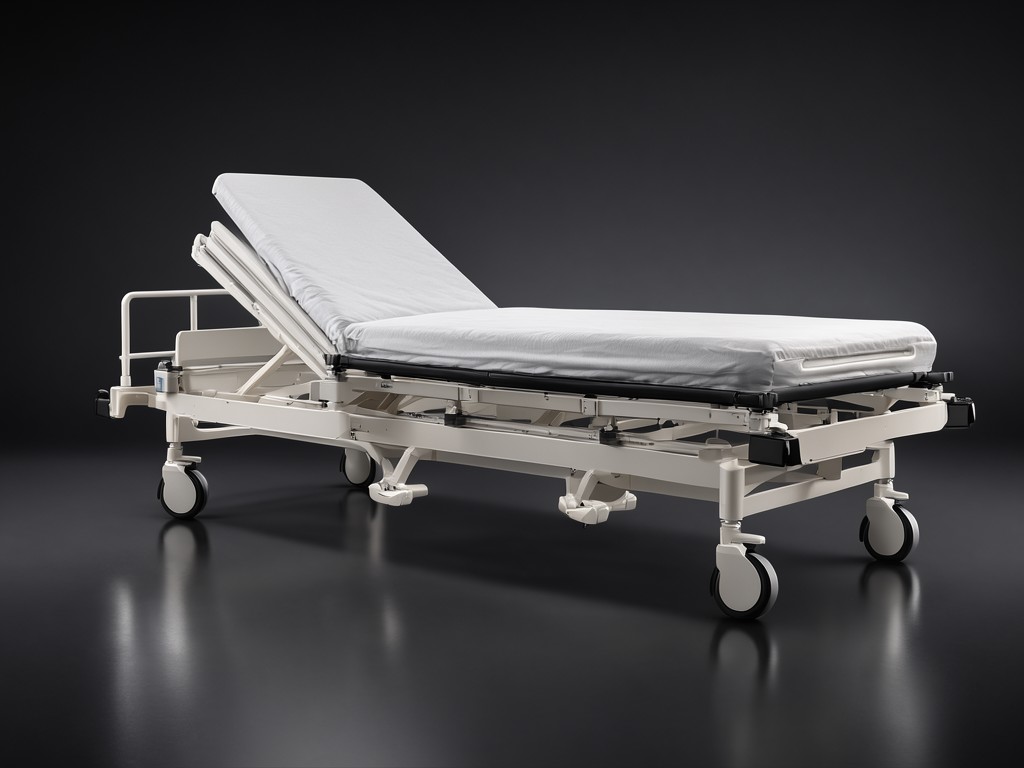
Specifying wholesale 4 crank manual hospital beds with mattress and casters Company for Wholesale and OEM Orders
Where Cheaper Alternatives Fall Short
Low‑cost frames often use 1.2 mm cold‑rolled steel that deflects under a 250 kg load.
When the crank gear is cut from a softer alloy, the torque required to raise the backrest exceeds 12 Nm after 5 000 cycles, causing the handle to slip and the patient to experience sudden drop. The same beds typically ship with 50 mm single‑wheel casters that lock only in one direction, so lateral movement on vinyl flooring creates a safety hazard. Powder‑coat thickness below 60 µm chips within the first 30 days of cleaning with quaternary ammonium solutions, exposing the substrate to corrosion.
Materials and Construction Trade-offs
Choosing a 1.5 mm frame adds 3 kg per unit but cuts deflection by 40 %.
The mattress core can be 30 kg/m³ high‑resilience foam or 45 kg/m³ viscoelastic foam; the latter reduces peak pressure by 15 % but increases compression set after 10 000 cycles from 5 % to 9 %. Vinyl cover weight 300 g/m² meets EN 1849‑2 tear resistance, while a 350 g/m² polyurethane‑coated fabric adds abrasion resistance at the cost of breathability. Crank shafts machined from 42CrMo4 with induction‑hardened teeth survive 20 000 cycles versus 8 000 for standard carbon steel.
- Frame: 1.5 mm cold‑rolled steel, epoxy powder coat ≥ 80 µm
- Crank: 42CrMo4, induction‑hardened to 55 HRC
- Mattress core: 30 kg/m³ HR foam or 45 kg/m³ viscoelastic foam
- Cover: 300 g/m² vinyl or 350 g/m² PU‑coated fabric
- Casters: 75 mm or 100 mm polyurethane, dual‑direction lock, 8 Nm torque
Customisation Options and Their Limits
Colour matching on powder coat is limited to RAL 9003, 9005, 7016.
Private‑label branding can be applied by laser etching on the headboard or by a removable vinyl label; laser depth 0.15 mm survives autoclave cycles but adds 0.2 mm to the headboard thickness, which may affect compatibility with existing bedside tables. Mattress firmness can be tuned in 5 kg/m³ increments, yet each step changes the overall bed height by 2 mm, so the caster stem length must be adjusted accordingly. Caster wheel diameter can be specified 75 mm or 100 mm; the larger wheel reduces rolling resistance on carpet by 30 % but raises the bed frame 15 mm, potentially exceeding ceiling‑mounted lift clearances.
Standard Config
1.5 mm frame, 30 kg/m³ foam, 75 mm casters, RAL 9003 coat
Heavy‑Duty Config
1.5 mm frame, 45 kg/m³ viscoelastic foam, 100 mm casters, RAL 7016 coat
Segment-Specific Requirements
ICU beds demand a 300 kg static load rating and a 5 ° Trendelenburg angle.
General ward units typically accept a 200 kg rating and a 10 ° reverse Trendelenburg; the crank torque spec can be relaxed to 10 Nm. Long‑term care facilities prioritize mattress compression set below 6 % after 15 000 cycles and a caster swivel radius under 120 mm to navigate tight corridors. Pediatric beds require a reduced frame height of 450 mm and a mattress thickness of 100 mm, which forces a thinner foam core and a higher IFD value to avoid bottom‑out.
| Service Condition | Common Failure Mode | Design Spec that Mitigates |
|---|---|---|
| ICU – 300 kg static load, frequent Trendelenburg | Frame weld fatigue, crank gear stripping | 1.5 mm frame, 55 HRC gear, 8 Nm caster lock |
| General ward – 200 kg load, reverse Trendelenburg | Caster lock slip on vinyl | Dual‑direction lock, 80 µm coat |
| Long‑term care – 15 000 cycle mattress use | Compression set >6 % | 45 kg/m³ viscoelastic core, IFD 120 N |
| Pediatric – 450 mm frame height | Mattress bottom‑out | 100 mm foam, IFD 150 N |
Keeping Repeat Orders Supplied
Batch‑to‑batch dimensional variance stays within ±1 mm when the same jig is used for frame welding.
We run a first‑article inspection that checks crank torque at 0, 5 000, and 10 000 cycles, records mattress IFD at 25 % and 65 % compression, and verifies caster lock torque on a calibrated torque wrench. Packaging uses double‑wall corrugated cartons with corner protectors; each pallet holds 12 beds and is shrink‑wrapped to prevent frame shift during sea freight. Lead time for a 200‑unit order is 35 days from approved drawing, with a 10 % buffer stock kept in the regional warehouse for rapid replenishment.
- First‑article crank torque and IFD audit
- Double‑wall cartons, corner protectors, palletised 12‑unit packs
- 35‑day lead time, 10 % safety stock in regional hub
Ready to lock in specs and lead times? Request a quotation review and we’ll align the build sheet with your launch calendar.