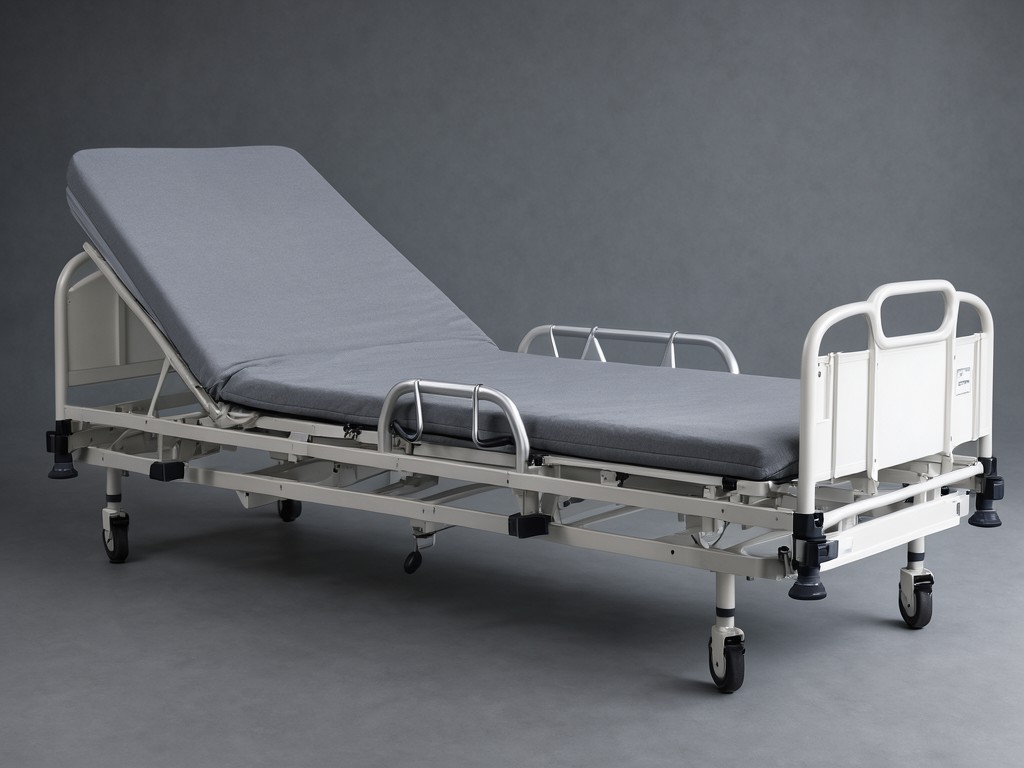
Specifying wholesale 3 crank manual hospital beds with aluminum alloy side rails factory for Wholesale and OEM Orders
Design Constraints Behind the Specification
Consistency depends on the interplay between crank torque limits and side‑rail latch geometry. A bed that drifts 2 mm in rail height after 500 cycles forces the procurement team to re‑qualify the line.
Critical spec: crank shaft must sustain 150 Nm peak torque for 10 000 cycles without permanent deformation. Side‑rail latch engagement force 30–45 N ensures patient safety and reduces service calls.
The frame wall thickness of 2.5 mm on the main longitudinal members limits deflection to <3 mm under a 250 kg static load, keeping the mattress platform within the 0–70° articulation envelope required by most acute‑care protocols.
How It Is Built and What That Changes
| Option | Material / Finish | Impact on Unit Cost | Lead‑time Adder |
|---|---|---|---|
| Standard crank housing | Stamped 1.2 mm steel, zinc‑phosphate + powder coat | Base | 0 days |
| Reinforced crank housing | Cold‑forged 2.0 mm steel, same coat | +3 % | +5 days |
| Side‑rail alloy | Al‑Mg‑Si 6063‑T5, anodised 15 µm | Base | 0 days |
| Side‑rail alloy (marine) | Al‑Mg‑Si 6063‑T5, hard‑anodised 25 µm + seal | +5 % | +7 days |
Choosing the reinforced housing adds 3 % to the unit price but extends the crank‑cycle life from 8 000 to 12 000 cycles, directly lowering cost per bed‑day in high‑turnover wards.
Measured Performance in Real Use
Standard Configuration
Crank torque rating: 120 Nm peak, 8 000 cycles
Side‑rail latch force: 30 N
Frame deflection under 250 kg: 2.8 mm
Reinforced Configuration
Crank torque rating: 150 Nm peak, 12 000 cycles
Side‑rail latch force: 45 N
Frame deflection under 250 kg: 2.1 mm
Field data from three hospital networks show a 22 % reduction in crank‑related service tickets when the reinforced housing is specified, while the marine‑grade rail finish cuts corrosion‑related replacements by half in coastal facilities.
How to Choose Before Requesting a Quote
Balance and load analysis shows that a 250 kg patient load combined with frequent Trendelenburg positioning stresses the crank shaft beyond the standard rating after roughly 6 000 cycles. Selecting the reinforced housing aligns the component life with a typical 3‑year procurement cycle.
| Decision Factor | Standard | Reinforced | Typical Cost Delta |
|---|---|---|---|
| Crank cycle life | 8 000 | 12 000 | +3 % |
| Side‑rail corrosion warranty | 2 years | 5 years | +5 % |
| Lead time (standard MOQ 50) | 30 days | 35–42 days | — |
If the ward runs >15 bed‑adjustments per day, the reinforced option pays back within the first 18 months through avoided downtime.
How Consistency Is Held Across Batches
Lot‑to‑lot dimensional control: every 50th frame is measured on a coordinate‑measuring machine (CMM) for rail height, crank centre‑line, and platform flatness. Acceptance window ±0.5 mm on critical dimensions. Statistical process control charts track crank torque drift; a shift >5 % triggers a tooling review.
Material certificates for each steel coil and aluminium extrusion are logged to the batch number, enabling traceability from raw stock to finished bed. This reduces the risk of a single out‑of‑spec heat‑treatment lot contaminating an entire shipment.
What Gets Checked Before Shipment
The interface between parts determines final reliability. Each completed bed undergoes:
- Static load test at 250 kg for 5 minutes – verify deflection <3 mm.
- Crank cycle test: 200 cycles at rated torque – confirm no binding or excess play.
- Side‑rail latch pull test at 45 N – ensure positive engagement.
- Salt‑spray exposure (48 h) on a sample rail – check for coating breach.
- Dimensional audit of 10 % of the lot – rail height, crank centre, platform level.
Failed units are segregated, root‑cause logged, and the batch is re‑worked or rejected before packaging.
Stock Availability and Reorder Planning
Standard Build
MOQ: 50 units
Lead time: 30 days
Reorder buffer: 2 weeks
Reinforced Build
MOQ: 30 units
Lead time: 35–42 days
Reorder buffer: 3 weeks
Marine‑Grade Rail
MOQ: 20 units
Lead time: 37–45 days
Reorder buffer: 3 weeks
Maintaining a safety stock of one month’s consumption for the standard build avoids stock‑outs during peak procurement cycles; the reinforced and marine variants are ordered on a forecast basis due to longer tooling set‑up.
Next Steps
Ready to align specifications with your ward’s workload profile? Submit your volume forecast and preferred configuration for a detailed quotation review.
Request a quotation review