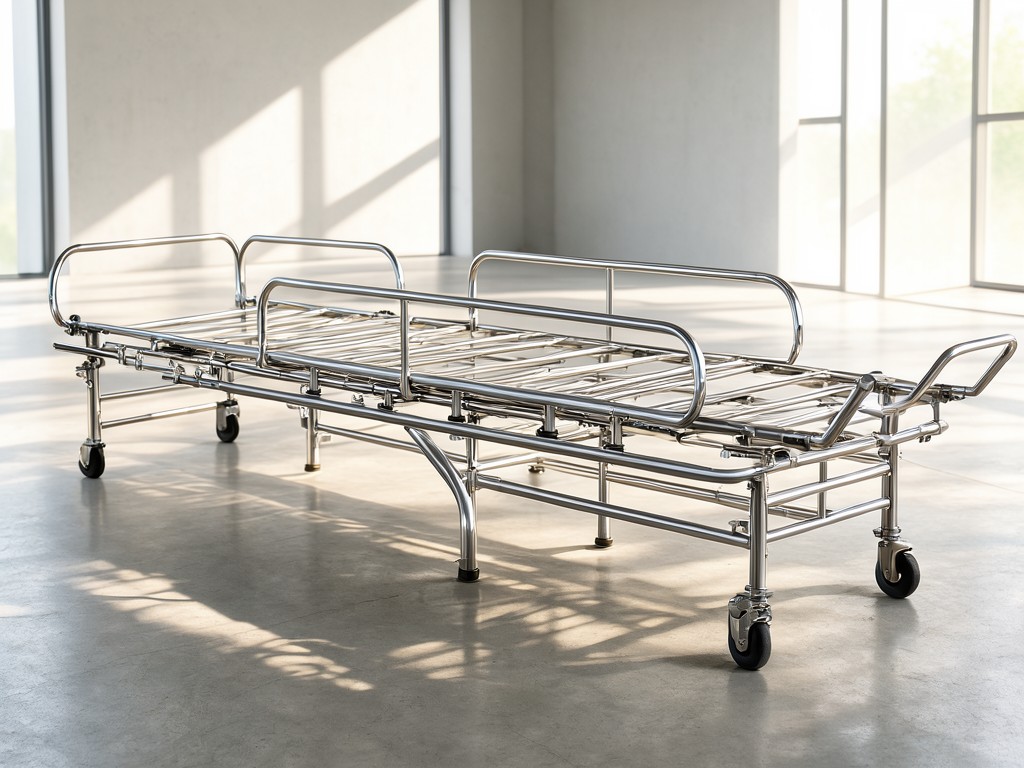
Specifying wholesale 1 crank stainless steel manual hospital beds factory for Wholesale and OEM Orders
Material choice starts with the conditions the product will meet: repeated manual cranking, aggressive disinfectant regimens, and a load envelope that can reach 250 kg per patient. Stainless steel 304 or 316 becomes the baseline because it resists chloride‑induced pitting better than powder‑coated carbon steel, and the single‑crank mechanism keeps the bill of materials lean for high‑volume runs.
Scope of Supply and Physical Form
Each unit ships as a welded frame (304 or 316), a manually operated crank assembly rated for 10 000 cycles at full load, a four‑section mattress platform (grid or slat), four 125 mm twin‑wheel casters (two locking), and optional fixed or removable side rails. Overall length ranges 2000–2200 mm, width 900–1000 mm, height adjustable 450–750 mm via the crank. Net weight sits between 85 kg and 110 kg depending on steel grade and rail configuration.
Design Constraints Behind the Specification
Corrosion resistance drives the steel grade decision: 304 suffices for routine sodium‑hypochlorite wipes, while 316 adds molybdenum for environments where quaternary ammonium compounds linger. The crank gear train uses hardened 42CrMo4 pinions mated to a stainless‑steel rack; backlash is held under 0.15 mm to prevent “free‑play” that nurses feel as uneven height changes. Load testing follows a 1.5× static proof (375 kg) and a 10 000‑cycle dynamic run at 250 kg; any permanent deformation over 2 mm triggers a redesign.
Critical Specification Rule
Crank mechanism rated for 10 000 cycles under 250 kg load; exceeding reduces service life. Verify cycle count during sample approval; a 20 % margin is typical for OEM warranties.
Where This Product Beats Standard Alternatives
Compared with powder‑coated steel beds, the stainless frame eliminates touch‑up paint cycles and the associated downtime. Against aluminum frames, the higher modulus of stainless steel reduces frame flex, which translates into a more stable mattress platform and fewer pressure‑point complaints. Electric beds add motor failure modes and higher FOB cost; the manual crank keeps total cost of ownership low for facilities that adjust height infrequently.
Comparing Two Standard Configurations
| Parameter | Config A – 304 SS, Fixed Rails | Config B – 316 SS, Removable Rails |
|---|---|---|
| Frame material | AISI 304 | AISI 316 |
| Side rails | Fixed, welded | Removable, bolt‑on |
| Casters | Two locking, two swivel | Four locking |
| Crank cycles rated | 10 000 @ 250 kg | 10 000 @ 250 kg |
| Typical FOB (USD/unit) | $420–$460 | $480–$530 |
Matching the Product to the Buyer's Need
Use the decision flow below to align configuration with procurement targets.
- Define maximum patient weight — if >250 kg, select Config B for the 316 frame’s higher corrosion margin.
- Confirm with a 1.5× static proof test on the first article.
- Assess cleaning chemistry — facilities using quaternary ammonium or peracetic acid benefit from 316’s molybdenum content.
- Evaluate mobility frequency — wards that relocate beds daily should specify four locking casters (Config B).
- Determine side‑rail policy — removable rails (Config B) support infection‑control protocols that require rail‑free surfaces.
Customisation Options and Their Limits
Length can be trimmed in 50 mm increments without new tooling; width changes require a new jig and add 3–4 weeks lead time. Mattress platform may switch between grid and slat at no cost if the same frame pattern is used. Crank handle colour coding (e.g., red for pediatric, blue for ICU) is a simple powder‑coat on the handle only — no effect on corrosion rating. Brand plates laser‑etched on the footboard are limited to 30 × 15 mm; larger logos need a dedicated fixture and raise MOQ to 200 units.
Ready to lock in tooling and run a first‑article inspection? Request a tooling review and we’ll align sample specs with your private‑label timeline.