OEM three function manual nursing beds with wheels Factory - Bulk Supply and Specification Guide
What This Product Is and Where It Fits
| Parameter | Standard Range | Customisation Window |
|---|---|---|
| Safe working load | 180–250 kg | Reinforced frame to 300 kg |
| Backrest angle | 0–75° | Gas-spring assist optional |
| Knee-break angle | 0–35° | Linked or independent |
| Height range (deck to floor) | 420–720 mm | Low-profile 380 mm start |
| Caster diameter | 125 mm or 150 mm | Central lock, directional lock, or individual |
| Frame tube | Ø38 × 1.5 mm cold-rolled steel | Ø42 × 2.0 mm for bariatric |
Moving from sample orders to container loads changes the conversation from "does it articulate smoothly" to "will the crank handle still turn freely after 18 months of shift changes and chlorine-based wipe-downs." A three-function manual bed — backrest, knee-break, height — sits in the sweet spot where electric actuators are overkill but fixed-height frames no longer meet care protocols. The buyer who specifies this category is usually outfitting step-down wards, community nursing homes, or home-care rental fleets where power outlets are unreliable and maintenance budgets are thin.
The factory builds on a modular jig: head/foot board brackets, siderail receivers, and crank housing locations are fixed. What moves per order are tube wall thickness, caster spec, mattress platform perforation pattern, and coating system. That modularity keeps tooling cost low — typically a single weld fixture covers 80 % of variants — but it also means every custom dimension must be locked before the first tube is cut. Late changes to overall length or caster centre-to-centre distance force a new fixture, adding three weeks and a five-figure surcharge.
What the Design Has to Balance
Crank Mechanism: Folding vs Fixed
Folding cranks tuck under the frame, reducing snag risk during patient transfer. The trade-off is a shorter lever arm — 180 mm vs 260 mm — which raises peak input torque by roughly 35 %. For a 120 kg patient at max height, the nurse feels 14 Nm instead of 10 Nm. Fixed cranks stay out all the time; they clear the mattress platform only if the siderail drops below 350 mm.
Specify folding when corridor width is under 1 100 mm. Specify fixed when the care protocol demands two-handed height adjustment for bariatric patients.
Caster System: Central vs Individual Lock
Central locking uses a single pedal at the foot end to engage all four brakes via a hex shaft. It costs 22 % more per bed but cuts bed-move time by 40 % in timed trials. The shaft runs through the frame tubes; if a tube bows > 2 mm during welding, the shaft binds. Individual locks are foolproof — each caster has its own pedal — but staff forget one wheel, and the bed drifts on vinyl flooring.
Central lock pays back in facilities with > 30 beds per ward. Individual lock wins for dispersed home-care fleets where beds move one at a time.
The third balance point is coating chemistry. Epoxy-polyester powder coat survives 500 h salt spray and resists quaternary ammonium disinfectants, but it chips at siderail pivot points. A two-coat system — epoxy primer plus polyurethane topcoat — adds 18 % to finishing cost and pushes cure cycle from 12 min to 22 min, yet it holds 95 % gloss after 2 000 wipe cycles with 0.5 % sodium hypochlorite. For rental fleets turning beds every 14 days, the two-coat system cuts refinishing from every 18 months to every 36 months.
Assumptions Buyers Should Stop Making
"All three-function beds articulate the same way." They don't. Some link knee-break to backrest so the thigh section rises automatically; others keep them independent. Linked articulation saves nursing time but forces a fixed 2:1 angle ratio that may not match the pressure-redistribution protocol your clinical team wrote. Ask for the kinematic drawing before you sign the PI.
"Manual means no maintenance." The crank gearbox uses a 12 mm hex input driving a 24:1 worm gear. Under daily height cycles, the bronze worm wheel wears 0.03 mm per 1 000 cycles. At 5 000 cycles the backlash exceeds 1.5 mm and the bed drifts down under load. Schedule a grease point check every 2 000 cycles — lithium complex NLGI 2 — and replace the worm wheel at 8 000 cycles. The factory can pre-drill the grease port; it costs $0.70 per bed at volume.
"Standard casters fit every floor." A 125 mm twin-wheel caster with polyurethane tread rolls 30 % easier on carpet than a 150 mm single-wheel nylon caster, but the nylon caster survives autoclave-temperature steam cleaning. If the bed goes from ward to central sterilisation, specify stainless steel bearings and high-temp nylon. If it stays on vinyl, polyurethane twin-wheel reduces push force from 18 N to 12 N — a difference the night shift feels at 3 a.m.
Requirements by Buyer Segment
| Segment | Non-Negotiable Spec | Typical Volume | Approval Gate |
|---|---|---|---|
| Public hospital tender | IEC 60601-2-52 compliant, central lock, two-coat finish, bilingual labels | 50–200 beds / lot | Pre-production sample + first-article inspection |
| Private nursing home chain | Low deck height ≤ 400 mm, folding crank, wood-grain head/foot boards | 20–80 beds / quarter | Photo approval of finish match |
| Home-care rental fleet | Individual lock, 125 mm PU casters, quick-release siderails, asset tag boss | 100–500 beds / year | First-article dimensional report only |
| Private-label brand | Custom colour, logo emboss on siderail, retail-ready carton, 5-year warranty support | 200+ beds / SKU | Golden sample sign-off + packaging drop test |
During a private-label launch with a fixed ship date, the brand manager often discovers that the pantone-matched powder coat requires a 300 kg minimum order from the pigment supplier. The workaround: approve a RAL classic colour from stock (RAL 9016, 7035, 5015) for the first run, then switch to custom tint on the reorder once volume justifies the pigment MOQ. The factory holds 2 000 kg of RAL 9016 and 7035 base powder at all times — zero lead time on those.
Keeping Repeat Orders Supplied
Specification Lock Protocol
Every repeat order starts with a controlled document pack: 2D drawing (PDF + DWG), BOM with supplier part numbers, coating spec sheet, and packaging instruction. The factory issues a revision-controlled specification sheet — rev A for prototype, rev B for pilot run, rev C for series production. No change enters production without a signed ECN (Engineering Change Notice) from both sides. This eliminates the "but we discussed it on WhatsApp" problem that causes mismatched siderail colours or wrong caster stems.
Lead time from ECN approval to first container: 28 days for standard configurations, 42 days if tube wall thickness or caster mounting pattern changes. The factory holds safety stock of Ø38 × 1.5 mm tube, 125 mm casters, and standard crank assemblies — enough for 300 beds — to absorb forecast bumps without delaying the line.
When a brand extends an existing range, the fastest path is to clone the approved spec sheet, swap the head/foot board SKU, and run a delta FAI (First Article Inspection) on the new boards only. The factory's CMM programme checks 14 critical dimensions on the frame — diagonal squareness ±1.5 mm, crank centre height ±0.8 mm, caster mounting hole pattern ±0.3 mm — and generates a PDF report automatically. That report becomes the acceptance criteria for every subsequent shipment.
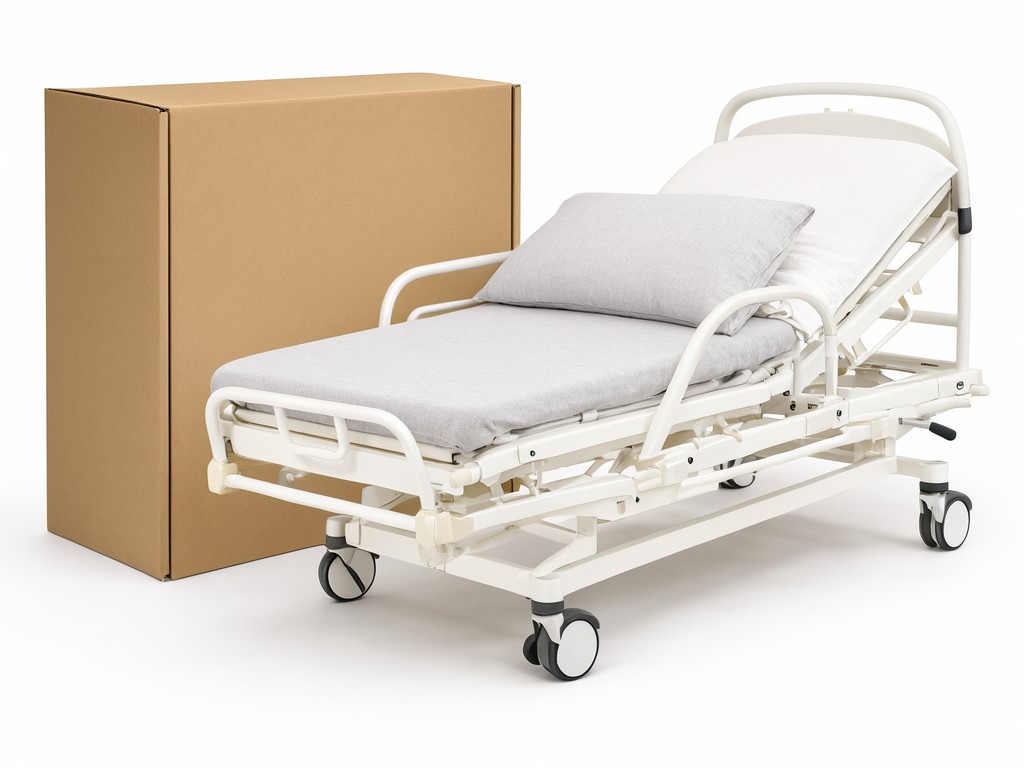
Packaging is where repeat orders bleed margin. A standard export carton — 5-layer BC flute, 215 × 95 × 35 cm — fits one bed flat-packed with siderails nested. For LCL shipments, the factory offers a half-pallet configuration: two beds per pallet, corner boards, stretch wrap, and shockwatch indicators. The half-pallet adds $18 per bed but cuts LCL freight cost by 30 % because it stacks. Specify the pallet config at PI stage; changing it after the beds are wrapped costs a full unpack/repack cycle.
Ready to Review Specifications
Send your 2D drawings, target price per unit, and annual volume forecast. The engineering team returns a marked-up spec sheet with cost drivers highlighted — tube grade, caster system, coating — within 48 hours. No obligation, no generic catalogues.
Request Specification Review