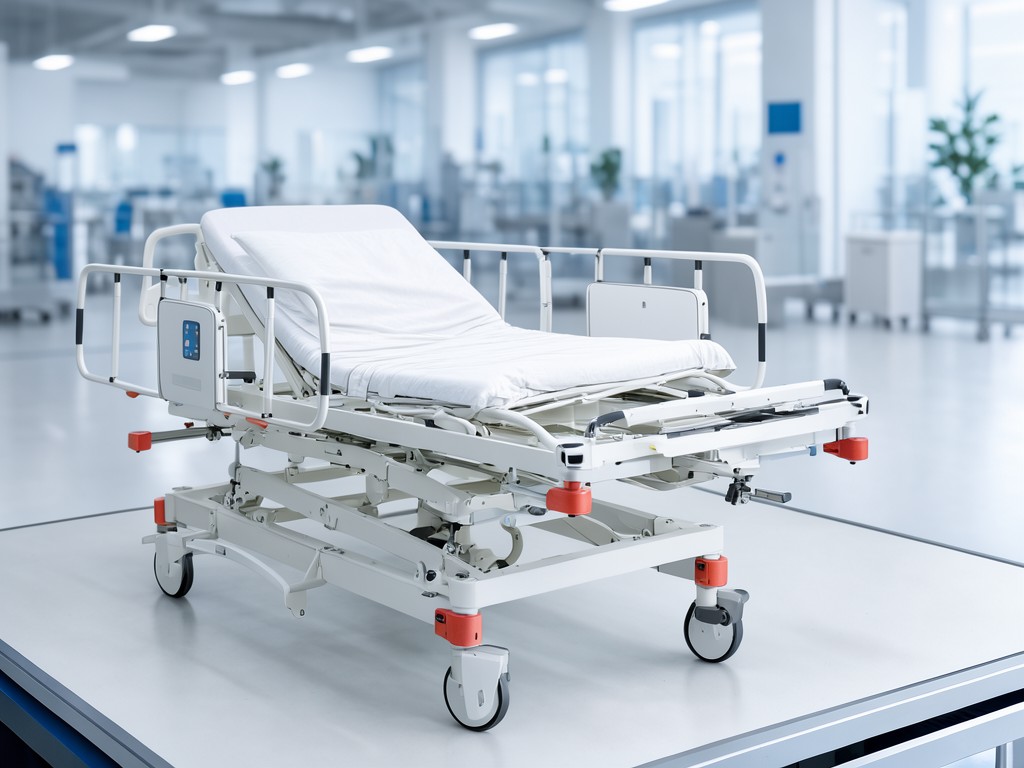
OEM manual crank hospital bed with side rails Exporter: Specification, Ordering and Quality Notes
Key trade‑off: a heavier 1.5 mm cold‑rolled steel frame with a 12‑tooth crank gear gives 250 kg static load rating and 10 000 crank cycles, but adds 3 kg per unit and raises tooling cost; a 1.2 mm frame with a 10‑tooth gear saves weight and tooling but drops the load rating to 200 kg and cycle life to 6 000.
Where Cheaper Alternatives Fall Short
During a private‑label launch with a fixed ship date, a buyer chose a 1.0 mm tubular frame to cut unit cost. The crank gear stripped after 3 000 cycles, side‑rail latches bent under 120 kg lateral load, and the powder coat chipped at the weld seams within six months of ward use. Those failures generated warranty claims that erased the initial savings.
The root cause is not the crank itself but the torque transmission path: thinner wall tubing flexes, misaligning the gear mesh and concentrating stress on the latch pivots. A 1.5 mm frame keeps deflection under 0.8 mm at full load, preserving gear mesh geometry and latch alignment throughout the service interval.
Material Options and Their Trade-offs
Frame steel: cold‑rolled SPCC 1.5 mm (standard) versus 1.2 mm (light) versus 1.0 mm (budget). The 1.5 mm grade yields a 250 kg static rating, 10 000 crank cycles, and passes 500 h salt‑spray without red rust. The 1.2 mm grade drops to 200 kg and 6 000 cycles, still passes 300 h salt‑spray. The 1.0 mm grade is only suitable for low‑acuity wards where load rarely exceeds 150 kg.
Side‑rail material: ABS‑PC blend (impact‑resistant, 2 mm wall) versus polypropylene (cheaper, 1.5 mm). ABS‑PC survives 50 J impact at 20 °C; polypropylene cracks at 30 J. The cost delta is roughly $1.20 per rail set, but the failure rate in high‑traffic units falls from 4 % to under 0.5 % over two years.
Crank gear: 12‑tooth hardened steel (module 2) versus 10‑tooth case‑hardened (module 1.75). The 12‑tooth gear spreads load over a larger contact patch, reducing tooth stress by ~18 % and extending cycle life. The 10‑tooth gear saves 0.15 kg and $0.30 per unit but requires a tighter tolerance on the crank shaft bore (±0.02 mm vs ±0.05 mm).
How It Is Built and What That Changes
The frame is CNC‑cut, robotically welded on a 6‑axis cell, then shot‑blasted before a two‑coat epoxy‑polyester powder coat (80 µm total). Weld seam inspection uses ultrasonic thickness mapping; any seam below 1.2 mm triggers rework. This process caps frame dimensional variance at ±1 mm across a 2 m length, which directly controls crank gear meshing repeatability.
Side rails are injection‑moulded in a multi‑cavity tool (8 cavities per cycle). Gate location is optimized to avoid weld lines at the latch pivot. Each rail undergoes a 5 kN pull‑out test on the latch before assembly. The crank assembly is sub‑assembled on a dedicated line: gear, shaft, bearing, and handle are press‑fit, then torqued to 12 Nm. Final bed integration adds casters (125 mm double‑brake) and a mattress support grid (wire mesh, 30 mm pitch).
Assumptions Buyers Should Stop Making
Assuming all manual crank beds share the same load rating because they look similar. In practice, the gear module, frame wall thickness, and latch geometry create a 30 % spread in safe working load.
Assuming a single powder‑coat spec covers all climates. Coastal hospitals need a minimum 500 h salt‑spray rating; inland facilities can accept 300 h. Specifying the higher rating on every order adds $0.80 per unit but eliminates a common corrosion claim vector.
Assuming the crank handle torque feel is irrelevant. A handle radius of 45 mm with a 12‑tooth gear gives a 1.8 Nm input for a 150 kg lift; a 38 mm handle on a 10‑tooth gear needs 2.4 Nm, increasing staff fatigue and accelerating gear wear.
Keeping Repeat Orders Supplied
On a club programme that reorders twice a season, the buyer locks in a 4‑week lead time by committing to a 200‑unit blanket order. The blanket releases 50 units per month, allowing the welding cell to run a dedicated fixture set and the injection mould to stay in the same cavity set, which holds dimensional drift to ±0.3 mm across the run.
If the buyer switches to ad‑hoc 30‑unit POs, each batch incurs a 3‑day fixture changeover and a 2‑day mould warm‑up, adding 5 days to lead time and widening frame variance to ±1.5 mm. The cost impact is roughly $4 per unit in extra handling and re‑inspection.
Care, Storage and Service Life
Store frames upright on pallets with 30 mm spacers to prevent rail deformation. Keep crank gears lubricated with NLGI‑2 grease; re‑apply every 2 000 cycles or 12 months, whichever comes first. Side‑rail latches should be inspected for latch‑pin wear at each preventive maintenance visit; replace pins when play exceeds 0.5 mm.
Expected service life: 10 years (≈10 000 crank cycles) for the 1.5 mm frame with ABS‑PC rails in a climate‑controlled ward; 6 years for the 1.2 mm frame with polypropylene rails in a high‑humidity environment. Casters rated for 150 kg each; replace when wheel tread wear exceeds 2 mm.
Ordering, Tooling and Lead-Time Questions
What is the minimum order quantity for a custom frame thickness? 100 units for a new fixture set; 50 units if the thickness matches an existing fixture.
How long does tooling take for a new side‑rail colour? 3 weeks for a single‑cavity colour change; 5 weeks if a new mould cavity is required.
Can the crank gear ratio be altered after production starts? Only by swapping the gear sub‑assembly; this requires a 2‑week line stop and a new gear‑tooth inspection batch.
What artwork files are accepted for bed‑frame branding? Vector AI or EPS at 300 dpi; raster files must be ≥600 dpi at final size.
How are beds packed for sea freight? Each unit is wrapped in 200 µm PE film, placed on a 1 200 mm × 2 000 mm pallet, strapped with two polyester bands, and loaded 4‑high in a 40‑ft container.
Inspection Standards
| Test | Reference Method | Acceptance Criteria |
|---|---|---|
| Static load test | ISO 14971‑type load protocol (internal) | No permanent deformation at 1.25× rated load |
| Crank cycle endurance | 10 000 cycles at rated torque | Gear tooth wear <0.05 mm, no gear slip |
| Side‑rail latch pull‑out | 5 kN tensile test | Latch holds without fracture |
| Salt‑spray corrosion | ASTM B117 (neutral salt spray) | No red rust after 500 h (coastal spec) / 300 h (inland spec) |
| Caster brake torque | ISO 7176‑type brake test | Brake holds 150 kg on 10° incline |
Ready to lock in specifications, tooling schedule, and a blanket‑order plan that protects your repeat‑order margins? Request a quotation review and we’ll align the build sheet to your ward‑level requirements.