OEM double crank manual patient nursing beds with wheels Supplier: Specification, Ordering and Quality Notes
The Problem Buyers Keep Paying For
The complaint that repeats across reorders: crank handles develop play after six months, caster brakes stop engaging, and side rails bind at the same pivot points. Private-label buyers absorb the warranty cost while the factory ships the same tooling.
Most quality disputes start with a consistency gap. A 200-bed order arrives with backrest crank torque varying 30% unit to unit. The knee-break linkage on 15% of frames requires two-handed operation. Casters from the same lot show brake holding force from 18 kg down to 6 kg on a 12° incline. These are not cosmetic issues — they determine whether a facility reorders or switches suppliers.
Wear shows up at the same point every season. Epoxy coating chips at the crank housing weld line because the pre-treatment bath misses the interior radius. Caster yokes crack at the kingpin after 18 months of daily patient transfers. The pattern is predictable when you know which process steps drift first.
What Actually Determines Performance
Critical specification rule: crank mechanism cycle life is driven by gear material and heat treatment, not frame gauge. A 1.2 mm cold-rolled steel frame with induction-hardened gears (HRC 48-52) outperforms 1.5 mm frame with untreated gears by 3:1 in 10,000-cycle testing. Specify gear hardness on the purchase order or the factory will substitute untreated 45# steel to save ¥12 per bed.
Caster performance splits three ways: wheel material (TPR vs PU vs nylon), bearing type (plain vs single ball vs double ball), and brake mechanism (side-lock vs central-lock vs directional-lock). TPR wheels with double-ball bearings and central-lock brakes hold 25 kg on a 12° ramp after 50,000 roll cycles. Nylon wheels with plain bearings fail at 8 kg after 15,000 cycles. The price difference is ¥45 per set.
Side rail latch durability correlates with stamping die maintenance. A fresh progressive die holds 0.15 mm clearance on the latch hook; after 80,000 strokes clearance grows to 0.35 mm and the rail rattles. Factories running three shifts rarely replace dies on schedule unless the PO mandates first-article inspection with go/no-go gauges.
Comparing Two Standard Configurations
| Parameter | Standard Export Config | Institutional Grade Config |
|---|---|---|
| Frame tube | 50×30×1.2 mm oval, Q235 | 50×30×1.5 mm oval, Q235B |
| Crank gears | 45# steel, untreated | 45# steel, induction hardened HRC 48-52 |
| Caster set | 125 mm nylon, plain bearing, side-lock brake | 125 mm TPR, double-ball bearing, central-lock brake |
| Mattress platform | Perforated metal, 2 mm pitch | Woven wire mesh, 8×8 mm grid, 3 mm wire |
| Side rails | ABS, two-position latch | ABS with aluminum reinforcement, four-position latch |
| Surface treatment | Epoxy powder, 60-80 μm | Epoxy-polyester hybrid, 80-100 μm, salt spray 500 h |
| Safe working load | 170 kg | 200 kg |
| Crank torque (backrest, 75 kg load) | 18-28 Nm | 12-16 Nm |
| FOB price delta (per bed) | Baseline | +¥180-220 |
The institutional grade configuration reduces crank effort by 35% and extends caster brake life from 18 months to 4+ years in high-turnover wards. For a 50-bed facility, the ¥9,000-11,000 premium pays back in avoided maintenance calls within 14 months.
Customisation Options and Their Limits
Head/Foot Board Materials
ABS (standard): 2.5 kg each, impact resistant to 20 J, colour-matched to ±1.5 ΔE. Tooling cost ¥8,000-12,000 for custom colour.
PP (budget): 1.8 kg each, impact resistant to 12 J, fades 3-4 ΔE/year under fluorescent light. No tooling charge for standard colours.
HPL laminate on MDF core (premium): 4.2 kg each, scratch resistant, 10-year colour stability. Adds ¥95/board, requires 300+ MOQ for custom patterns.
Caster Upgrades
Directional-lock casters (two per bed): enable straight-line tracking on corridors. Adds ¥35/set. Requires frame bracket redesign — 15-day tooling lead time.
Central-lock with pedal operation: single pedal locks all four wheels. Adds ¥65/set. Pedal shaft bearing must be specified as sealed ball bearing or it seizes in 8 months.
Anti-static conductive wheels: mandatory for OR-adjacent recovery rooms. Adds ¥120/set. Carbon-loaded TPR compound wears 20% faster than standard TPR — plan replacement at 30 months.
IV pole sockets and drainage hooks are standard. Custom socket positions require fixture welding — minimum 100 units to amortise the jig. Mattress platform width can shift from 900 mm to 1000 mm in 50 mm increments; each step changes crank linkage geometry and requires new gear cutting — 25-day lead time, ¥15,000 tooling.
Usage Scenarios and Buyer Segments
Public hospital procurement officers buy on 5-year depreciation schedules. They specify institutional grade with central-lock casters, welded IV pole sockets, and 500-hour salt spray coating. Orders run 50-200 beds per tender. They require batch traceability to heat number and first-article reports with dimensional records.
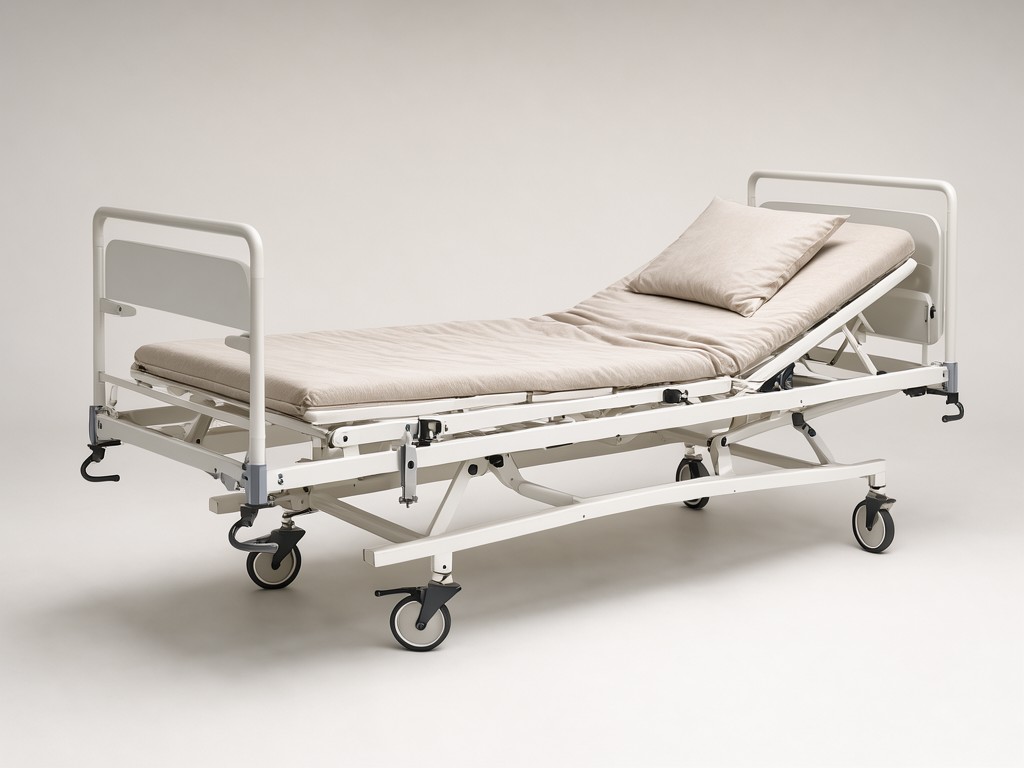
Private nursing home chains standardise on the standard export configuration but demand ABS head/foot boards in their brand colour. They order 20-50 beds quarterly with blanket POs. Their failure mode is crank handle loosening — they need thread-locking adhesive specified on the BOM, not left to operator discretion.
Home medical equipment distributors private-label the standard configuration with custom logo silk-screen on head boards. They order 100-300 beds per SKU annually. Their complaint is packaging damage: caster brackets bend in transit because export cartons lack corner reinforcement. They need 5-layer corrugated with 200 lb burst strength and internal foam blocks at each caster mount.
Emergency field hospital buyers need flat-pack density: beds must stack 4-high in a 20 ft container. This forces knockdown side rails and removable crank handles. The trade-off is 40% longer assembly time on site and 15% lower side rail pull-out strength.
Requirements by Buyer Segment
| Requirement | Public Hospital | Nursing Home Chain | HME Distributor | Field Hospital |
|---|---|---|---|---|
| Configuration grade | Institutional | Standard export | Standard export | Knockdown export |
| Caster spec | TPR, double-ball, central-lock | TPR, single-ball, side-lock | Nylon, plain, side-lock | TPR, double-ball, directional-lock |
| Side rail latch | 4-position, Al reinforced | 2-position, ABS | 2-position, ABS | Removable, 2-position |
| Coating spec | Hybrid, 80-100 μm, 500 h salt spray | Epoxy, 60-80 μm, 200 h salt spray | Epoxy, 60-80 μm, 200 h salt spray | Epoxy, 60-80 μm, 200 h salt spray |
| Packaging | 5-layer carton, foam blocks, 2/container | 5-layer carton, foam blocks, 2/container | 5-layer carton, foam blocks, 2/container | 3-layer carton, flat-pack, 4/container |
| Documentation | Full FAI, heat certs, biocompatibility | COC, dimensional report, logo artwork | COC, logo artwork, barcode labels | COC, assembly manual, tool kit |
| Typical MOQ | 50 | 20 | 100 | 200 |
Volume Planning and Lead Time
Standard export configuration ships in 25-30 days from PO confirmation for quantities up to 100 beds. Institutional grade adds 7-10 days for gear heat treatment and caster sourcing. Custom head/foot board colours add 15 days for ABS tooling validation.
The factory runs two welding lines and one coating line. Peak capacity is 180 beds/week if all lines run standard configuration. Mixing configurations on the coating line creates changeover waste — each colour change loses 4 hours and 30 kg of powder. Batch orders below 50 beds of a single configuration get slotted into gaps, adding 5-7 days unpredictability.
Blanket POs with monthly call-offs lock coating line slots and caster allocations. A 12-month blanket at 50 beds/month reduces per-unit cost by 4-6% versus spot orders and guarantees 28-day lead time. Without a blanket, January and September runs fill with tender deliveries and spot orders push to 45 days.
Sea freight from Qingdao/Shanghai to major ports: 25-35 days. Air freight for urgent top-ups (max 8 beds/pallet) costs 4.5× ocean but arrives in 5-7 days. Most buyers keep 10-15% buffer stock at their forward warehouse to absorb lead-time variance.
Questions Buyers Ask Before Ordering
- What is the actual crank torque at 75 kg backrest load for the standard configuration, and can you guarantee ±2 Nm consistency across a 100-bed lot?
- Which caster brand and bearing type are used on the institutional grade, and do you have 50,000-cycle brake holding force data?
- Can the side rail latch mechanism be tested to 10,000 cycles with go/no-go gauge data included in the first-article report?
- What is the coating adhesion (cross-hatch) and salt spray rating for the standard epoxy, and is the interior crank housing radius coated?
- How many beds fit in a 40 ft HQ container for each configuration, and what is the carton burst strength?
- If we specify thread-locking adhesive on crank handle bolts, will the factory apply it consistently or only when the operator remembers?
- What is the MOQ and tooling lead time for custom head/foot board colour in ABS, and can we approve a moulded sample before production?
- Do you offer a blanket PO program with fixed pricing and reserved coating line capacity for 12-month call-offs?
Ready to Align Specifications with Your Procurement Schedule
Share your configuration requirements, volume profile, and quality documentation needs. We will return a specification sheet with confirmed cycle-life data, packaging options, and a lead-time commitment tied to your delivery calendar.
Start a project discussion