Specifying Low Price two function manual medical patient bed with wheels exporter for Wholesale and OEM Orders
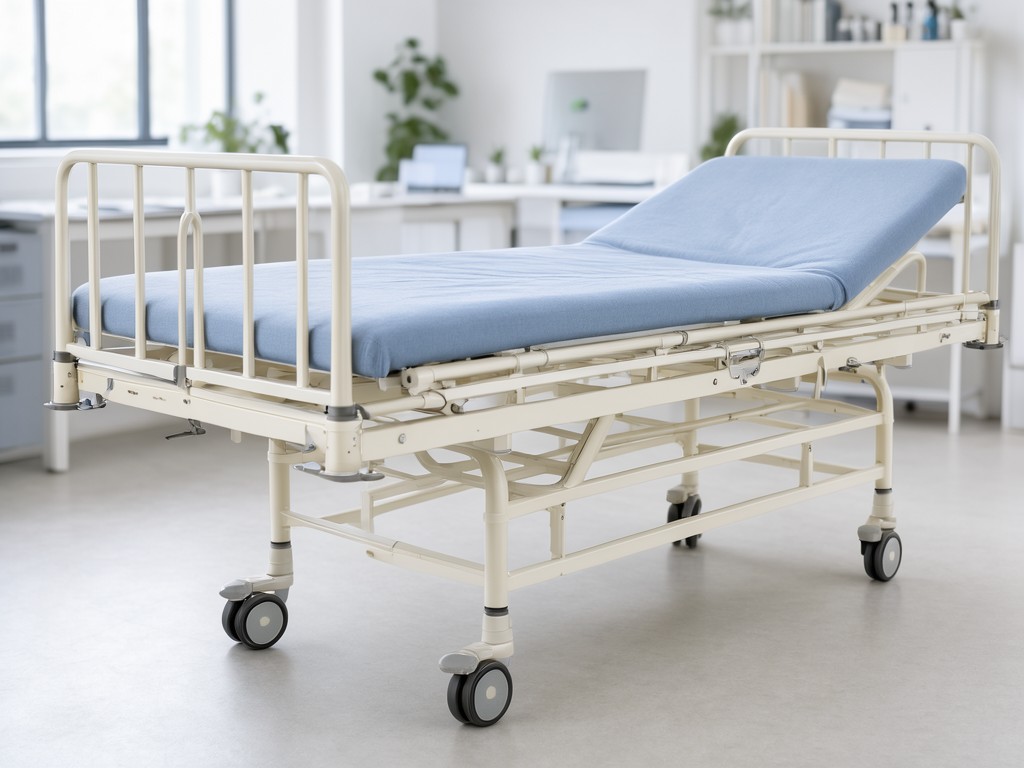
Manual two-function patient beds move the back rest and knee rest through separate crank screws, while 125 mm or 150 mm casters let ward staff reposition the frame without lifting. Buyers qualifying a second source usually cite crank slip, loose swivel bolts, or ABS panel gaps that widen after the first quarter of shipments. The bed arrives knocked down or semi-knocked down, with four steel cranks, two interchangeable crank handles, four casters with total brakes, and a set of head and foot panels.
Scope of Supply and Physical Form
A two-function manual bed is judged in the ward by how quietly the back rest lifts under load and whether the casters track straight after crossing a threshold. The frame is usually cold-rolled steel tubing, powder-coated, with stamped steel or ABS deck sections. Crank rods run through threaded nuts welded to the frame; if the nut is undersized or the thread pitch varies between lots, the crank spins without lifting.
Standard overall length runs around 2140 mm, width around 980 mm, and platform height adjusts manually between roughly 450 mm and 600 mm depending on caster specification. Safe working load is typically 180 kg to 250 kg; beyond that the weld at the headboard bracket is the first fatigue point. Packaging is KD or SKD in five-layer cartons with foam corner guards.
- Back-rest crank: 0 to 75 degrees, manual worm gear.
- Knee-rest crank: 0 to 40 degrees.
- Casters: 125 mm or 150 mm polyurethane, two with directional locks, two with total brakes.
- Frame: 1.2 mm or 1.5 mm cold-rolled steel, epoxy powder coating.
Option Comparison by Usage Level
| Configuration | Frame tube wall | Caster mm | Safe working load kg | Crank positions | Best suited |
|---|---|---|---|---|---|
| Ward economy | 1.2 mm | 125 mm | 180 kg | Head and foot | Low-acuity long-term care |
| General ward | 1.5 mm | 125 mm | 225 kg | Head and foot | Acute or general wards |
| Heavy turnover | 1.5 mm | 150 mm | 250 kg | Head, foot, and side | High-admission private or public wards |
Unit price settles the question only after the crank nut tolerance and caster swivel play are fixed in the purchase order. A 1.2 mm tube saves tooling cost but flexes at the headboard bracket under repeated 225 kg loading, while 1.5 mm adds roughly 6 kg per bed and keeps the weld within its elastic range. The 150 mm caster rolls over door thresholds with less push force than 125 mm, which matters when staff move beds multiple times per shift.
How to Choose Before Requesting a Quote
Two suppliers quoting the same specification can still deliver different beds. Unit price and service life diverge when crank nut tolerances or caster swivel play are not locked in the purchase order.
Request a crank-torque sample before production approval. Measure the torque needed to lift the back rest at maximum rated load; if it drifts more than 10 percent between units, the batch will generate service calls. Check caster swivel resistance after one thousand cycles across a door threshold. Lot-to-lot consistency in tube wall thickness determines whether the frame flexes at the headboard weld within two years.
Ask for the previous three batch records and the rejected-unit rate from the last export lot. A supplier who cannot show dimensional variance on length, width, and diagonal squareness will likely repeat the same defects in your order.
Usage Scenarios and Buyer Segments
Long-term care facility
Residents stay for months or years, so the back rest and knee rest move daily. Casters roll over thresholds and into elevators, and the frame must survive weekly cleaning with chlorine-based disinfectants without coating loss.
Acute care ward
High patient turnover puts repeated load on the crank nuts and headboard weld. Gurneys and IV poles strike the frame during transport, so the 1.5 mm tube option and total-brake casters see the most use.
Wholesale buyers order by pallet and need carton markings that match the consignee label. Distributors check pallet configuration and fumigation status before booking ocean freight. Private-label buyers focus on panel color, crank handle placement, and logo position, because any drift between lots triggers returns from their retail or institutional customers.
Inspection Items and Test Methods
Dimensional checks
Length, width, platform height, and diagonal squareness. Tolerance typically plus or minus 5 mm on overall length and width.
Mechanical checks
Crank cycle count, typically five thousand cycles without nut slip. Caster swivel and brake holding force under rated load.
Finish checks
Coating adhesion, paint chip at welds, and panel color delta between lots. Reject units where crank torque varies more than 10 percent across a sample of ten.
| Item | Specification |
|---|---|
| Carton type | Five-layer corrugated cardboard |
| Pallet | Euro pallet or container fit, heat-treated where required |
| Foam protection | Corner guards and interlayer foam between decks |
| Marking | PO number, batch code, consignee label |
Inspect at the factory before loading, not after the container opens. A rejected unit at origin costs less than a return shipment and a credit note after the bed reaches the ward.
Ready to qualify a second source for manual two-function patient beds? Send your target configuration, annual volume, and port of destination to open a project discussion.
Request project discussion