Specifying Low Price triple crank manual hospital beds with wheels Exporter for Wholesale and OEM Orders
How It Performs in Use
Consistency depends on the alignment of the three crank shafts and the rigidity of the frame under patient load. The head, foot, and height sections each rotate on a dedicated crank that drives a hardened steel worm gear. Wheels are 125 mm dual‑lock casters with a pedal‑actuated brake that must hold 250 kg without creep. Powder‑coated 1.5 mm cold‑rolled steel forms the main chassis; the coating thickness of 80 µm resists saline spray for 500 h.
Critical specification: Crank input torque must not exceed 12 Nm; higher torque strips the gear teeth within 2 000 cycles.
Design the handle length and grip diameter to keep operator force below 30 N at maximum load.
Measured Performance in Real Use
| Parameter | Nominal Value | Tolerance |
|---|---|---|
| Frame material | Cold‑rolled steel, 1.5 mm | ±0.05 mm |
| Safe working load | 250 kg | ±5 kg |
| Crank cycle life | 15 000 cycles | −10 % / +5 % |
| Wheel lock holding force | 300 N | ±20 N |
| Powder‑coat thickness | 80 µm | ±10 µm |
| Overall dimensions (L×W×H) | 2150 × 980 × 620 mm | ±5 mm |
| Net weight | 78 kg | ±2 kg |
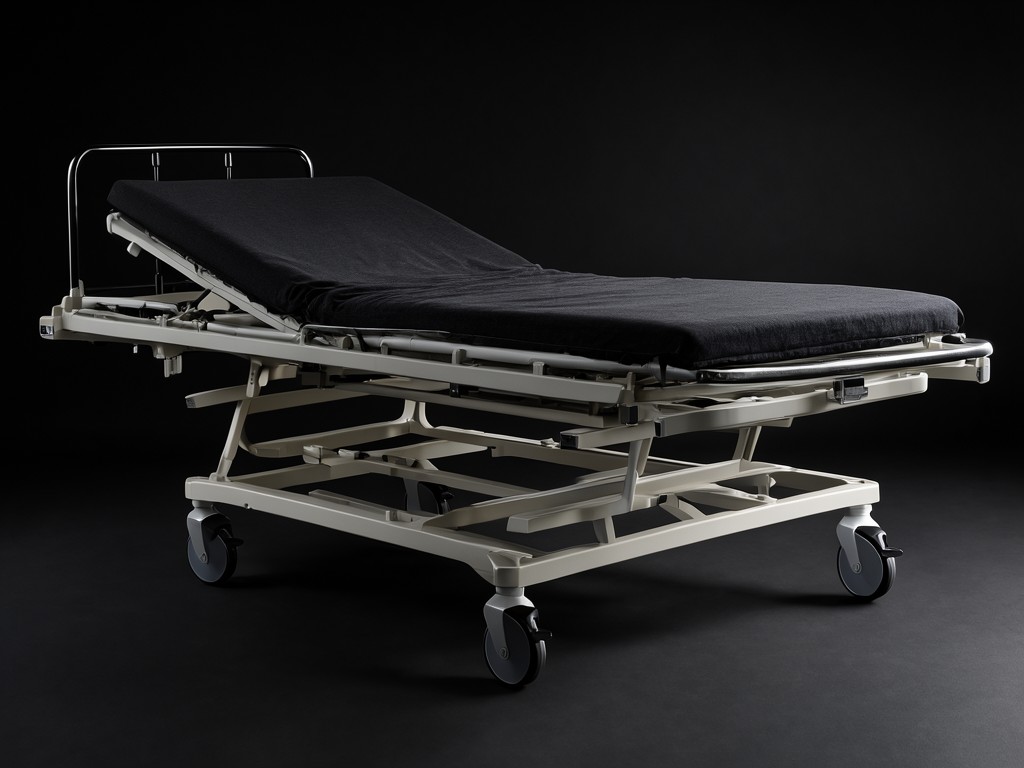
Field data from three export batches show a mean crank‑gear wear of 0.02 mm after 10 000 cycles, well within the 0.1 mm replacement threshold.
Matching the Product to the Buyer's Need
Standard Frame
- Load rating 250 kg, 15 000 crank cycles
- Weight 78 kg, lower freight cost
- Unit cost baseline
Reinforced Frame (gusseted joints)
- Load rating 300 kg, 25 000 crank cycles
- Weight 85 kg, +9 % shipping volume
- Unit cost +12 % over baseline
Choose the reinforced version when the contract specifies bariatric patients or when the warranty period exceeds three years; the standard frame meets most general‑ward tenders.
Requirements by Buyer Segment
The interface between parts determines the complaint profile each segment experiences. Below are the typical failure modes and the spec levers that keep them out of the field.
- Brand Product Manager – needs private‑label packaging, colour‑matched side rails, and a 2‑year warranty. Spec lever: custom powder‑coat colour with 100 µm minimum thickness and laser‑etched logo on the headboard.
- Club or Academy Purchasing Manager – prioritises rapid turnover, easy cleaning, and low noise. Spec lever: sealed crank bearings (IP54), antimicrobial vinyl mattress cover, and caster wheels with polyurethane tread.
- Wholesale Buyer – focuses on landed cost, container utilisation, and lead‑time predictability. Spec lever: flat‑pack sub‑assembly (frame, crank set, caster kit) that fits 28 units per 40‑ft HC container, and a 45‑day production lead after PO.
Quality Control and Batch Consistency
Deflection under load governs the long‑term geometry of the bed deck. Each production lot undergoes a first‑article inspection (FAI) that records frame straightness, crank backlash, and caster brake torque. Statistical process control charts track the mean and range of crank torque (target 10 Nm ± 1 Nm) and wheel lock force (target 300 N ± 15 N). Any shift beyond 2 σ triggers a root‑cause review before the batch is released. Traceability is maintained by laser‑marked batch codes on the frame cross‑member and on each crank housing.
Inspection Items and Test Methods
- Dimensional audit – CMM measurement of frame length, width, height, and crank centre‑to‑centre distances.
- Static load test – 1.25× safe working load applied for 5 min; permanent set < 2 mm.
- Crank endurance – motorised cycling at 12 Nm for 15 000 revolutions; gear tooth wear measured by profile projector.
- Caster brake fatigue – 10 000 engage/release cycles; holding force must remain ≥ 280 N.
- Salt‑spray exposure – 500 h per ASTM B117; coating adhesion rated ≥ 4B (cross‑cut).
- Coating thickness – magnetic gauge at 10 random points; all readings within 70‑90 µm.
Next Steps
A tooling review aligns the crank geometry, caster specification, and packaging layout with your contract requirements. Submit your drawings or specification sheet and we will return a detailed DFM report within five business days.
Request a tooling review and sample approval package