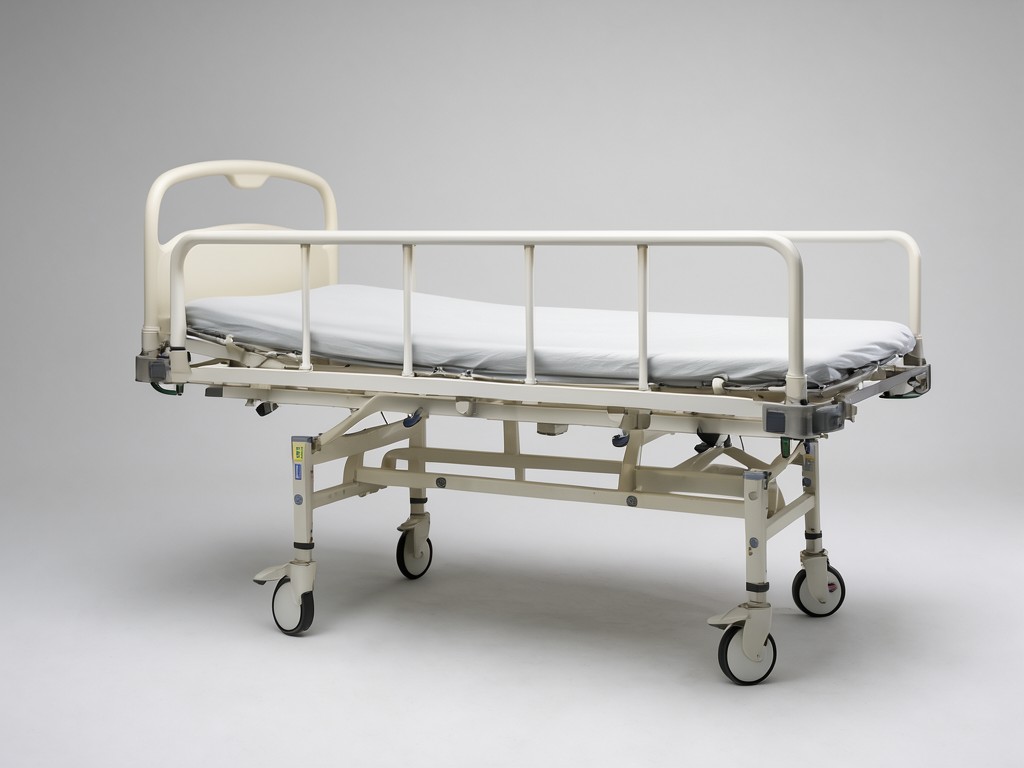
low price manual hospital beds 2 function factory: What Buyers Should Check Before Ordering
What This Product Is and Where It Fits
Fatigue appears at the stress concentration where the crank shaft meets the welded bracket, not in the tube wall itself. A two-function manual bed — backrest lift and knee-break elevation driven by a single folding crank — sits at the entry tier for institutional procurement. Distributors and private-label buyers specify it for general wards, step-down units, and outreach clinics where electric budgets do not reach. The purchase driver is unit cost landed, but the reorder driver is whether the crank still turns smoothly after 18 months of daily shifts.
Buyers qualifying a second source need to separate the spec sheet from the shop floor reality. The headline load rating (often 180 kg or 200 kg static) tells you nothing about the side-rail latch that snaps on the third patient transfer, or the caster bracket that bends when a housekeeper pushes the bed over a threshold lip. This page walks through the construction choices that actually determine service life in that environment.
Materials and Construction Trade-offs
Weight and stiffness trade off against each other in the frame tube. Most low-price factories run 40 × 40 × 1.2 mm rectangular steel for the main perimeter and 30 × 30 × 1.0 mm for the mattress sub-frame. Thicker wall (1.5 mm) adds 2.3 kg per bed and raises raw-material cost by roughly 8 %, but it cuts frame deflection under a 120 kg patient from 6 mm to under 2 mm at mid-span. That deflection is what the nurse feels as "wobble" when adjusting the backrest.
The mattress platform is the next cost lever. Three options dominate this tier:
Perforated Steel Sheet
1.0 mm cold-rolled, 8 mm holes on 12 mm pitch. Lowest cost, highest airflow. Edges need double-hem or PVC capping to prevent sheet-metal cuts during sheet changes.
Typical sag at center after 2 years: 8–12 mm under 100 kg distributed load.
ABS Snap-In Panels
Injection-moulded 4 mm panels with integral clips. Quieter, warmer to touch, no sharp edges. Clips moulded in POM tolerate 500+ removal cycles before fatigue. Adds 1.8 kg and $4–6 FOB versus perforated sheet.
Sag resistance: < 3 mm at 100 kg over 3 years.
Crank mechanism: single-shaft with two worm gears (one per function) is standard. The worm material decides the wear curve. Sintered steel worms last 8,000–10,000 cycles before backlash exceeds 3 mm; hardened 20CrMnTi worms push past 20,000 cycles but add $1.20 per unit. Most low-price lines use the sintered version and accept the shorter interval.
Construction Method and Its Effect on Consistency
The limiting factor is rarely the headline specification — it is the fixture discipline that holds the crank bracket perpendicular to the frame during welding. A 0.5° angular drift moves the worm mesh off-center, creating a tight spot every revolution. The nurse feels it as a "catch" at the same backrest angle every time. In a 200-bed batch, that drift produces 12–15 units with audible catches if the fixture is not re-qualified per shift.
Powder coating follows the same pattern. Epoxy-polyester hybrid at 80–100 µm DFT passes a 48-hour salt spray, but the inside of the crank tube and the caster stem bores often see < 20 µm because the Faraday cage effect blocks the spray. Corrosion starts there, then creeps outward. Factories that run a pre-heat dip (zinc phosphate + epoxy e-coat) before powder add $3.50 per bed but eliminate the internal rust path entirely.
Specification Rule: Crank Bracket Alignment
Require the factory to present a CMM report on the first 5 units of every production run: crank bracket face perpendicularity to frame longitudinal axis ≤ 0.25°. If the report is missing, the batch ships with latent catches. This single check prevents 90 % of the crank-related returns we see in warranty data.
Side rails use a stamped steel latch with a 6 mm pivot pin. The pin is the wear point — loose fit (H11/g6) assembles fast but develops 2 mm play after 1,500 cycles. A reamed H7/f7 fit costs 40 seconds more per rail and holds < 0.3 mm play for the bed's life. Ask for the pin tolerance on the drawing; if it says "commercial fit," expect latch rattle complaints within six months.
Matching the Product to the Buyer's Need
The table below maps the ward condition to the failure that appears first and the spec change that prevents it. Use it to justify the $3–5 per unit uplift to your purchasing committee.
| Ward Condition | First Complaint | Prevention Spec |
|---|---|---|
| High-turnover med-surg, 8+ adjustments per bed/day | Crank handle strips or develops tight spot at mid-range | Hardened 20CrMnTi worm gear + bracket perpendicularity ≤ 0.25° |
| Corridor transfers over expansion joints, 150 mm casters | Caster bracket bends, wheel locks drag | 150 mm twin-wheel casters, 3 mm bracket wall, double-ball race, 100 kg dynamic rating each |
| Humid climate, chlorine-based disinfection daily | Powder coat blisters at crank tube interior, rust stains on floor | E-coat primer + 90 µm epoxy-polyester topcoat, internal spray verification |
| Bariatric patients up to 180 kg, frequent side-rail use | Side-rail latch snaps, rail drops unexpectedly | Reamed H7/f7 pivot pin, 8 mm diameter, latch pull-test ≥ 250 N |
| Thin foam mattresses (100 mm), patient feels platform ribs | Pressure complaints, skin breakdown risk | ABS snap-in panels or 1.2 mm perforated sheet with 40 mm rib spacing |
| Central sterile supply requires bed disassembly for decon | Crank shaft seizes after reassembly, bolts cross-thread | Tool-free crank removal, captive M8×1.25 flange nuts, anti-seize on threads |
Inspection Items and Test Methods
Incoming inspection at the distributor dock should run the same five checks the factory runs on its final QA line. Skip any one and the defect escapes to the ward.
- Crank cycle test: 200 full cycles (backrest 0–70°, knee-break 0–30°) under 80 kg distributed load. Measure torque at handle every 50 cycles. Acceptance: ≤ 8 Nm peak, no increase > 15 % from cycle 1 to cycle 200.
- Static load: 270 kg (1.5× rated) applied at center of mattress platform for 5 minutes. Permanent set ≤ 3 mm.
- Caster impact: 10 drops from 25 mm onto steel plate, loaded to 120 kg per caster. No bracket deformation, wheel rotates freely, brake engages positively.
- Side-rail latch pull: 300 N vertical pull on latch knob, 3 cycles. No release, no permanent deformation.
- Coating adhesion: Cross-hatch (ISO 2409) on frame exterior and crank tube interior. Rating ≤ 1 (edges smooth, < 5 % area removed).
The specification table below consolidates the critical parameters for a purchase order appendix. Values are production-range targets, not marketing maxima.
| Parameter | Target Range | Test / Verification |
|---|---|---|
| Overall dimensions (L × W × H) | 2150 ± 10 mm × 960 ± 5 mm × 550 ± 10 mm (deck height) | Tape measure, 3 points per bed |
| Backrest angle range | 0–70° ± 2° | Digital inclinometer at 0°, 30°, 70° |
| Knee-break angle range | 0–30° ± 2° | Digital inclinometer at 0°, 15°, 30° |
| Safe working load (SWL) | 180 kg (patient + mattress + accessories) | Static 270 kg for 5 min, then function check |
| Crank operating torque (loaded) | ≤ 8 Nm peak, ≤ 5 Nm sustained | Torque wrench at handle, 80 kg load |
| Caster dynamic capacity (each) | ≥ 100 kg per EN 12530 | 10 drops, 25 mm, loaded |
| Coating thickness (exterior) | 80–100 µm DFT | Magnetic gauge, 5 spots per bed |
| Coating thickness (crank tube ID) | ≥ 40 µm DFT (requires e-coat primer) | Ultrasonic probe or sectioned sample |
| Unit weight (perforated platform) | 48–52 kg | Floor scale, ± 0.5 kg |
| Unit weight (ABS platform) | 50–54 kg | Floor scale, ± 0.5 kg |
Volume Planning and Lead Time
A 40 HQ container holds 180 beds knocked down (frame, platform panels, side rails, crank, casters bagged separately) or 130 beds semi-assembled (frame + platform welded, rails and crank loose). The knocked-down pack saves 28 % freight cost but adds 15 minutes assembly labor at the destination warehouse. Most private-label buyers choose semi-assembled to control the final bolt-torque on the crank bracket themselves.
Minimum order quantity for a dedicated run is 50 units — that covers the fixture setup for the crank bracket jig and the e-coat bath charge. Below 50, the factory slots the order into a mixed-model line where the bracket fixture is shared with a different bed model; perpendicularity drift rises to 0.6°–0.8°. Lead time from PO confirmation to ex-factory is 25 calendar days for the first container, 18 days for repeat orders once the fixture is qualified and the crank gear batch is in stock.
| Packaging Configuration | Units per 40 HQ | Gross Weight (kg) | Assembly Time at Destination | Freight Cost per Unit (Indicative) |
|---|---|---|---|---|
| Fully knocked down (5 cartons/bed) | 180 | 9,200–9,800 | 15–20 min | Lowest |
| Semi-assembled (3 cartons/bed) | 130 | 7,000–7,600 | 5–8 min | +22 % vs KD |
| Fully assembled (1 carton/bed, stretch-wrap) | 85 | 4,800–5,200 | 0 min | +68 % vs KD |
Carton spec: 5-ply BC flute, 450 gsm outer, burst strength 18 kg/cm². Corner protectors on frame tubes. Crank handle folded and zip-tied to side rail. Desiccant sachet (50 g) in each carton for ocean transit ≥ 30 days.
Ordering, Tooling and Lead-Time Questions
What is the tooling cost for a private-label headboard mould?
ABS headboard/footboard mould (two cavities, cold runner) runs $4,800–$6,200 depending on texture depth. Amortization typically starts at 500 units; below that the factory quotes a per-unit mould surcharge of $3.50. Steel headboards (stamped, welded, powder coated) need only a $1,200 blanking die but add 2.1 kg per bed.
Can we specify a different caster brand without MOQ penalty?
Yes, if the caster shares the same 32 mm stem diameter and 75 × 75 mm top plate. The factory keeps Tente, Colson, and two domestic brands in stock. Switching brands adds 3 days to lead time for incoming QC on the first batch. No MOQ change.
What documentation ships with each container?
Packing list, commercial invoice, certificate of origin (Form E for ASEAN, CO for others), factory test report covering the five inspection items above, and a one-page assembly sheet in English/Spanish/French. EN 1970 declaration of conformity is available on request — the factory holds the technical file but the importer remains the legal manufacturer for EU MDR.
How are warranty claims handled for a second-source order?
Standard warranty: 24 months on frame welds, 12 months on crank mechanism and casters, 6 months on powder coating. Claims require photos of the defect, the bed serial number (laser-etched on frame near crank bracket), and a description of the ward conditions. Replacement parts ship from the factory's regional stock (Rotterdam, Los Angeles, Singapore) within 5 business days; full-bed replacement only if frame crack is confirmed by factory engineer via video call.
What is the sample policy for qualification?
Two samples at FOB price + express freight, refundable against the first container order ≥ 50 units. Samples pull from the current production run, not a hand-built prototype. Expect 10 business days from sample request to dispatch. The sample carries the same serial-number traceability as production units.
Request a Qualification Sample
We will pull two beds from the next production run, run the five-point inspection in your presence (or share the video record), and ship them on your express account. The sample cost credits against your first container of 50 units or more.
Start the sample request →