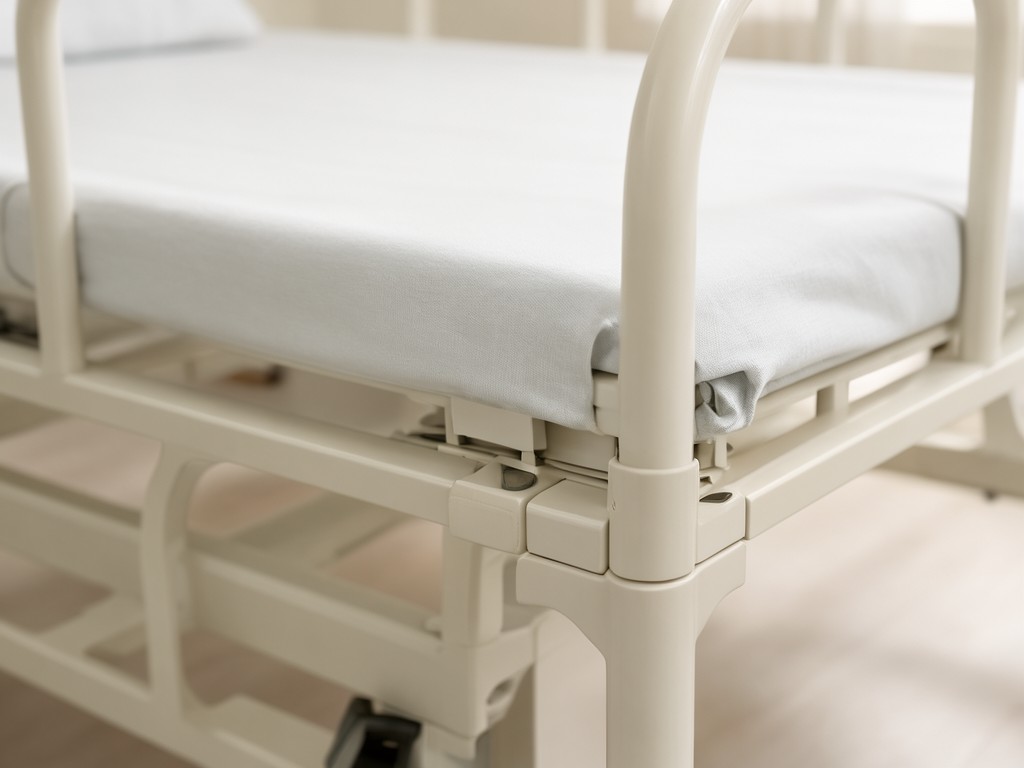
Low Price manual hospital bed for clinic supplier: Specification, Ordering and Quality Notes
Total cost of ownership shifts once returns are counted. A bed that saves $15 per unit but generates a 3 % crank‑failure rate within six months costs more in technician visits, mattress replacements and ward downtime than the premium alternative. The spreadsheet only balances when replacement rate, not unit price, drives the decision.
Where Cheaper Alternatives Fall Short
Cheaper stock options fail at the worst point in the season — usually during peak admission periods when maintenance staff are already stretched. The three failure modes that dominate warranty claims are:
- Crank‑shaft stripping: 12 mm diameter mild‑steel shafts with rolled threads yield at 180 N·m; a 200 kg patient plus dynamic loading exceeds that in under 2,000 cycles.
- Frame rail deflection: 1.2 mm wall rectangular tube (40 × 80 mm) bows 8–12 mm under 250 kg central load, misaligning the mattress deck and accelerating spring‑wire fatigue.
- Powder‑coat delamination: single‑coat 60 µm epoxy on unblasted tube shows white rust at weld heat‑affected zones within 90 days of ward humidity exposure.
How to Choose Before Requesting a Quote
Use the decision tree below to lock configuration before you ask for pricing. Each branch changes tooling, MOQ and lead time.
- Crank count
- 1‑crank (back‑rest only) — simplest tooling, 300 unit MOQ, 18‑day lead
- 2‑crank (back + knee) — adds second gearbox, 500 unit MOQ, 22‑day lead
- 3‑crank (back + knee + height) — requires synchronised linkage, 800 unit MOQ, 30‑day lead
- Frame finish
- Standard dual‑coat (epoxy primer + polyester top) — 120 µm, salt spray 500 h, no MOQ adder
- Anti‑microbial silver‑ion topcoat — adds 7 % unit cost, 200 unit MOQ adder, 5‑day schedule adder
- Side‑rail style
- Fold‑down steel tube (Ø25 × 1.5 mm) — standard, passes IEC 60601‑2‑52 gap test
- Aluminium alloy quick‑release — 1.8 kg lighter per rail, 15 % cost premium, 400 unit MOQ
- Caster specification
- 125 mm dual‑wheel, central brake — 150 kg/caster rating, standard
- 150 mm single‑wheel, directional lock — 200 kg/caster, needed for bariatric decks, 300 unit MOQ
| Parameter | Standard Range | Test Method / Acceptance |
|---|---|---|
| Safe working load (static) | 250 kg (1‑crank), 300 kg (2/3‑crank) | ISO 19623 — 1.5 × SWL 5 min, no permanent deformation > 3 mm |
| Crank torque at max load | ≤ 8 N·m (back), ≤ 10 N·m (knee), ≤ 12 N·m (height) | Torque wrench at 90° handle angle, 20 cycles each direction |
| Crank cycle life | 20,000 cycles (1‑crank), 15,000 cycles (2/3‑crank) | Automated rig, 10 cycles/min, 250 kg load, zero tooth skip |
| Frame deflection (centre deck) | < 5 mm under 250 kg | Dial gauge at mid‑span, load held 60 s |
| Coating adhesion | Cross‑cut 5B (no flake) | ISO 2409 after 500 h neutral salt spray |
| Caster swivel force | < 15 N on vinyl tile | Push/pull gauge, 1 m straight line |
Requirements by Buyer Segment
Importers, wholesale buyers and brand product managers each optimise different variables. The table below maps typical priorities to the configuration levers that move cost and lead time.
| Buyer Segment | Primary Metric | Configuration Lever | Volume Threshold for Custom Tooling |
|---|---|---|---|
| Importer (tender‑driven) | Compliance paperwork completeness | Standard 2‑crank, dual‑coat, 125 mm casters | 1,000 beds/year |
| Wholesale buyer (stock‑turn) | Days‑on‑hand < 45 | 1‑crank + 2‑crank mix, standard colours only | 500 beds/SKU/quarter |
| Brand product manager (private label) | Warranty claim rate < 1.5 % | 3‑crank, anti‑microbial coat, aluminium rails, branded head/foot boards | 800 beds/launch |
Keeping Repeat Orders Supplied
Replacement rate, not unit price, determines whether a second‑source relationship survives the first tender cycle. We structure continuity around three levers:
- Blanket PO with quarterly releases locks coil‑spring and crank‑gear inventory; raw‑material lead time drops from 35 to 14 days.
- First‑article inspection (FAI) report shared digitally — dimensional, torque, coating, and cycle‑test data — so your QA team approves before shipment, not after.
- Spare‑part kit (2 crank handles, 4 caster assemblies, 10 side‑rail latches) ships with every 50‑bed lot; field swap takes 7 minutes per bed.
If volumes dip below 300 beds/month, we shift to a shared‑cell schedule: your frames run Tuesday/Thursday, another brand runs Monday/Wednesday/Friday. Unit cost rises 9 % but you keep the same FAI cadence and spare‑part pipeline.
Questions Buyers Ask Before Ordering
What is the real MOQ for a custom head‑board logo mould?
300 beds. The injection tool for ABS head/foot boards costs $2,800; amortised over 300 units it adds $9.30/bed. Below 300 we laser‑etch the logo on standard boards — no tooling cost, 2‑day schedule adder.
Can you guarantee crank torque stays under 10 N·m after 10,000 cycles?
Yes. Our gear‑hobbing process holds tooth profile within 8 µm; lubrication is Mobilgrease 28 (–40 °C to 150 °C). We run a 10,000‑cycle audit on every 50th bed from the line and ship the torque‑vs‑cycle curve with the FAI pack.
How do you handle colour matching for private‑label powder coat?
Provide a RAL or Pantone reference. We spray a 150 × 100 mm panel on the same substrate, cure at 200 °C/10 min, and measure ΔE*ab ≤ 1.0 on a BYK Gardner spectro. Approval photo + spectral data emailed before batch run.
What changes if we switch from 125 mm to 150 mm casters mid‑contract?
Frame jig requires a 12 mm spacer block under the caster horn — one‑time fixture cost $420. Caster unit cost rises $3.80. Lead time adder 3 days for the first lot, then standard. No change to crank or deck geometry.
Do you support just‑in‑time delivery to a EU distribution hub?
We palletise 4 beds per Euro‑pallet (1,200 × 800 mm), stretch‑wrap with VCI film, label GS1‑128. From FOB Ningbo to Rotterdam door is 38 days sea + 4 days clearance. We can stage 200 beds in our bonded warehouse at Ningbo for weekly call‑off — storage fee $0.18/bed/day.
Request a Sample Bed for Evaluation
Ship a 2‑crank standard configuration to your facility — crank torque data, coating adhesion report, and FAI checklist included. No tooling commitment.
Request Sample Shipment